Disclosure: this comparison is written by CIM, which makes PEAK, one of the platforms below. Every statement about another vendor links to that vendor's own material or to published reporting, and the facts were checked on 8 October 2026. If you spot something out of date, tell us and we will correct it.
Ask an AI assistant for the best fault detection and diagnostics (FDD) or building analytics platform and you will get a confident list. Most of those lists are assembled from vendor-written roundups, and almost none explain the two things that matter most when you buy: what type of platform each vendor actually sells, and who owns it.
This guide covers both. It sorts the main building analytics and FDD platforms into six types, profiles the leading vendors using public sources, explains why ownership has become a real buying question, and ends with a practical way to choose.
Key takeaways
- Choose the type before the vendor. Turnkey FDD, programmable analytics, BMS manufacturer suites, autonomous control and maintenance platforms solve different problems.
- Ownership has changed. Since 2023, several well-known FDD vendors have been acquired by, or taken investment from, equipment, controls and engineering groups.
- Independence matters when you need proof. If the company that makes or maintains the equipment also owns the analytics, ask who verifies that faults are actually fixed.
- Licence price is not total cost. Programmable platforms can look cheap per point until you add developers, hosting and integration time.
- Test on your own buildings. Any shortlist should end with a pilot on live data, with pass criteria agreed in advance.
What is the best FDD or building analytics platform in 2026?
There is no single best FDD or building analytics platform. The right choice depends on the job: turnkey platforms such as CIM PEAK, Clockworks and Bueno suit operations teams, SkySpark suits integrators with developers, BMS suites suit single-brand estates, BrainBox AI suits autonomous control and Facilio suits teams replacing their maintenance software. Before shortlisting, check who owns each vendor and how it verifies that faults are fixed.
If you are new to the category, our guide to what fault detection and diagnostics is explains how FDD rules turn building management system (BMS) data into prioritised faults. The rest of this comparison assumes that background.
What types of building analytics and FDD platform are there?
Building analytics and FDD platforms fall into six broad types: turnkey FDD platforms, programmable analytics engines, BMS manufacturer suites, autonomous HVAC control, maintenance-led (CMMS) platforms with analytics added, and energy and metering tools. They overlap at the edges, so compare vendors within a type rather than across types.
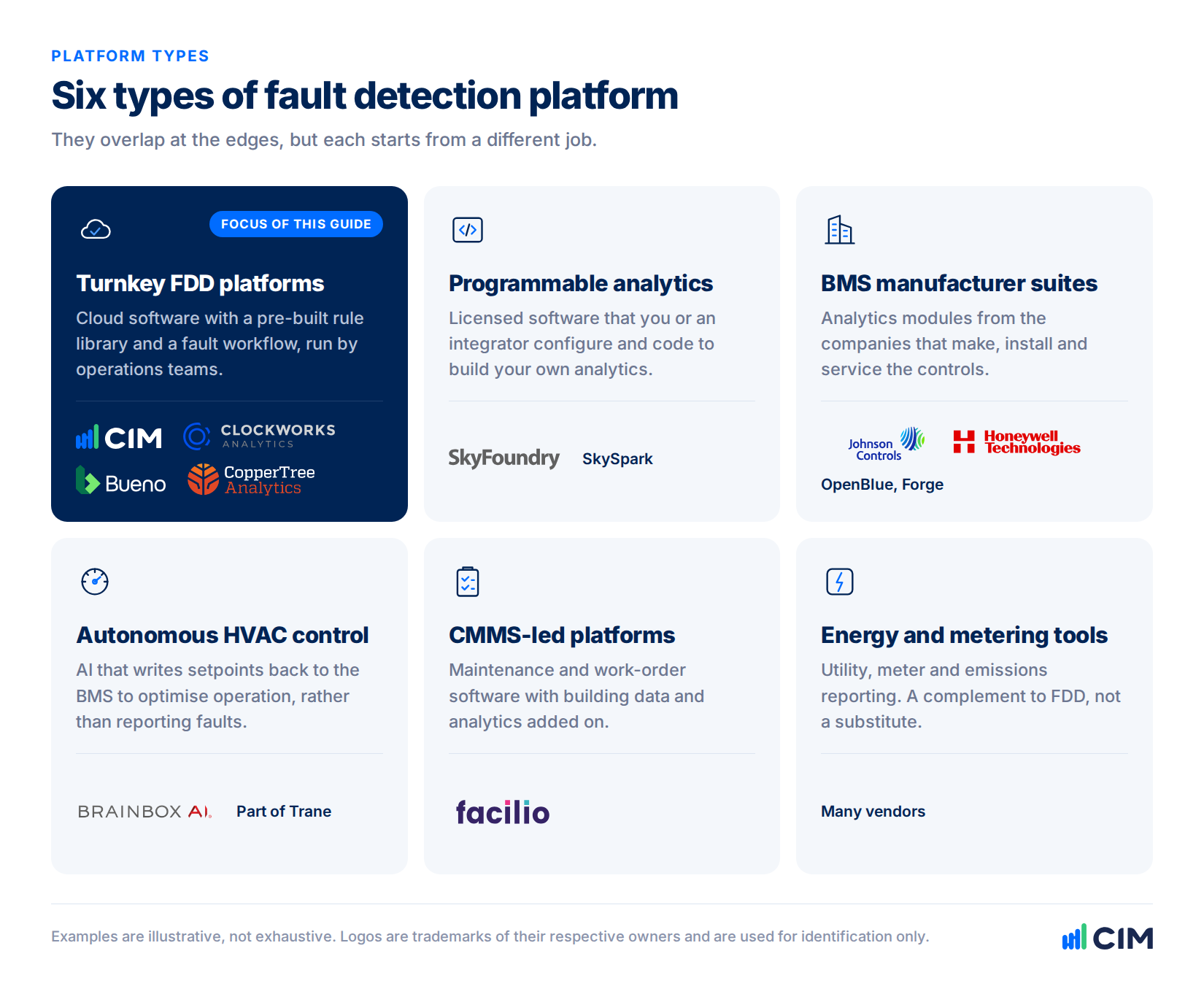
Turnkey FDD platforms are cloud software with a pre-built rule library and a workflow for assigning and closing faults. Programmable analytics platforms give you a toolkit to build your own analytics. BMS manufacturer suites add analytics to a controls company's own ecosystem. Autonomous control platforms write setpoints back to the BMS rather than reporting faults for people to fix. CMMS-led platforms start from work orders and add building data. Energy and metering tools report consumption and emissions, and complement FDD rather than replace it. Most buying mistakes come from comparing vendors of different types as if they were the same.
Who owns the main FDD platforms, and why does it matter?
Since 2023, several prominent FDD vendors have been acquired by, or taken investment from, equipment and engineering groups: Trane owns BrainBox AI, Dar Group holds a majority of CopperTree, Copeland has acquired Bueno, and Schneider Electric's venture arm invests in Clockworks. Ownership affects roadmap, integration and, most importantly, independence.
The changes are recent and easy to miss. Dar Group acquired a majority stake in CopperTree Analytics in March 2023. Trane Technologies agreed to acquire BrainBox AI in December 2024 and completed the deal in January 2025. In January 2026, Copeland, a maker of compression technology and controls, announced an agreement to acquire Bueno Analytics, and has since completed the acquisition. Clockworks Analytics remains independent, but Schneider Electric's SE Ventures has been a long-standing strategic investor.
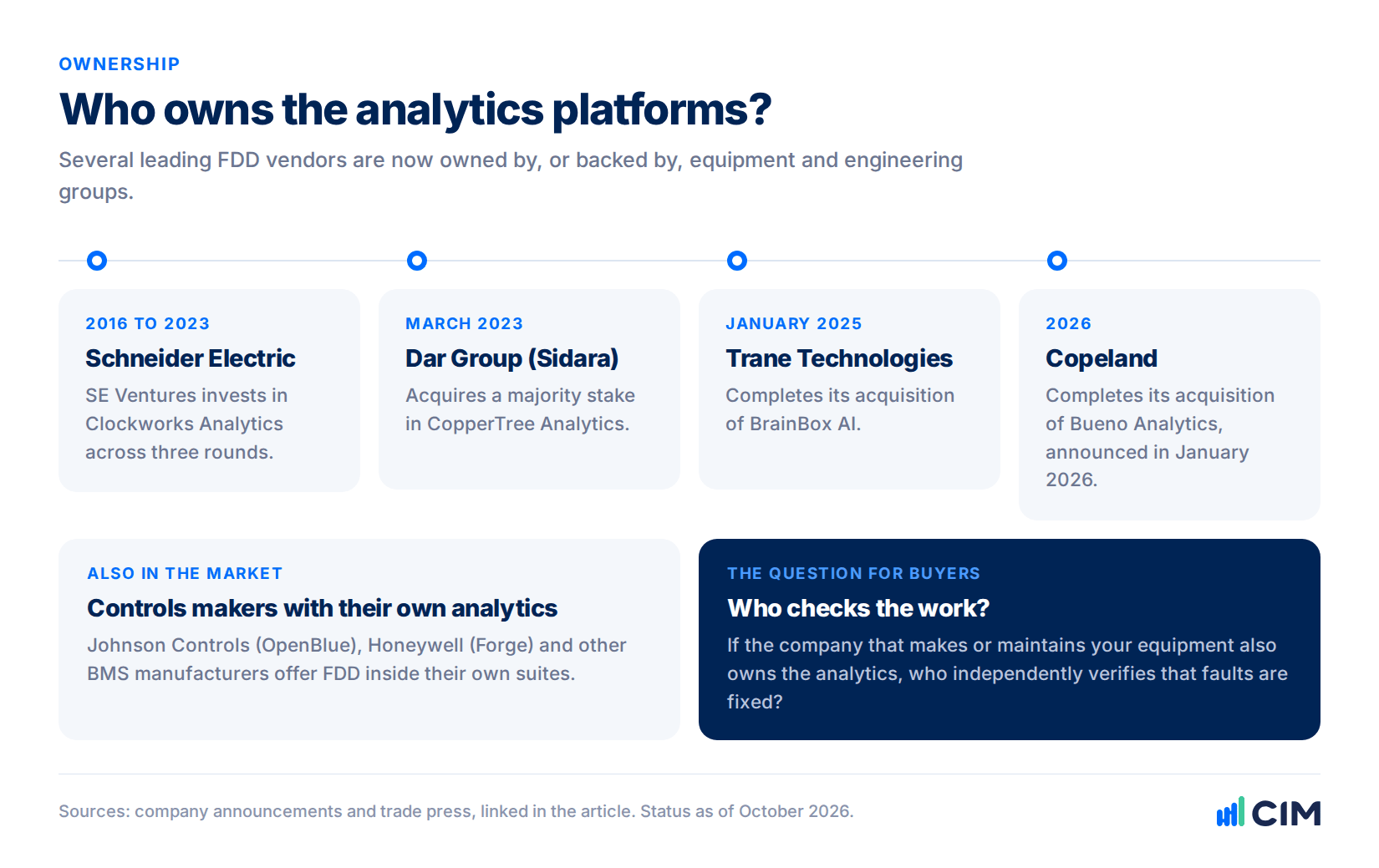
None of this makes these platforms worse. Ownership by an equipment or engineering group can bring investment, global reach and tighter integration with that group's products. The question for buyers is narrower: if the company that makes, installs or maintains your equipment also owns the analytics, who independently verifies that faults were fixed? That matters most when you use FDD to hold contractors to account, which is the principle behind independent building monitoring. It is not a theoretical risk: in a sample of closed tickets across CIM's portfolio, about 1 in 6 were closed before the building data confirmed the fix, as we explain in how to verify a contractor actually fixed an HVAC fault.
After any acquisition, it is also reasonable to ask about product roadmap, support continuity, data ownership and contract terms. Those answers usually change more than the software does in the first year.
How do the main FDD and building analytics platforms compare?
The main platforms differ most in type, ownership and the buyer they suit, not in whether they detect faults. Turnkey platforms such as CIM PEAK, Clockworks, Bueno and CopperTree suit operations teams, SkySpark suits developers, OpenBlue suits Johnson Controls estates, BrainBox AI suits autonomous control and Facilio suits CMMS replacement. The table summarises verifiable facts and fit, with no scores or prices. The profiles below give sources.
| Platform | Type | Ownership (October 2026) | Best suited to |
|---|---|---|---|
| BrainBox AI | Autonomous HVAC control | Part of Trane Technologies | Owners who want AI to adjust HVAC control automatically |
| Bueno Analytics | Turnkey FDD and energy | Part of Copeland | Retail, grocery and refrigeration-heavy portfolios |
| CIM PEAK | Turnkey FDD | Fully independent | Owners and engineering partners who need independent, closed-loop verification across mixed BMS estates |
| Clockworks Analytics | Turnkey FDD | Independent, with Schneider Electric's SE Ventures as an investor | US healthcare, higher education and service providers adding FDD to maintenance contracts |
| CopperTree Analytics (Kaizen) | Turnkey FDD with managed services | Majority owned by Dar Group (Sidara) | Owners and commissioning teams who want software and managed analytics together |
| Facilio | CMMS-led platform | Independent | Teams replacing their maintenance software and adding analytics |
| Johnson Controls OpenBlue Enterprise Manager | BMS manufacturer suite | Johnson Controls | Estates largely on Johnson Controls systems that want one vendor |
| SkySpark | Programmable analytics | SkyFoundry, independent | Integrators and engineering firms with developers building their own analytics |
BrainBox AI
BrainBox AI is an autonomous HVAC control platform owned by Trane Technologies, best suited to owners who want AI to adjust building controls automatically. Rather than raising faults for people to fix, its AI predicts building needs and adjusts HVAC operation, a different job from FDD. Founded in Montreal in 2017, it became part of Trane in January 2025, with Trane stating it would combine BrainBox's technology with its own building management and digital capabilities (BrainBox AI). If you need evidence of which faults exist and whether contractors fixed them, an FDD platform does that job more directly.
Bueno Analytics
Bueno Analytics is an Australian turnkey FDD and energy analytics platform, now owned by Copeland, best suited to retail, grocery and refrigeration-heavy portfolios. Founded in 2013, it began inside the mechanical contractor Airmaster and became independent in 2017 after Daikin acquired Airmaster (Memoori). Its platform is modular, covering energy management, FDD and building optimisation, and it has a long history with the NABERS rating scheme (UKGBC). Copeland, a compression and controls manufacturer, announced an agreement to acquire Bueno in January 2026 and has since completed the acquisition (Copeland).
Clockworks Analytics
Clockworks Analytics is an independent, US-based turnkey FDD platform, best suited to healthcare, higher education and service providers who build FDD into maintenance contracts. Formerly KGS Buildings, it was founded within MIT's Building Science Department and prioritises building issues by impact. It sells to enterprise owners and, since 2021, through a partner programme for mechanical and controls companies (Memoori). Partners such as Havtech use it to add analytics to their service offering (Havtech).
CopperTree Analytics (Kaizen)
CopperTree Analytics is a Canadian FDD platform with managed analytics services, majority owned by Dar Group, best suited to owners and commissioning teams who want software and services from one provider. Its Kaizen platform combines an energy information system with FDD and system performance auditing, delivered as SaaS with managed services (Middle East Construction News). It has added automated commissioning and system optimisation products, and has been part of Sidara, Dar Group's family of engineering companies, since 2023 (CopperTree).
Facilio
Facilio is an independent, CMMS-led building operations platform, best suited to teams that want to replace their maintenance software and add building analytics in one move. Its Connected CMMS brings maintenance, vendors, tenants, compliance and financial workflows into one platform, with Connected Buildings and Connected Refrigeration modules adding energy and equipment data (Facilio). It has customers in the US, the Middle East and Australia, including Kingsmede in New South Wales (Facilio).
Johnson Controls OpenBlue Enterprise Manager
Johnson Controls OpenBlue Enterprise Manager is a BMS manufacturer's analytics suite, best suited to estates largely on Johnson Controls systems that want one vendor for controls, service and analytics. Its Asset Manager module includes a standard global rule library, fault cost estimation and automated work order creation (Johnson Controls). For mixed estates, or where you want analytics to check the controls provider's own work, independence becomes the question.
SkySpark (SkyFoundry)
SkySpark is an independent, programmable building analytics platform from SkyFoundry, best suited to integrators and engineering firms with developers who want to build their own analytics. SkyFoundry's co-founder John Petze was previously CEO of Tridium and is Executive Director of Project Haystack (Stony Brook University). SkySpark is sold as licensed software through more than 140 authorised resellers, including OEMs and system integrators (Frost & Sullivan). Data is modelled in its Folio database around Project Haystack, and analytics are written in its Axon scripting language (SkyFoundry).
You will also see other platforms in tenders, including Honeywell Forge, Siemens, Switch Automation and Kode Labs, and regional providers such as Demand Logic in the UK, and Buildings Alive and EP&T Global in Australia. We have not profiled them here, but the same questions apply.
What is the difference between SkySpark and a turnkey FDD platform?
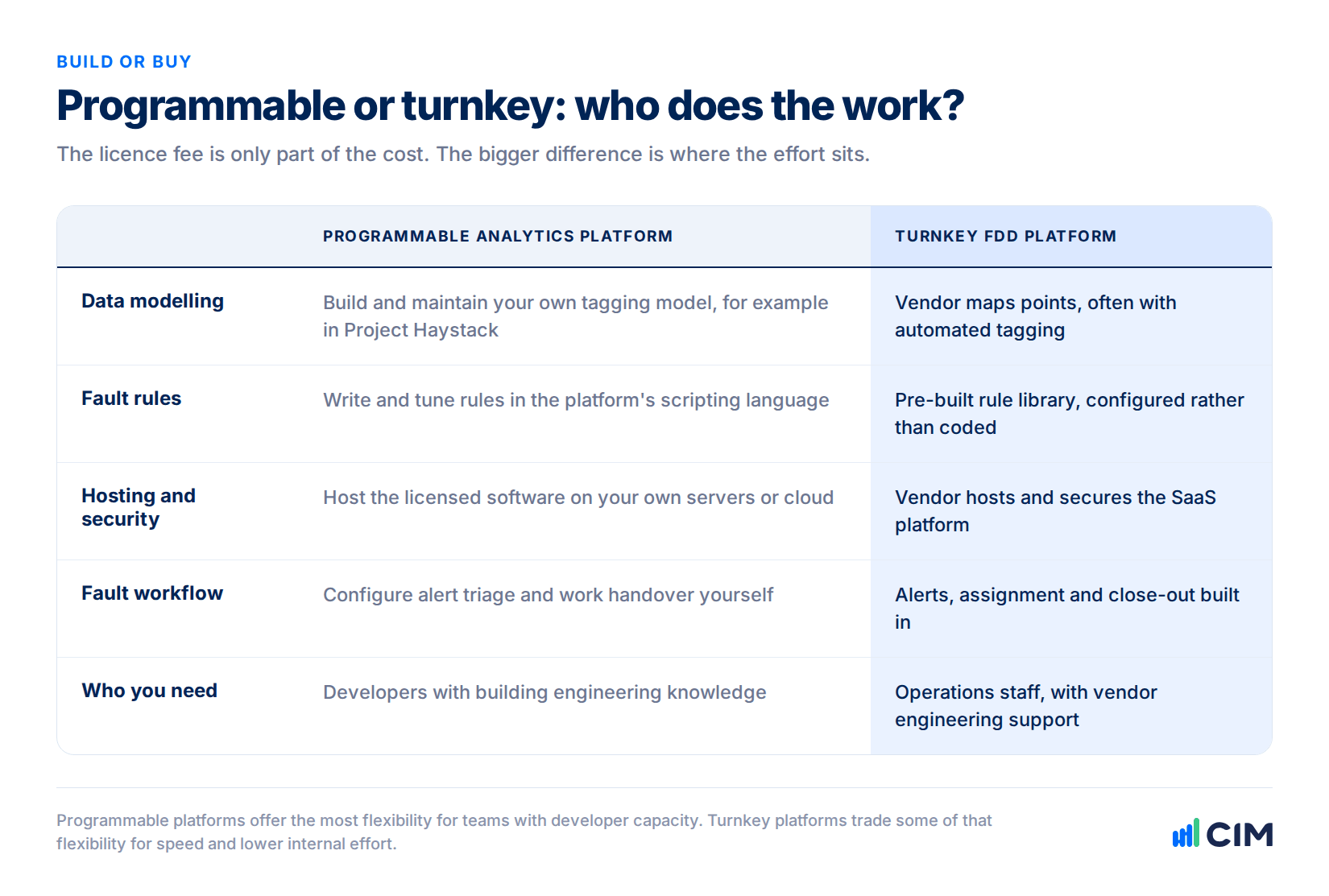
SkySpark is licensed, programmable software: you or an integrator model the data, write rules in its Axon language and host the platform. A turnkey FDD platform is cloud software with a pre-built rule library, automated point mapping and built-in fault workflow. The trade-off is flexibility against speed and internal effort.
SkySpark's strengths are real. SkyFoundry describes it as combining a library of standard analytic functions with full programmability, so owners and partners can build analytics around the specific characteristics of their facilities (FacilitiesNet). Its core modules, including the Folio database and the Axon engine, are available as open source through Haxall. For an integrator that wants to own its analytics intellectual property, that is a strong foundation.
The cost is in the work. Someone has to build and maintain the data model, write and tune the rules, host and secure the software, and design how alerts reach the people who fix them. Those tasks need developers with building engineering knowledge, which is a scarce skill set. When you compare options, model a three-year total cost that includes internal or integrator labour, hosting and integration time, not just the licence price per point. Our guide to the data layer behind FDD explains why point mapping alone can decide how long a deployment takes.
For engineering firms weighing whether to build on a programmable platform or partner with a turnkey one, we cover the commercial side in how engineering firms should choose a building analytics platform.
Which building analytics platforms work with poor-quality or incomplete BMS data?
No building analytics platform fixes bad data on its own, but some handle it far better than others. Look for automated point mapping with human review, rules that detect failed, drifting or flatlined sensors as faults in their own right, clear flags when data is missing, and a vendor willing to tell you which alerts cannot be trusted until sensors are fixed.
This matters on almost every site. In CIM's analysis of its monitored portfolio, sensor faults affected 78% of buildings, and a failed sensor makes every rule downstream of it wrong (most common HVAC faults in commercial buildings). The integration route also sets a ceiling on data quality before any analytics run: native BACnet/IP usually gives the best data, routed BACnet MS/TP is a close second, and scheduled CSV exports are a last resort. When you evaluate vendors, ask how they map and validate points, how they handle gaps and stale values, and whether sensor faults are reported separately from equipment faults. PEAK uses machine learning to help tag BMS points and reports sensor faults as their own fault family.
Which building analytics platforms integrate with Tridium Niagara, Schneider and Honeywell systems?
Most independent FDD and building analytics platforms read data from several BMS brands rather than one manufacturer's. What differs is the route: native BACnet/IP, routed BACnet MS/TP, a vendor API or scheduled CSV exports. Ask each vendor which route it would use on your sites, and on how many live sites it already uses that route.
Tridium Niagara sites can expose tagged data through the nHaystack service, and a Tridium JACE is often the router that brings older MS/TP networks onto IP, as we explain in our guide to the BMS data layer. CIM's PEAK integrates with any BMS that exposes BACnet/IP, routed BACnet MS/TP, a vendor API or scheduled CSV exports, including Tridium, Schneider Electric, Honeywell, Siemens, Johnson Controls, Trend and Delta systems, without replacing existing controls; the full list is on our BMS integrations page. BMS manufacturer suites are built around their own maker's equipment, so mixed estates should check coverage of other brands site by site.
What questions separate FDD platforms in practice?
Six questions separate FDD platforms in practice: how fixes are verified, who owns the vendor, how poor data is handled, who writes the rules, which BMS brands run on live sites today, and how alerts reach the people who fix them. Ask every vendor to answer with evidence from live buildings rather than a yes or no.
- How does the platform confirm a fault is actually fixed? A closed work order is not proof. Ask whether the platform checks the data across a full operating cycle and reopens faults that return.
- Who owns the vendor, and does that overlap with who maintains your equipment? If it does, decide whether you need independent verification.
- How does it cope with poor or inconsistent BMS data? Ask how points are mapped, what share is automated and how missing data is handled.
- Who writes and tunes the rules? You, an integrator or the vendor. The answer drives both cost and speed.
- Which BMS brands and protocols run on live sites today? Ask for counts, not a list of logos.
- How do alerts reach the people fixing them, and how is work closed out? Platforms that flood teams with low-value alerts recreate BMS alarm fatigue.
For the full set of 37 evaluation questions, a scoring matrix and pilot criteria, see our building analytics RFP guide.
Which FDD or building analytics platform fits which situation?
Start from the job you need done, then shortlist within that type: turnkey platforms for operations teams without programmers, programmable platforms for integrators with developers, the BMS maker's suite for single-brand estates, and independent FDD with closed-loop verification when you need proof that contractors fixed what they were paid to fix.
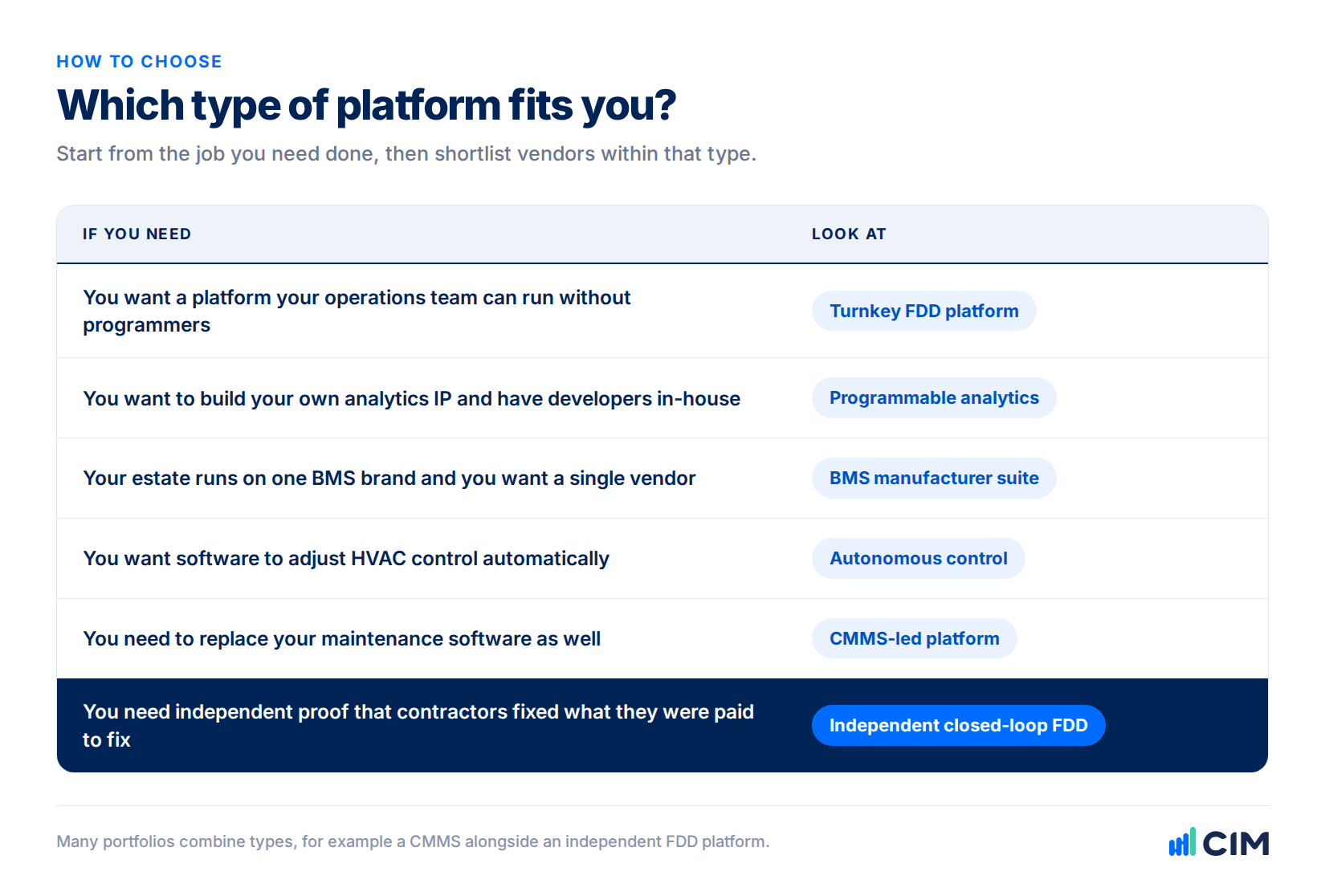
Many portfolios combine types. A common pattern is a CMMS for work orders, the BMS maker's tools for controls, and an independent FDD platform that checks whether the work in the CMMS actually changed how the building performs. For engineering and commissioning firms, monitoring-based commissioning (MBCx) is often where FDD earns its keep first. MBCx providers need a platform that tracks each fault from detection to a fix verified in the data, which is the same closed-loop capability owners need.
What are the alternatives to Clockworks Analytics?
Turnkey alternatives to Clockworks include CIM PEAK, Bueno Analytics and CopperTree Kaizen. SkySpark is a programmable alternative delivered through integrators. Johnson Controls OpenBlue and Honeywell Forge suit estates committed to one BMS brand, and Facilio suits teams that want FDD inside a maintenance platform.
Many people searching for Clockworks alternatives are mechanical and controls service providers, because its partner programme is aimed at them. If that is you, compare how each platform supports partners: who owns the customer relationship, who supports your engineers, and whether the vendor also sells direct into your accounts. CIM's partner programme and SkySpark's reseller network are the two most common alternatives for service firms.
What are the alternatives to Bueno Analytics in Australia?
Alternatives used in Australia include CIM PEAK, SkySpark through local integrators, Facilio, BMS manufacturer suites such as Johnson Controls OpenBlue and Honeywell Forge, and regional platforms such as Buildings Alive and EP&T Global. Current Bueno customers may also want to ask about its roadmap now that it is part of Copeland.
For Australian portfolios, NABERS performance is usually part of the brief, so ask each vendor how its platform supports the 12-month NABERS Energy rating period and which fault types it links to rating outcomes. Our guide to NABERS ratings covers how the scheme works.
Where does CIM's PEAK Platform fit, and when is it not the right choice?
CIM's PEAK Platform is an independent, turnkey FDD and building analytics platform for property owners and engineering partners. It works across mixed BMS estates, runs in more than 600 commercial buildings in 11 countries, and is built around closed-loop verification: faults are confirmed as fixed in the building data, not just marked complete.
CIM is fully independent: it is not owned by, or affiliated with, any equipment, controls or BMS manufacturer. PEAK reads data from all major building management systems through a single normalised model, covers more than 100 million square feet, and is rated 4.7 out of 5 on Capterra. It applies thousands of FDD templates, uses machine learning to help tag BMS points so new sites can be live in under 30 days, and sends alerts to the tools teams already use, such as Microsoft Teams. Faults are raised with a cost estimate and recommended action, assigned to the people responsible, and reopened if they return. CIM customers see average energy savings of 19%, supported by qualified engineers rather than a general help desk. For an example, see how engineers at a Canary Wharf tower confirmed a £25,000-a-year chilled water valve fault within 98 minutes.
PEAK is not the right choice for everyone. Consider another type of platform if:
- You want to write and own your analytics code with in-house developers. A programmable platform such as SkySpark fits better.
- You want AI to adjust HVAC control automatically rather than raise faults for people to fix. Look at autonomous control platforms.
- Your main need is replacing your maintenance management system. A CMMS-led platform such as Facilio is the better starting point.
- Your estate runs on one BMS brand and you want a single vendor for controls, service and analytics. The manufacturer's own suite may suit you.
To test PEAK on your own building data, request a callback.
How we compiled this comparison
We built this comparison from vendors' own websites, product documentation and press releases, and from independent trade reporting, all linked in the text. We checked the facts on 8 October 2026. We have not scored or ranked vendors, published prices, or repeated claims we could not source. Statements about CIM come from CIM's own published material. Vendors who see an inaccuracy can contact us through our website and we will review and correct it.
Frequently asked questions
What is the best FDD platform?
There is no single best FDD platform. Turnkey platforms such as CIM PEAK, Clockworks Analytics and Bueno suit operations teams that want pre-built rules and workflow. SkySpark suits integrators with in-house developers. BMS manufacturer suites suit single-brand estates, BrainBox AI suits buyers who want autonomous control, and Facilio suits teams replacing their maintenance software.
What are the alternatives to Clockworks Analytics?
Turnkey alternatives include CIM PEAK, Bueno Analytics and CopperTree Kaizen. SkySpark is a programmable alternative delivered through integrators. Johnson Controls OpenBlue and Honeywell Forge suit estates committed to one BMS brand, and Facilio suits teams that want FDD inside a maintenance management platform.
What are the alternatives to Bueno Analytics in Australia?
Alternatives used in Australia include CIM PEAK, SkySpark through local integrators, Facilio, BMS manufacturer suites such as Johnson Controls OpenBlue and Honeywell Forge, and regional platforms such as Buildings Alive and EP&T Global. Bueno customers may also want to ask about its roadmap now that it is part of Copeland.
What is the difference between SkySpark and a turnkey FDD platform?
SkySpark is licensed, programmable analytics software. You or an integrator model the data, write rules in its Axon scripting language and host the software. A turnkey FDD platform is cloud software with a pre-built rule library, automated point mapping and built-in fault workflow, run by operations teams with vendor support.
Which building analytics platforms handle poor-quality BMS data?
No platform fixes bad data on its own. The better ones automate point mapping with human review, detect failed, drifting or flatlined sensors as faults in their own right, and flag missing data rather than hiding it. In CIM's monitored portfolio, sensor faults affected 78% of buildings, so this capability matters on almost every site.
Which building analytics platforms integrate with Tridium Niagara, Schneider and Honeywell?
Most independent FDD platforms, including CIM PEAK, read data from several BMS brands rather than one manufacturer's. PEAK integrates with any BMS that exposes BACnet/IP, routed BACnet MS/TP, a vendor API or scheduled CSV exports, including Tridium, Schneider Electric and Honeywell systems. Ask each vendor which route it would use on your sites.
Should FDD be independent of the BMS manufacturer?
It depends on what you need it to prove. Analytics from the BMS or equipment maker can integrate tightly with that maker's systems. Independent FDD is better placed to verify the work of contractors and manufacturers, because the company checking the results is not the company that installed or maintains the equipment.
How much does FDD software cost?
Pricing is usually per building, per unit of floor area, or per data point, plus onboarding. Lawrence Berkeley National Laboratory's Smart Energy Analytics Campaign found US installation and software costs typically ranged from two to eight cents per square foot, with a median simple payback of about two years. For programmable platforms, include the cost of developers, hosting and integration time.
How long does it take to deploy an FDD platform?
Turnkey platforms with automated point tagging can bring a site live within weeks. Programmable platforms take longer when your team or integrator has to model the data and write rules first. Deployment time also depends on BMS protocols, network access and point naming quality.
.avif)
Unlock the power of building analytics. Discover how data-driven insights can optimize building performance, reduce costs, and improve sustainability.
A sceptical engineering team put PEAK to the test during their first training session, and confirmed a live £25,053-a-year chilled water valve fault within 98 minutes.
Read the story →