
NEW
The AI Portfolio Playbook - read it
Most AI watches buildings. PEAK closes the loop.
CIM is the Full Loop Building Operations System. PEAK's AI doesn't just find faults across a building - it drives every one through to verified action, whoever runs the building.
700+
Buildings under management
100M+ ft²
Under continuous monitoring
10 yrs
Of verified outcomes
Trusted by leading global portfolios





Why we exist
The best-run buildings are run by great engineers. Technology has been letting them down.
More alarms, more admin, more noise - while quietly promising their bosses it will one day replace them. We built CIM to take the other side of that bet.

Built for engineers
Find your path into PEAK
Three ways of operating. One loop.
Whichever side of the building you're on, the data, the loop and the proof don't change.

PEAK Enterprise
Owner-operators
I own and operate my buildings
See everything across your portfolio, fix what matters, and hold your supply chain to verified results.

Through a CIM partner
Outsourced operations
I own buildings.
Someone else runs them.
Keep your operating model. Find a CIM partner already running PEAK Professional on portfolios like yours.

PEAK Professional
Service firms
I run buildings for clients
Cover more contracts with the same team, prioritise what engineers act on, and prove every outcome.
The PEAK Full Loop
Six stages. It only counts if it closes.
Detection was never the hard part. Getting the fix done, and proving it held, was. PEAK's AI runs all six stages - from raw data to verified result and back again.


01
Every building system,
one connected data feed.
BMS, meters, IoT and equipment data over BACnet, Modbus and Niagara - no rip-and-replace, no proprietary hardware.
02
Live equipment health
against PEAK performance.
Every asset scored continuously, so degradation shows up as a trend long before it shows up as a failure.
03
Root cause identified.
Not a flag.
What is wrong, why, what it costs, and the engineering-grade fix - from 6,000+ advanced FDD rules.

WHERE PEAK'S VALUE IS CREATED
Execution - done, verified, improved.
Detection finds the waste. Execution is what turns it into savings that are fixed, proven in the building's own data, and banked.
04
The fix, assigned to the
right person.
To whoever actually holds it - in-house engineer, FM, mechanical contractor - with priority and expected outcome attached.
05
Resolution verified, supply chain benchmarked.
PEAK checks the building's own data to confirm the fix held, then benchmarks who closes work fast and well.
06
Portfolio intelligence:
plan, forecast, improve.
Ten years of verified outcomes become capital plans, ESG reporting and forecasts traceable to real events.
Where every other category stops
The gap between detection and proof is where performance is won.
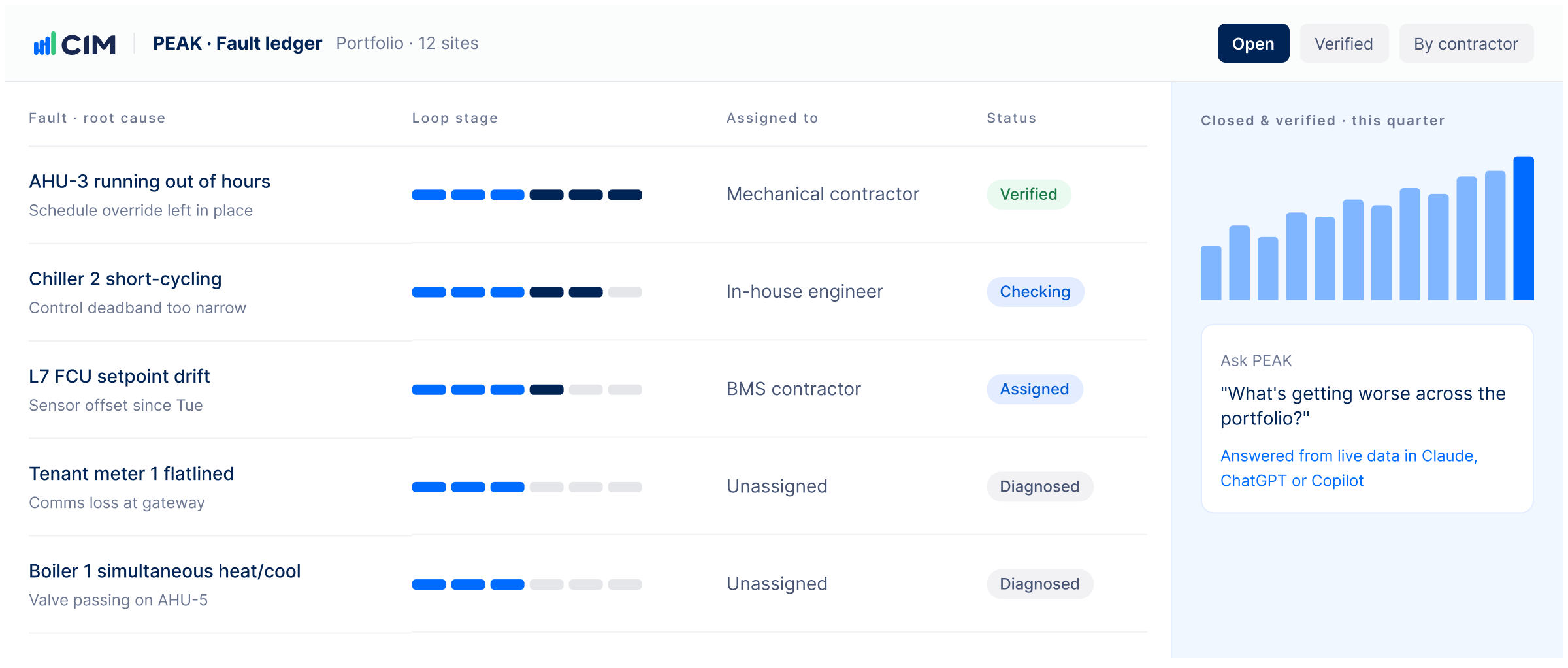
Analytics platforms stop at stage 03. Workflow tools start at 04 and never see the building's data. PEAK runs all six - so the outcome is verified, not reported.
Acquire
Assess
Alert
Action
Account
Augment
Analytics & FDD
Detect and report

Workflow & CMMS
Assign, never see the data

PEAK · the full loop

Intelligence · stages 01–03
Execution · stages 04–06
Not covered
PEAK AI
It takes four kinds of AI to actually run a building.
Anyone's AI can find a fault. PEAK runs four layers - every one tunable and explainable, because an engineer won't act on what they can't interrogate.

109M
Parameter model tagging every point
20M+
Sensors classified,
one ontology
6,000+
Advanced FDD rules running
Billions
Real-time checks per portfolio, per year
Detection - the AI that knows what a building should be doing
Warpspeed, CIM's language model for buildings, auto-tags every point across manufacturers and protocols against one unified ontology. No six-month tagging project, no hand-assembly per site.
On top of it runs an expert-system FDD library refined across every portfolio CIM operates. Every fault pattern in a building new to PEAK is already known from the buildings PEAK runs.
Point tagging · before → after
AHU3_SA_TMP
Supply Air Temp
CHW.VLV.POS.2
CHW Valve Position
L7_FCU_STPT
Zone Setpoint
KW_TOT_MTR1
Total Power
1,284 points discovered and classified against one ontology - no hand-mapping.
Assurance - the AI that proves the fix held
A closed ticket is not a fixed building. PEAK returns to the building's own data after the work is done and checks consumption, schedules and equipment health against the expected outcome. If the fault recurs, it reopens.
This is the layer that converts reported savings into verified savings, and it is why every number in a CIM report traces to an operational event.
Consumption · fault → fix → verified
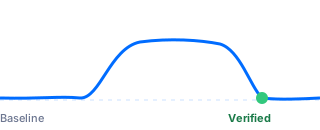
PEAK re-checks the data before the saving is booked.
Escalation - the AI your team already talks to
Connect Claude, ChatGPT or Microsoft Copilot to PEAK over the Model Context Protocol. "What needs attention at Skyline Tower?" returns structured answers from live building data, inside the tools your team already uses.
No dashboard to learn, no exports, no context switching - and priority, owner and recommended action come attached to every answer.
Analyst agent · via MCP
What's getting worse across the portfolio?
Skyline Tower · AHU-3
↓ 14%
Quay West · Chiller 2
↓ 9%
Bourke St · CHW pumps
stable
Northpoint · FCU zone 7
improving
Governance - the AI that chases the close-out
The AI recommends. The engineer decides. Human authority is the architecture, not a setting - and it is why this layer gets used rather than switched off.
The Compliance Agent triages faults, assigns ownership and follows work through to completion. Behind it, supplier performance is benchmarked on evidence rather than on who reports well.
Close-out flow
1
Detected and triaged
2
Prioritised and assigned to an owner
3
Followed through to completion
4
Closed, verified, supplier benchmarked
The results
What PEAK is worth on a portfolio.
Starting with the people who run the building. Modelled on portfolio shape - the same model behind the ROI calculator.


Engineer capacity
5x
More portfolio covered by the same engineering team.
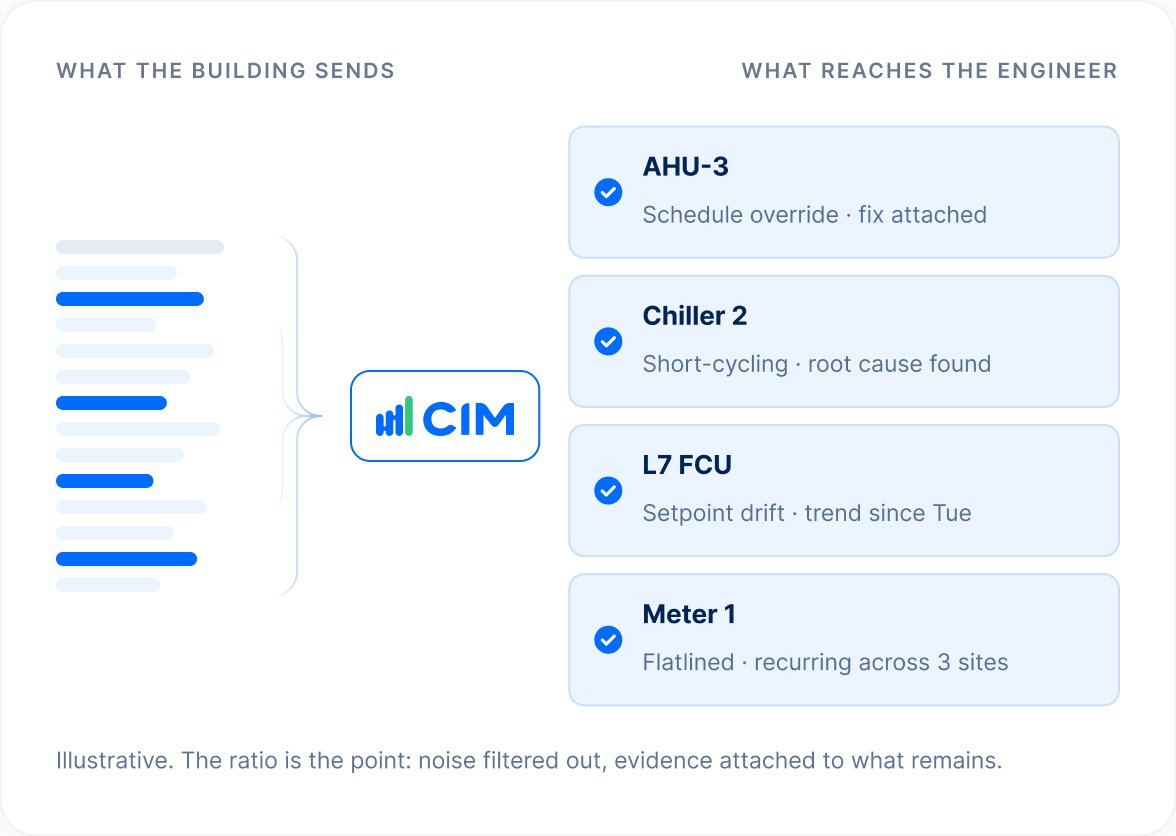
PEAK filters the noise, arrives with the diagnosis done and chases the close-out, so engineering hours go on the work only people can do.
Built for engineers

Team productivity
10-15%
Engineers start the day with the diagnosis already done.

Energy & emissions
10-25%
Charter Hall: 17.4M kWh verified

Equipment life
8-10%
Replaced on evidence of condition, not age.

ROI calculator · 5 min
Model it on your own portfolio
Outcomes on record
Verified results, whoever runs the building.

Energy & emissions
17.4M kWh saved
15M ft² under continuous monitoring across 60+ buildings. Waste patterns became booked savings.

Equipment life
Five chillers, five more years
Of six chillers scheduled for replacement, condition analysis showed only one needed immediate action.

Ratings & disclosure
IEQ up 8%, ratings held
The improvement and the audit trail behind it, so rating gains stood up under independent verification.

Team productivity
More projects per engineer
"PEAK has helped us increase productivity and significantly expand the number of projects the team can actively work on." - Nick Muscolino, VP
Eagle Street Partners
Supply chain
97% action completion
Every action assigned to the firm that holds it, verified against the building's own data and benchmarked by who closed it.
The partner network
The firms already delivering PEAK to building owners.
PEAK Professional doesn't replace their engineers. It expands what each one can cover - and what the firm can bill. RCx, MBCx, engineering, BMS and mechanical firms run it as a fully-managed service.

United States

United States

United States

United States

United States

United States

United States

United States

United States

United States

EMEA

EMEA

EMEA

EMEA

APAC

APAC

APAC

APAC
Go deeper
Three ways to evaluate PEAK before a call.

Tool · 5 min
ROI calculator
Enter portfolio size, building count and contract values. Models the capacity gain and savings PEAK adds.

Guide · PDF
CIM's Guide to Building Analytics
What building analytics covers, where FDD fits, and what separates detection from verified resolution.

Video · 2 min
The system overview
The full loop end to end, on a real portfolio, before you talk to anyone at CIM.
Common questions
The questions buyers ask before a first call.
PEAK
Still have a question?
Talk to someone who runs PEAK on real portfolios.
Most analytics platforms stop at detection - they tell you what is wrong and hand you a list. PEAK assigns the action to the person who holds it, checks the building's own data to confirm the fix held, and benchmarks who closed it. The difference is verification: a reported outcome versus a proven one.
Four layers. A language model that tags every data point against one ontology, an expert-system FDD library running billions of real-time checks, agents your team queries in plain English through Claude, ChatGPT or Copilot, and a governance agent that chases faults through to close-out. Every rule and policy is tunable and explainable.
PEAK reads from your existing BMS over standard protocols - BACnet, Modbus and Niagara - plus direct meter and IoT feeds. There is no rip-and-replace and no proprietary hardware. Point discovery and tagging are done by CIM during onboarding, so your team starts in a live deployment rather than an integration project.
No. PEAK sits across your data rather than on top of one stack. Your BMS, meters and CMMS all stay in place and keep doing what they do. PEAK connects to them and writes actions into the workflow your teams already use.
Under thirty days for most sites. Auto-commissioning brings new sites live in weeks rather than months, and most portfolios are producing closed, verified faults inside the first quarter.
That depends on how you operate. Owners who run their own buildings use PEAK Enterprise with their in-house team and existing contractors. Owners who have handed the day to day to a service firm get PEAK through a CIM partner running PEAK Professional. The operating model is yours to choose; the loop and the verification do not change.
No - the opposite. PEAK filters the routine verification a roster was never going to finish, so engineering hours land on diagnosis, corrective action and the client conversations only people can have. The AI recommends and the engineer decides. Human authority is the architecture, not a setting.
Because the best-run buildings are run by great engineers, and most building technology has handed them more alarms and more admin while promising their employers it would one day replace them. PEAK is built the other way round: it filters noise down to what is worth an engineer's time, backs every action with evidence they can show, and keeps the decision with the person on site. Adoption is the reason - a system engineers refuse to open delivers nothing to the owner who bought it.
Pricing depends on the product - PEAK Enterprise for owners, PEAK Professional for service firms - and on portfolio size, building count and which parts of the loop you run yourself. The ROI calculator models the return on your own numbers before you speak to anyone; a call covers the pricing model in detail.