Data-driven maintenance: service what needs it, not what's scheduled.
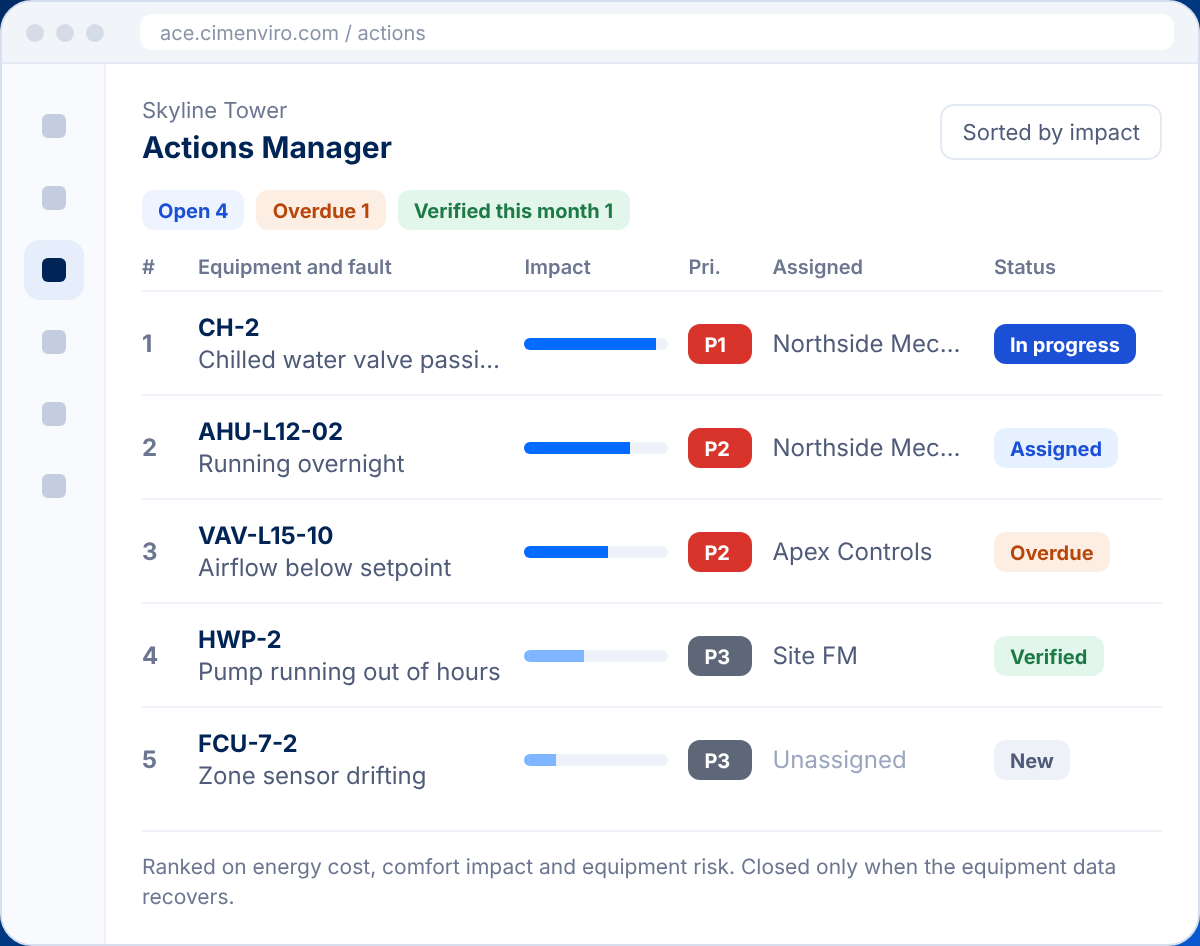
PEAK reads your plant continuously, ranks every fault by what it costs, assigns it and verifies the fix held. The engineer who knows the building decides what gets serviced - not a calendar written before anyone looked at the data.

80%
P1 and P2 actions verified

82%
Action closure across 58 properties

50%
More active projects, no extra staff






Data-driven maintenance uses live data from your plant and equipment to decide what gets serviced, when, and in what order. CIM PEAK, the Full Loop Building Operations System, runs it across a portfolio and keeps every job moving until the fix is verified in the equipment data.
You are paying to inspect equipment that is working fine
Most maintenance contracts run on planned preventive schedules, unplanned reactive callouts, or both. Neither is driven by what the equipment is actually doing.

Planned preventive (PPM)
Rigidly scheduled checks. Time and money spent inspecting plant that is running perfectly well, on a calendar written before anyone looked at the data.

Unplanned reactive (UPM)
The absence of a strategy. Work happens when something breaks or a tenant complains, which makes budgeting a guess and disruption routine.

Missed issues
While a contractor inspects working equipment, genuine faults elsewhere can sit unaddressed for months - quietly degrading efficiency until they become a failure or a tenant complaint.

Misaligned objectives
Traditional routines were not designed around what asset managers are judged on today - tenants, sustainability and cost - so they can jeopardise all three at once.
Predictive maintenance is the forecast. Someone still has to do the work.
Predictive maintenance uses live equipment data to anticipate failures before they happen, so plant is serviced on evidence of deteriorating condition rather than on a fixed schedule. It is the forecasting half of data-driven maintenance, and PEAK does it: continuous analysis of BMS, meter and sensor data flags equipment drifting away from expected performance, well before it fails outright.
The half that gets skipped is what happens next. A prediction that nobody is assigned to act on changes nothing about the building.
The forecast is right. The equipment still fails on schedule.
 Data-driven maintenance on PEAK
The same data that predicts the failure assigns the work, follows it up and proves it was done. 80% monthly completion standard on P1 and P2 actions.
Every job ends verified, not just predicted
PEAK covers what the industry calls predictive maintenance, and goes further: the same data that predicts a failure also ranks the work, assigns it and proves it was done.
Reads your equipment continuously
PEAK connects to your existing BMS, meters and sensors and analyses millions of data points as they arrive - so a dip in performance is visible the day it starts, not at the next scheduled inspection.
Predicts what needs attention next
The Rules Engine flags equipment drifting away from expected performance before it fails. Reactive work still happens - but it is triggered by the data, not by a tenant complaint.
Where PEAK keeps goingRanks the work by what it costs you
Every fault is scored on energy cost, comfort impact and equipment risk, so your team and your contractors work the most consequential issues first rather than the next item on a list.
Closes the job out and proves it
Work is assigned to a named person, followed up when it goes overdue, and checked against the equipment data afterwards. If the fix did not hold, PEAK reopens it.
Reactive, preventive, predictive, data-driven: what triggers the work in each
Four ways to decide what gets maintained. They differ in one respect above all: what triggers the work.
Reactive
Planned preventive
Predictive
 Strategy 4
Data-driven
One record of the work that owner and contractor both trust
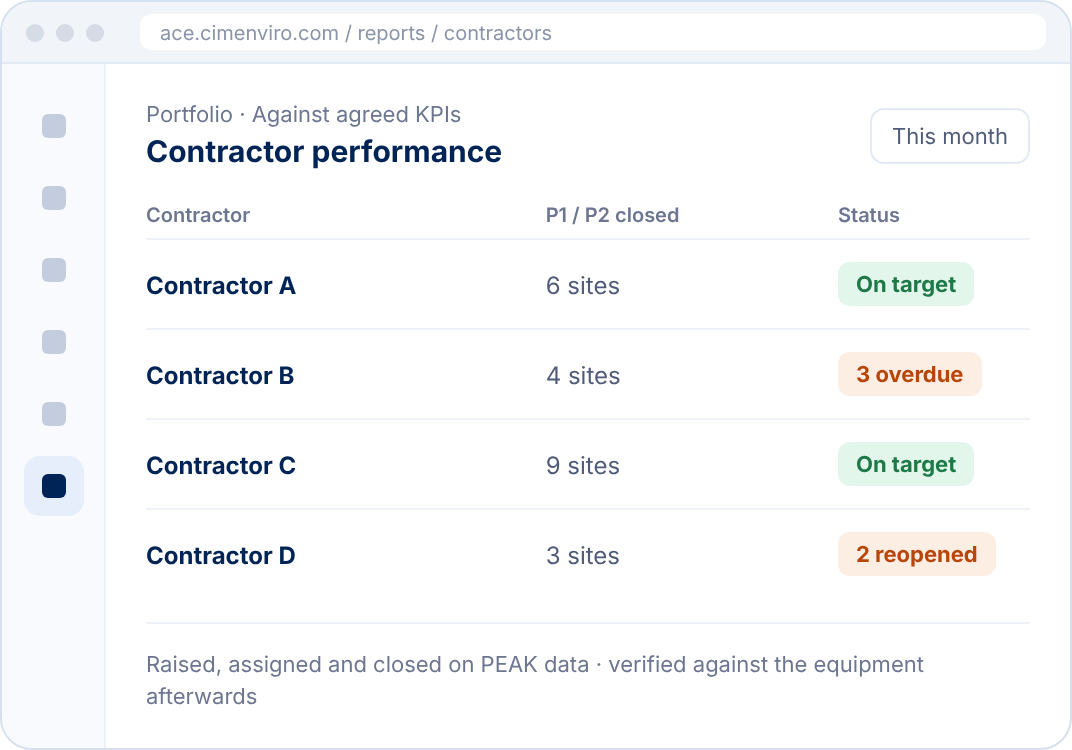
Most maintenance reporting comes from the people doing the maintenance. PEAK keeps an independent record - what was raised, who it went to, how long it sat, and whether the equipment actually recovered - so every contract review starts from the same facts.
What data-driven maintenance changes
Six places the difference shows up, from what the contract costs to what tenants notice.

Maintenance contracts
Fewer reactive callouts and a tighter focus on real issues change what you are buying - and what it should cost.

Equipment downtime
Continuous monitoring and automated fault detection catch issues before building users feel them.

Equipment life
Timely intervention mitigates wear, so plant runs properly for longer and capital replacement moves out.

Sustainability performance
Better-run equipment uses less electricity, gas and water - feeding ratings, net zero targets and green lease commitments.

Team productivity
Fewer wasted onsite hours, root causes addressed directly, and issues resolved centrally rather than building by building.

Tenant experience
Fewer disruptions and steadier conditions across all zones, because problems are found before they are reported.
What the evidence says about maintenance

of air handling units are carrying a fault on any given day - which is the work a calendar-based schedule is not looking for.
Lawrence Berkeley National Laboratory, analysis of 60,000+ pieces of HVAC equipment.

savings on energy bills from operations and maintenance programmes targeting efficiency, without significant capital investment.
US Department of Energy, Federal Energy Management Program, O&M Best Practices Guide.

monthly completion standard on P1 and P2 actions across PEAK portfolios - the measure most maintenance reporting never states.
CIM operating standard, measured on platform data.
How the transition actually happens
This is a contract change as much as a technology change. It runs in three stages, usually across renewal cycles rather than overnight.
Initial integration
Analytics goes in alongside the existing contract. It adds cost at first, and it produces the evidence of what the building actually needs.
Contract evolution
The maintenance contract is rewritten around condition rather than schedule. Analytics moves inside the core contract; routine servicing costs come down.
Mastery and refinement
Condition-based maintenance becomes the operating norm. Backlogs clear, equipment lasts longer, and costs settle lower than where you started.
Teams who stopped servicing to a calendar
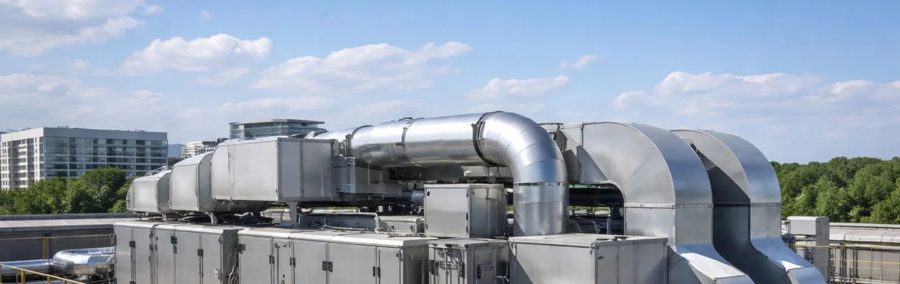
A failed 24/7 AHU, routed straight to the contractor
The building was moving to data-driven maintenance. PEAK flagged the failure as critical and assigned it to the mechanical contractor directly, cutting out manual triage.

Chiller down, BAS dark: classrooms kept cool
A new chiller failed on the morning the district's BAS front-end was down. PEAK flagged it first thing and a technician was dispatched before staff or students noticed.

A 24/7 toilet leak found before it escalated
Water metering showed continuous use in the Level 1 amenities. The site team found a running urinal and fixed it, avoiding $26,000 in annual cost exposure.
 Owner-operator · Australia
Scheduled maintenance checks are now a thing of the past.
"Scheduled maintenance checks and servicing is now a thing of the past as the data helps us determine precisely when and where maintenance is needed. We can now actively anticipate and prevent equipment breakdowns which means equipment is more likely to last its specified lifespan and we don't have to resort to costly fixes or replacements."
 Airport · Australia
Improving our operations through data-driven decisions.
"Brisbane Airport Corporation was pleased to engage CIM to assist with delivering energy savings, optimising building performance and improving our operations through data-driven decisions."
 UniversitiesUniversity · Australia
It finds what's broken and guides better maintenance man-hours.
"We want maintenance time to be better spent in a more productive fashion. It's impossible to check every sensor and every actuator every month. We want our BMS and Mech to investigate real alerts. That's where analytics like CIM have helped. It finds what's broken and guides better maintenance man-hours."
Fault detection is the engine. Maintenance is what it drives.
Fault detection and diagnostics sits inside data-driven maintenance. FDD finds and diagnoses what is wrong; data-driven maintenance is the operating model that decides what gets done about it, by whom, and in what order.
FDD
The operating modelData-driven maintenance
Decides what gets maintained, when, by whom, and how it is paid for.
You can have FDD without data-driven maintenance. Most organisations do: the platform runs, the faults are found, and the contract keeps billing for the same calendar inspections.
See how fault detection and diagnostics works →Two ways teams run data-driven maintenance on PEAK
Owners and operators use PEAK to manage maintenance on evidence. Maintenance and engineering firms use it to cover every point on every contract without adding engineers.

You own or operate the buildings
Maintenance spend follows equipment condition rather than the calendar. Every job has an owner and a verified close-out, so the maintenance contract is managed on evidence.

You maintain buildings for clients
Calendar-driven checks become automated verification of every point, every 15 minutes - closing the gap between what a maintenance standard requires and what a dispatch team can physically cover.
Go deeper on data-driven maintenance
A Guide to Data-Driven Property Maintenance
The practical playbook for moving a portfolio off calendar-based servicing - and rewriting the contract that goes with it.


Works with your existing BMS
Condition-based maintenance starts with the data your building already produces. PEAK reads your system through BACnet/IP, routed BACnet MS/TP, a vendor API or scheduled CSV exports, without a rip-and-replace of your existing controls.
See how PEAK connects to your BMS →
What is data-driven maintenance?+
Maintenance decided by the condition of the equipment rather than by a fixed schedule. Live data from plant and equipment determines what needs attention, when, and in what priority order.
How is it different from predictive maintenance?+
Predictive maintenance is the forecasting part - using data to anticipate failure. Data-driven maintenance includes that, and adds the operating model around it: prioritising the work, assigning it, tracking it and verifying the equipment recovered.
Does it replace planned preventive maintenance entirely?+
No. Statutory and safety-critical servicing still runs to schedule. What changes is the discretionary work: routine checks on equipment that is running well get replaced by attention to equipment that is not.
What happens to our existing maintenance contract?+
It typically changes at renewal rather than immediately. Analytics runs alongside the current contract first, then the scope is renegotiated once there is evidence of what the building actually needs.
Do we need new sensors?+
Usually not. Most buildings already produce far more data than anyone reads. PEAK is BMS-agnostic and works with the meters, sensors and equipment feeds already in place.
How does it hold contractors accountable?+
Every raised issue is tracked from detection to close-out on data neither party can edit, and the equipment data confirms whether the fix held. Performance is measured against agreed KPIs rather than self-reported completion.
Can maintenance contractors run data-driven maintenance on PEAK?+
Yes. PEAK Professional is built for maintenance, engineering and FM firms that look after buildings for clients. Calendar-driven checks become automated verification of every point, every 15 minutes, and the verified record of what was fixed goes straight into client reporting.