Indoor environment monitoring that protects tenant comfort and your rating
Right now, your complaints inbox is your detection system
Most buildings find out about a comfort problem when someone reports it. By then the condition has usually been wrong for days, the tenant has already formed a view, and nobody can say how long it lasted or how many floors it affected.

Complaints arrive after the damage
A hot-or-cold call is a lagging indicator. The occupant experience it describes has already happened, and repeat complaints shape lease conversations.

Failed sensors report nothing
A dead temperature or CO2 sensor does not raise an alarm - it simply stops contributing data, leaving a silent gap in the record you need for reporting.

Annual data exports, checked too late
Where compliance depends on a yearly export, problems are found after the measurement period has closed - when nothing can be done about the result.

Comfort traded away for energy
Efficiency programmes that are not watching zone conditions save energy by making the building less comfortable - and the complaints follow a season later.
Why indoor conditions carry commercial weight
Temperature is the second largest source of dissatisfaction reported by building occupants.
Center for the Built Environment, University of California Berkeley, occupant survey research.
of occupants is the satisfaction threshold ASHRAE Standard 55 uses to define acceptable thermal conditions - a target you can only prove with continuous measurement.
ASHRAE Standard 55, Thermal Environmental Conditions for Human Occupancy.
of a commercial building's energy goes to HVAC - the same equipment that determines whether the space is comfortable. Comfort and consumption share a root cause.
US Energy Information Administration.
What PEAK does for indoor environment quality

PEAK monitors every zone continuously
Thermal comfort, relative humidity and air quality tracked against setpoints and acceptable ranges across every zone, floor and tenancy - not sampled once a year.

PEAK finds the sensors that stopped working
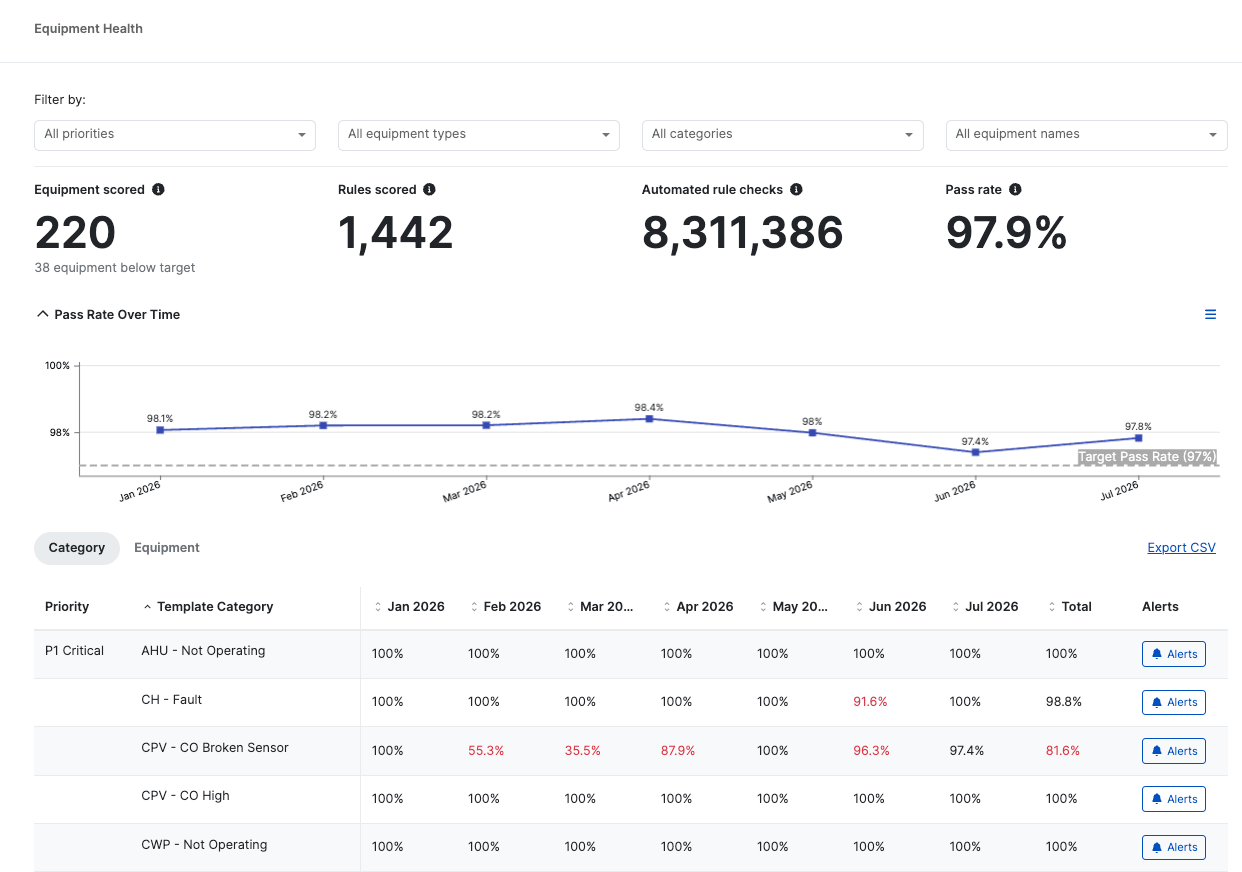
Fault detection covers the instrumentation itself - flat-lining, drifting or dead sensors are raised as faults, so the data behind your reporting stays intact.

PEAK diagnoses the cause, not just the symptom
A warm zone is traced back to the equipment behind it - a stuck valve, a failed outside air fan, a control override - so the fix addresses the cause.

PEAK produces the evidence trail
A continuous, auditable record of conditions and corrective work - the dataset that supports rating submissions, certification and tenant conversations.
Whichever standard your market reports against
Indoor environment requirements differ by region, but they share one demand: measured evidence of the conditions occupants actually experienced.
WELL, RESET Air, ASHRAE
The WELL Building Standard for occupant health, RESET Air for continuously monitored air quality, and ASHRAE 55 and 62.1 for thermal comfort and ventilation.
NABERS Indoor Environment
A star rating built from measured thermal comfort, air quality, lighting and acoustics - assessed annually, but decided by how the building ran all year.
BREEAM In-Use, EPBD
BREEAM In-Use health and wellbeing criteria, alongside the indoor environmental quality provisions member states are transposing under the recast EPBD.
LEED IEQ, Fitwel, Green Mark
LEED indoor environmental quality credits for existing buildings, Fitwel for occupant health, and Green Mark across Singapore and South East Asia.
Comfort and energy are not a trade-off
The clearest evidence against the assumed compromise comes from a portfolio that improved both at once.
Indoor environment scores up, energy down, same period
Across LaSalle's Australian portfolio, average indoor environment scores rose 13% to a portfolio-wide 84%, while energy consumption fell 18% over the same period.
How PEAK benefits tenants → Office portfolio
Charter Hall's average indoor environment score, up from 84%
Measured before and after PEAK was deployed across the office portfolio, tracked continuously rather than at annual assessment.
Read the NABERS IE guide →A rating saved by sensor data nobody knew was missing
Across a premium portfolio managing more than 4,700 temperature sensors, alternative PEAK sensor data let assessors validate thermal comfort scores - and the building retained its 6-star NABERS Indoor Environment rating.
Read the story →An outside air fan stopped. Nobody had to complain first.
At an A-grade Brisbane office, a critical outside air fan ceased operating and CO2 began climbing. PEAK alerted the Operations Manager before occupants were affected.
Read the full example →Maximising Tenant Satisfaction
How improving the tenant experience lifts the value of a commercial property, with insights from industry leaders.
Indoor environment quality, explained
What is indoor environment quality?
Indoor environment quality, or IEQ, is the measured condition of the space people occupy inside a building - principally thermal comfort, relative humidity and air quality, and in some schemes lighting and acoustics. It is assessed on what was actually measured over time, not on how the systems were designed.
What is the difference between indoor air quality and indoor environment quality?
Indoor air quality (IAQ) covers ventilation and pollutants in the air. Indoor environment quality is broader, adding thermal comfort, humidity and, in some rating schemes, lighting and acoustic conditions.
Which standards and ratings does PEAK support?
PEAK monitors the conditions used by NABERS Indoor Environment in Australia and New Zealand, WELL and RESET Air globally, BREEAM In-Use in the UK and Europe, LEED indoor environmental quality credits and Fitwel in the United States, and Green Mark across South East Asia - alongside ASHRAE 55 and 62.1 as underlying standards.
Do we need to install new sensors?
Usually not. PEAK reads the temperature, humidity and air quality sensors already connected to your BMS, whatever the vendor. Where coverage is genuinely missing, that gap is identified rather than assumed.
Does improving comfort mean using more energy?
Not necessarily. Most comfort problems are faults - a stuck valve, simultaneous heating and cooling, a failed fan - and fixing them improves conditions while reducing consumption. Across LaSalle's Australian portfolio, indoor environment scores rose 13% while energy fell 18% in the same period.
How does PEAK detect a faulty sensor?
The same fault detection engine that monitors equipment also monitors the instrumentation: readings that flat-line, drift outside plausible ranges or stop arriving are raised as faults, so gaps are found during the measurement period rather than at assessment.
Powering property teams in these world leading companies.