Fault detection and diagnostics that closes the loop
Buildings aren't under-analysed.
They're under-executed.
Every building already knows hundreds of things that should be fixed. Almost none of them happen.
Analytics tells you what is wrong. Operations determines whether anything changes. The gap between insight and action is where savings, ratings and engineers' time quietly leak away.
of air handling units are carrying a fault on any given day.
Lawrence Berkeley National Laboratory, analysis of more than 60,000 pieces of HVAC equipment. Faults are not the exception in commercial buildings - they are the steady state.
Faults found
Detection works. The list grows every week.
Reports issued
Dashboards, exports, recommended actions.
Nothing changes
The energy keeps leaking. Nobody owns the difference.
Detect is level one.
AI handles the volume. People handle the judgement. Governance keeps priority issues moving. Each level builds on the one below it.
 Where CIM operates
Detect
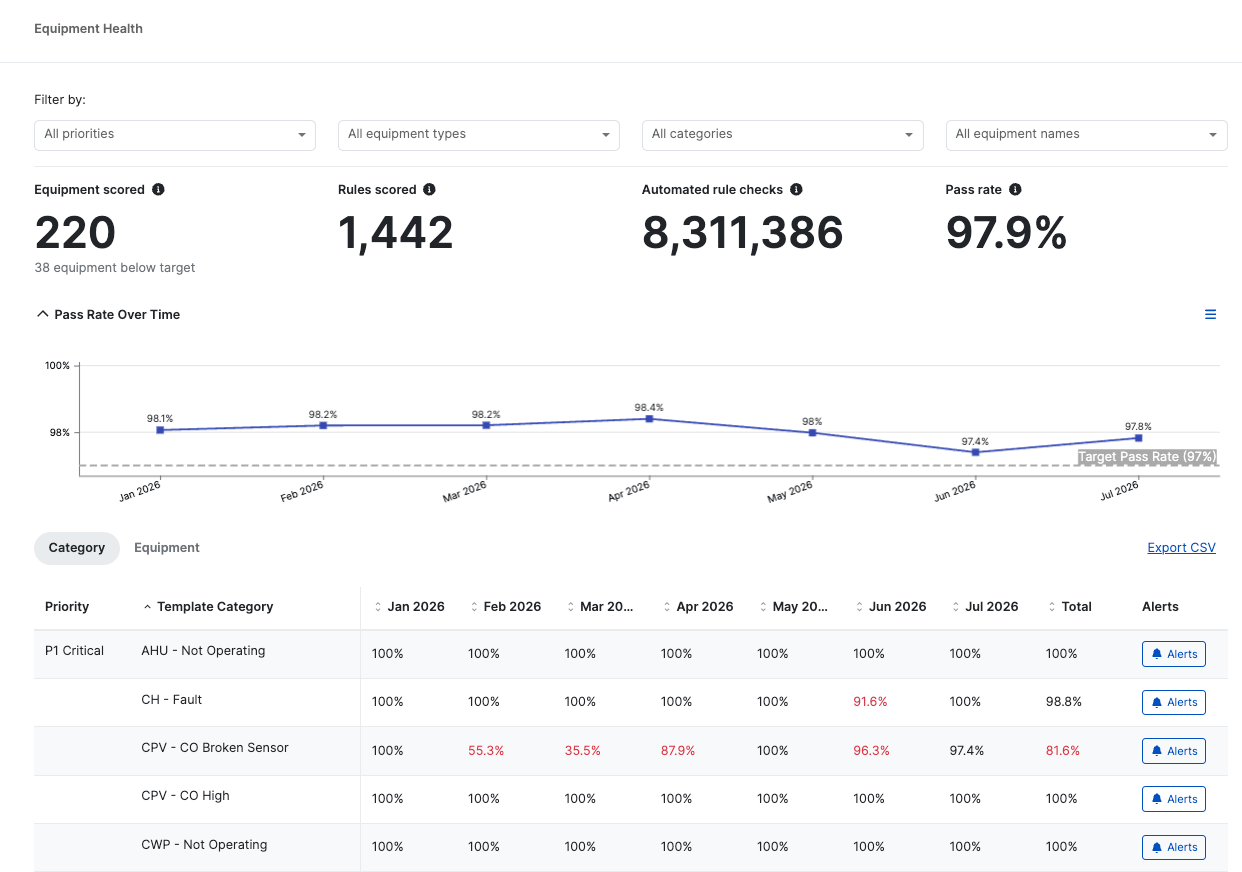
The Rules Engine catches equipment faults the moment they happen, ranks them by business impact, and tells the right site team.

Assure
An AI agent checks the work: flags false alerts, reopens actions that weren't really fixed, chases what's overdue.

Escalate
A named CIM engineer triages what's been left unassigned, backs up site teams, and holds the standard week by week.

Govern
Portfolio performance reported monthly, backlogs escalated, top performers named. An 80% monthly completion standard on P1 and P2 actions.
Everyone detects. Almost nobody closes.
| Capability | BMS & controls | FDD & analytics | ESG reporting | |
|---|---|---|---|---|
| Real-time data and dashboards | partial | |||
| Detect and diagnose faults at scale | ||||
Most of the market stops here | ||||
| Assure - every alert and action reviewed | partial | |||
| Close - escalation, SLA, contractor accountability | ||||
| Govern - portfolio cadence on verified data | partial | partial | ||
Your BMS vendor and your maintenance contractor both have a stake in how their own work looks. PEAK doesn't - which is why its record of what was raised, what was fixed and what is still open holds up in a contract conversation.
What closing the loop actually looks like
A GBP 25,053-a-year fault, found in the first training session
A sceptical engineering team put PEAK to the test and confirmed a live chilled water valve fault before the session ended.
Read the story →The contractor oversight nobody else spotted
PEAK surfaced a contractor error that was quietly wasting energy and damaging equipment - the accountability half of the loop, working.
Read the story →A hidden fan fault in a 6-star building
A top-rated building is not a fault-free building. PEAK found what the rating didn't.
Read the story →An energy spike stopped before it took hold
Real-time detection flagged manual overrides instantly - drift caught at the start, not at the quarterly review.
Read the story →Every analytics vendor will show you faults found. Ask them their action completion rate.
PEAK portfolios run to an 80% monthly completion standard on P1 and P2 actions.
How FDD unlocks growth for engineering consultancies
For engineering and commissioning firms building a service line on top of fault detection and diagnostics.
What's underneath

The Rules Engine
Algorithms written by CIM's mechanical, mechatronic and electrical engineers from real building operating experience, streaming millions of data points across your plant.

Fault classes covered
Overnight operation, mechanical failure, energy wastage, safety and compliance, tenant comfort, and sensor performance.

BMS-agnostic by design
Works with the BMS you already have, plus IoT sensors, HVAC, lifts, electricity and water meters, NMI feeds, weather and occupancy data.

Tuned, not dumped on you
Engineers monitor model decisions and tune rules to balance false positives against missed faults. Alert fatigue is a design problem, not a customer problem.
Two ways teams use FDD on PEAK

You own or operate the buildings
Faults get found, assigned and closed without adding headcount. Your ratings hold, your energy spend falls, and you see the whole portfolio instead of one building at a time.

You service buildings for clients
PEAK is the engine under your service line. Aero Performance Group grew active properties under management by 50% without adding resources, and built a recurring technology revenue stream alongside its consultancy work.

What is fault detection and diagnostics? The complete 2026 guide
How FDD works, how it differs from a BMS, what it finds, what it is worth, and how it connects to systems you already own.
FDD is where it starts, not where it ends
Fault detection is the detection layer inside a wider operating model. The same engine feeds every other solution on PEAK.


Fault detection and diagnostics, explained
What is fault detection and diagnostics (FDD)?
FDD is the continuous, automated analysis of building equipment data to identify when something is operating incorrectly and explain why. Detection finds the symptom; diagnostics identifies the probable cause so a team can act on it.
What is the difference between FDD and AFDD?
AFDD means automated FDD - rules and models running continuously rather than an engineer manually interrogating BMS trends. PEAK's Rules Engine is an AFDD system: it runs around the clock without anyone asking it to look.
Does FDD replace my BMS?
No. A BMS controls equipment; it is not built to analyse its own performance. PEAK sits alongside the BMS you already have, reads its data, and adds the analysis and workflow layer on top. It is BMS-agnostic.
How is FDD different from building analytics?
Building analytics is the broader category of turning building data into insight. FDD is the specific discipline of finding and diagnosing equipment faults within it. The harder question is what happens after the fault is found, which is where closed-loop execution matters.
What data does PEAK need to start?
Your existing BMS data, plus whatever meters and sensors are already in place - electricity, gas and water meters, IoT sensors, lift and HVAC feeds. No rip-and-replace is required.
What is an action completion rate?
The proportion of raised actions that are actually completed, rather than the number of faults detected. It is the honest measure of whether analytics is changing anything. PEAK portfolios run to an 80% monthly completion standard on P1 and P2 actions.
Which equipment does PEAK monitor?
Chillers, boilers, air handling units, pumps, fans, cooling towers, lifts, meters and sensors - the plant that drives energy use, comfort and compliance in commercial buildings.
Works with your existing BMS
PEAK is BMS-agnostic. It reads Trend, Tridium Niagara, Schneider Electric, Honeywell, Siemens, Johnson Controls, Distech Controls, Delta Controls, Alerton and Automated Logic systems through BACnet/IP, routed BACnet MS/TP, a vendor API or scheduled CSV exports, without a rip-and-replace of your existing controls.
See how PEAK connects to your BMSPowering property teams in these world leading companies.