The same client, every year. Without adding headcount.
What changes in an engineering or commissioning firm when it delivers PEAK: recurring revenue from the clients you already serve, more buildings per engineer, and contracts that renew on verified results.

5x
Coverage per engineer

4-5 weeks
Signed to first client live

50%
More projects, same team
Six ways the partnership pays
Partners don't run PEAK for the software. They run it for what changes in the firm: what it earns, how far its engineers reach, and how long its clients stay.
 Revenue
Recurring fees from clients you already serve
Projects become the entry point. Monitoring retainers, remedial works and reporting follow on the same buildings.
How partners earn → Capacity
More buildings per engineer, without hiring
PEAK does the checking on every point. Your engineers spend their hours on diagnosis, fixes and advice.
The capacity maths → Retention
Contracts that renew on results
Clients see verified outcomes in their own data every week, not once in a closing report.
Why clients stay →SpeedFirst client live in 4-5 weeks
CIM does the connecting, tagging and commissioning, so billable work starts in the same quarter you sign.
See how it works →InvestmentNo platform to build or run
Hosting, the 6,000+ rule library and 24/5 engineering support come with the licence. You never fund an R&D team.
What is included → Growth
Help to win the work
Bid support, a listing in the partner directory, the partner portal and co-branded case studies.
Partner support →From one-off projects to recurring retainers
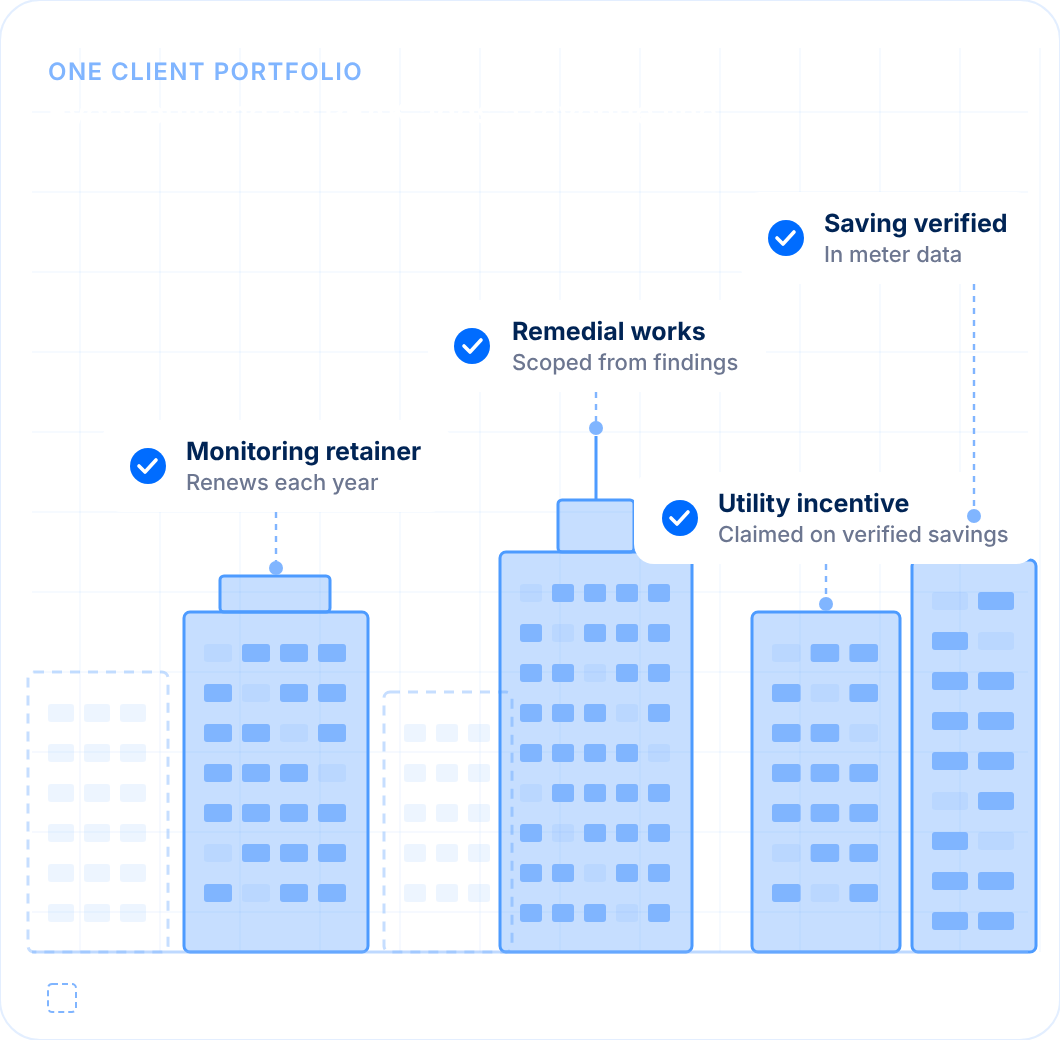
Project income is lumpy. A chiller replacement makes a great year, then next year starts at zero. On PEAK the project becomes the way in, and continuous monitoring becomes the service that follows it.
RCx study
Connect the BMS and deliver a ranked fault list in weeks, with a measures plan the client can fund.
→Monitoring retainer
Continuous monitoring, verified fixes and a quarterly statement from live data. Recurring revenue begins.
→Pull-through and roll-out
ECM design, remedial works, compliance reporting and more of the client's buildings on the same platform.
The same data feeds work your clients already ask for.
The district paid nothing: the US$17,480 implementation was 100% funded by the ComEd programme. Facility electricity fell 35.5%, verified in under five months.
Hourly contracts cap your upside the moment you get more efficient. Outcome-based retainers keep it.
Partner Value Series: Revenue →The ceiling is hours, not skill
Most of an engineer's week goes on looking for problems: pulling trend logs, chasing point names across vendors, checking plant that turns out to be fine. That is the least differentiated work a firm does, and it caps how many buildings each engineer can carry.


Projects end. Monitoring renews.
The services business has been a constant sales motion: every year starts at zero. Once continuous monitoring runs on a client's buildings, the relationship changes shape. The client sees the value every week, not once at the end of a report.
 35%
of retro-commissioning savings are lost over time, on average, when nobody keeps watching the building.
 1 in 10
MBCx contracts renew, usually because year two arrives as an invoice with no new story.
 1.8x
the savings of standard commissioning from utility MBCx programmes: a 9% median saving against 5%.

 PARTNER STORY
"The advanced visualization capabilities have enhanced our client engagement, helping to improve our retention rates."


The annual sales hunt ends when the client's buildings run on you.
Partner Value Series: Retention →The services revenue is yours
One licence, fully managed by CIM. PEAK is licensed wholesale per data point, per year, so the cost follows each client's buildings and builds into the fee you charge. We share pricing on a partner fit call.
 Everything below the line is on us
 Full PEAK feature set
 Hosting, security and system operations
 Tagging and commissioning, fully managedThe 6,000+ rule library, kept current
 Edge hardware and monitoring where a site needs it
 24/5 engineering support from engineers, not a call centre
 Comprehensive training and the partner portal
 Partner success and go-to-market support
CIM does not sell direct against partners in the markets we cover, and the rules your engineers write stay inside your firm.
Software cost scales with the work, so the next building adds margin, not headcount.
Book a partner fit call →Go deeper on partner economics
The Engineering Firm's Guide to Scaling MBCx
For principals and practice leaders at commissioning, energy engineering and performance contracting firms.

How do engineering firms make money with PEAK?+
From the services around the platform: deployment engineering, monitoring and MBCx retainers, remedial works scoped from what PEAK finds, and client reporting. PEAK is licensed wholesale, so all services revenue above the licence stays with your firm.
What does it cost to become a CIM partner?+
There is no platform to build. PEAK is licensed wholesale per data point, per year, so the cost follows each client's buildings and builds into the fee you charge. We share pricing on a partner fit call.
How many more buildings can an engineer cover on PEAK?+
Building coverage per engineer rises 5x on PEAK, because the platform does the continuous checking and engineers work a ranked list of diagnosed faults. Aero Performance Group grew its active projects by 50% with no additional staff.
Do utilities pay for monitoring-based commissioning?+
Many US utilities fund monitoring integration and pay incentives on measured savings. At an Illinois high school, CIM partner Aero Performance Group delivered MBCx on PEAK through the ComEd programme, which funded 100% of the implementation.
How quickly can a new partner start earning?+
Most client portfolios are live on PEAK in 4-5 weeks, because CIM does the connecting, tagging and commissioning. Billable work starts in the same quarter the partnership is signed.
Who owns the client relationship?+
Your firm does. You hold the contract, the retainer and the renewal. In the markets we cover, CIM does not sell direct against partners or approach your clients.
Model the partnership on your own practice
Tell us how many engineers and buildings you carry today. We will model the partnership with you.