Retro-commissioning works, and the business behind it is lumpy. A 12- to 18-month project, an invoice, then the hunt for the next one, while the building quietly drifts back towards where it started. Monitoring-based commissioning turns the same expertise into a standing service, and utilities, owners and regulators are all moving to pay for it.
This article is for principals, directors and commissioning leads at RCx, MBCx, Cx and energy engineering firms deciding how to grow the practice. It covers where the incentive money is, what an extra building per engineer is worth, how to package and price MBCx so it renews, and a 90-day plan to launch. It draws on our new eBook, The RCx Provider's Guide to Scaling MBCx, which has the full worksheets and checklists.
Key takeaways
- RCx wins the client; MBCx keeps them. Selling the two as one engagement is the biggest single change most practices can make.
- Utilities already pay for MBCx. Programmes fund monitoring integration and pay performance incentives on measured savings.
- The ceiling is hours, not skill. Moving from five to eight buildings per engineer adds revenue without adding headcount.
- Price for margin. Charge the retainer per building or per square foot, build the platform cost into the fee, and price remediation separately.
- Start small. Three pilot clients and one programme, proved in 90 days, then packaged.
Why is the commissioning business moving from projects to programmes?
Because the value of commissioning decays and the market now pays to keep it. ACEEE, citing earlier research, puts the share of retro-commissioning savings lost over time at about 35% when nobody keeps watching, while utility MBCx programmes have delivered around 1.8 times the savings of standard commissioning. Utilities, building performance standards and cheaper analytics all reward continuous, measured performance.
Three forces are behind the shift. Utilities now fund monitoring integration and pay on verified, measured savings rather than one-off studies. Owners face building performance standards such as New York's Local Law 97, Boston's BERDO and Washington's Clean Buildings Act, which reward performance every year, not once. And continuous fault detection now does the checking that used to consume the commissioning budget, which changes the economics of delivering it.
For a firm, the practical consequence is a different business model on the same skills. An RCx project is a one-off fee with a short data window and a relationship that ends at close-out. An MBCx programme is a retainer renewed annually, with permanent data, verification that continues after the fix, and a client relationship that deepens with every quarterly statement. We compare the three service types in detail in Cx vs RCx vs MBCx compared.
Which utility programmes pay for MBCx, and how?
Many US utilities pay for exactly what an MBCx practice delivers: typically an integration or implementation incentive to set up monitoring, then performance incentives on measured savings. Several work through closed networks of approved providers, so getting on the list in each territory is a firm's first business-development task.





Programme terms change every programme year. Check the current manual before scoping. Logos are trademarks of their owners, shown for identification only.
The evidence bar is rising. Programmes increasingly want resolved faults and measured savings rather than a list of findings, which is why the firms that win the most incentive work build the claim into the programme from day one: eligibility checked first, an adjusted baseline set before anything is touched, reporting that comes straight from live meter data, and verification that proves each fault was resolved. What each programme asks of your software is set out in our guide to MBCx software and tools; the guide's six-step incentive checklist covers how to run the claim.
New-construction commissioning firms have their own route in. Under LEED v4 and v4.1, the Enhanced Commissioning credit earns four points with the monitoring-based path against three without, which gives a Cx firm a reason to stay connected after occupancy. Ongoing monitoring through the warranty period and beyond is the natural bridge from a Cx project to an MBCx programme.
What is one more building per engineer worth?
A great deal. Most RCx engineers carry around five buildings when the analysis lives in spreadsheets, while platform-led firms target eight or more. For an eight-engineer practice, that is 24 more buildings under contract with no new hires, and on illustrative assumptions it lifts gross margin by about eight points even after paying for the platform.
The limit was never skill. It was hours. Checking every system in a 200,000 sq ft office properly takes more than 1,000 engineering hours a year, and a dispatch-based model delivers about 300. The rest goes to investigation: pulling trend logs, chasing point names across vendors and reverse-engineering what a BMS has been doing wrong. That is the least differentiated work a firm does, and it consumes most of the hours. On a continuous platform, the same RCx project that takes 12 to 18 months from kickoff to verified savings typically clears in three to five, so the same engineers run three to four times as many revenue or incentive cycles a year.
| Manual | Platform-led | Change | |
|---|---|---|---|
| Engineers | 8 | 8 | Same team |
| Buildings per engineer | 5 | 8 | +3 (+60%) |
| Buildings under contract | 40 | 64 | +24 |
| Revenue at $50,000 per building | $2.0M | $3.2M | +$1.2M |
| Engineering cost at $150,000 each | $1.2M | $1.2M | No new hires |
| Gross margin, after platform cost | 40% | 48% | +8 pts |
Two things change when the ceiling moves. Growth no longer depends on hiring, so the constraint shifts from headcount to sales. And because software cost scales with the work, the margin left after paying for the platform is still wider than the margin from adding engineers. Run your own figures through the worksheet before you take this to the partners' meeting.
How should you package and price MBCx services?
Package MBCx as one journey with a low-risk first step: an RCx study to win the client, an MBCx retainer to keep them, and a portfolio roll-out to grow. Price the retainer per building or per square foot per year, build the platform cost into your fee, keep remediation separate, and show clients their net cost after the utility pays.
Owners rarely buy "MBCx". They buy lower bills, fewer complaints, compliance and proof, so the offer needs a clear first step and an obvious next one.
Four pricing principles protect the margin. Price the MBCx retainer per building or per square foot per year, because that is the unit owners already budget in. Build the platform cost into your fee; licensing per data point means cost follows each client's building. Separate monitoring from remediation, so the retainer covers finding and verifying while fixes are scoped and priced as they arise. And where incentives apply, show the client their net cost after the utility pays.
Keeping the client is the harder half. A Building Commissioning Association market survey put the MBCx contract renewal rate at roughly 10%, usually because year two arrives as an invoice with no new story. The fix is a quarterly statement built from live meter data, covering verified savings, actions closed, comfort and compliance position, which we describe in how engineering firms run RCx, MBCx and data-driven maintenance on FDD. If the retainer sits inside a wider maintenance agreement, our guide to structuring an analytics-backed maintenance contract covers tiers, KPIs and pricing models.
What does it take to deliver MBCx at scale?
Delivery at scale depends less on the analytics than on four operational basics: a named owner for the fault list, a contract that covers analytics-driven work, verification that is contractual rather than optional, and the client's IT team engaged in week one. With those in place, a ranked fault list typically arrives two to eight weeks from data access.
The engagement only closes when every fault travels the full path from detection to a fix proven at the meter. "We recommended 31 actions" loses renewals; "we resolved 31, verified" wins them. We cover that delivery loop, and how platforms take the triage and follow-up off engineers, in how FDD platforms help engineers triage, follow up and verify faults. On platform choice, the analytics engine is the least differentiated part of the offer: own the client relationship and the judgement, and rent the engine. The guide includes eight questions to put to any vendor, ours included.
How do you launch an MBCx practice in 90 days?
Start with three pilot clients and one utility programme. In weeks one and two, pick the clients and confirm you are an approved provider. In weeks two to four, connect read-only and set baselines. In weeks four to eight, turn the first fault list into quick wins. In weeks eight to twelve, price the retainer and issue the first quarterly statement.
Before you start, put five questions to your leadership team. How many buildings does each engineer carry, and what would eight be worth? What share of our RCx projects convert into a recurring engagement? Are we on the approved provider list in every utility territory we serve? Can we show clients verified savings every quarter without Excel? And what do we answer when a client's IT team asks about security? The answers tell you where the first 90 days should focus.
What does this look like in practice?
Aero Performance Group, a Chicago RCx and MBCx provider in the ComEd programme, runs commissioning across its client portfolio on CIM's PEAK Platform. It grew its active project portfolio by 50% without adding resources, verifies around 6 million kWh of energy-saving incentives a year for clients, and has saved clients more than $26.5 million in energy costs since its utility programme began.
Before PEAK, Aero's engineers reviewed BMS data manually, and the hours capped how many buildings the team could take on. Now its engineers start from ranked, diagnosed faults instead of trend logs, savings are verified for incentive claims, and more fixed-term projects extend into longer-term engagements. The full story is in the Aero Performance Group case study, and the eBook shows the portfolio behind it.
Where does CIM's PEAK Platform fit?
CIM's PEAK Platform is turnkey fault detection and diagnostics built for engineering firms that deliver RCx, MBCx and data-driven maintenance to their own clients. It connects read-only to mixed and legacy BMS estates without forced hardware, runs many clients from one portfolio view, confirms fixes at the meter, and is licensed per data point so its cost builds into your fee. CIM is partner-first: partners hold the programme relationships and the client work. More than 20 engineering partners use PEAK across more than 700 commercial buildings. For the full playbook, including the worksheet, the incentive checklist, the vendor questions and the 90-day plan, download The RCx Provider's Guide to Scaling MBCx.
Grow your MBCx practice without growing your headcount
Talk to CIM's partner team about running RCx and MBCx on PEAK: read-only on any BMS, verified at the meter, priced to scale with your clients.
Talk to our partner teamGet the free guideFrequently asked questions
How do commissioning firms grow an MBCx practice?
By selling RCx and MBCx as one engagement, using utility incentives to fund the entry point, and raising the number of buildings each engineer can cover with continuous analytics. Firms that move from about five to eight buildings per engineer grow revenue without adding headcount, and quarterly verified-savings statements drive renewals.
Which utilities pay for monitoring-based commissioning?
Many US utilities do. ComEd in Illinois works through approved RCx providers with an MBCx path for large buildings, Puget Sound Energy pays implementation and performance incentives, Salt River Project funds up to $30,000 of monitoring integration, Seattle City Light requires FDD software that tracks resolved faults, and Mass Save pays per kWh and therm saved.
How should you price MBCx services?
Price the MBCx retainer per building or per square foot per year, the unit owners already budget in. Build the analytics platform cost into your fee, keep remediation separate from monitoring and verification, and where incentives apply, show the client their net cost after the utility pays.
How many buildings can one commissioning engineer cover?
Most RCx engineers carry around five buildings when analysis is done manually in spreadsheets. Firms using a continuous FDD platform that does the routine checking typically target eight or more, because engineers start from ranked, diagnosed faults rather than raw trend logs.
How do you turn an RCx project into an MBCx contract?
Plan for it from the start. Connect the BMS during the RCx study, set an adjusted baseline before any changes, and propose the MBCx retainer when the first measures are verified. A quarterly statement showing verified savings, actions closed, comfort and compliance gives the client a reason to continue.
How long does it take to launch an MBCx service?
About 90 days for a focused pilot: two weeks to choose three clients and programmes, two weeks to connect and baseline, four weeks to turn the first ranked fault list into quick wins, and four weeks to price the retainer and issue the first quarterly statement.
Should a commissioning firm build its own analytics platform?
Rarely. The analytics engine is the least differentiated part of an MBCx offer, and building it means funding developers, hosting and rule maintenance. Most firms do better licensing a turnkey FDD platform and keeping the client relationship, the engineering judgement and the margin.
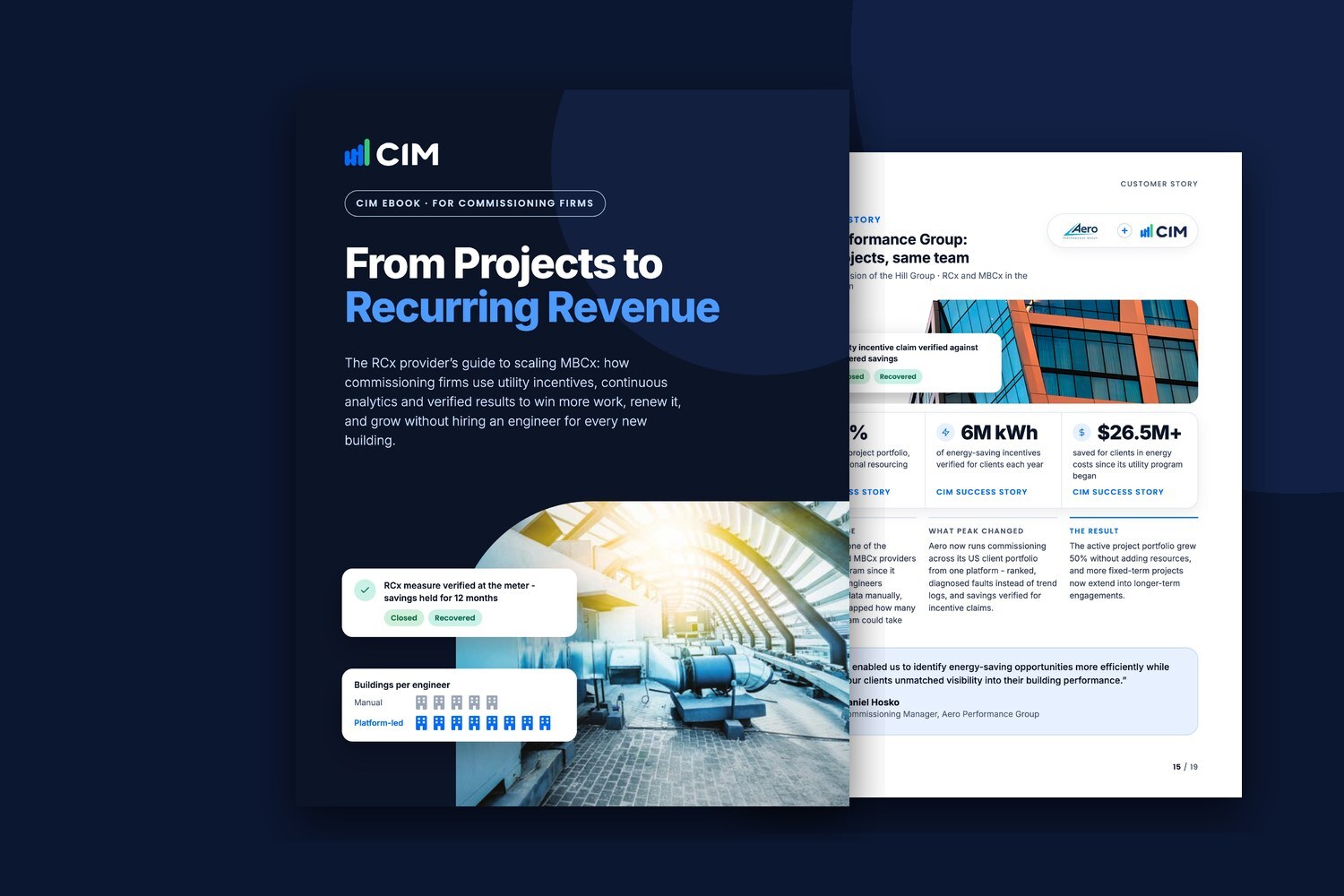
A practical, strategic guide for commissioning firms ready to grow beyond one-off projects. Learn where US utility incentives already pay for RCx and MBCx, what moving from five to eight buildings per engineer is worth, how to sell RCx and MBCx as one engagement and fix the renewal problem, and how to deliver at scale - with a customer story from Aero Performance Group and a 90-day launch plan. Written for principals, directors and commissioning leads at RCx, MBCx, Cx and energy engineering firms.
A new chiller failed at a US high school on the same morning its BAS front-end went dark. PEAK flagged it first thing, and the fix landed before anyone in class noticed.
Read the story →