Buildings rarely perform as designed - and almost never keep performing as commissioned. Control strategies drift, overrides accumulate, sensors fail silently, and the team that inherits the building inherits problems nobody documented. None of it announces itself. The only evidence is on the energy bill, months later, buried in a number nobody can explain.
Monitoring-based commissioning - MBCx, also called ongoing or continuous commissioning - is the discipline built for that reality. It turns commissioning from a handover event into a permanent feedback loop, so the question "is the building still performing?" gets answered every day instead of once.
This guide explains what MBCx actually is, why buildings drift, how it relates to the other systems in your stack, what a real program looks like, what it's worth, and how to evaluate the platforms that support it.
What is monitoring-based commissioning?
Monitoring-based commissioning is the practice of using continuous building data and automated fault detection and diagnostics (FDD) to hold a building at its commissioned level of performance - indefinitely, not just at handover.
Traditional commissioning verifies design intent at a point in time. MBCx starts from the truth about buildings: they change. Occupancy shifts, someone overrides an economy cycle during a heatwave and never removes it, a temperature sensor drifts out of calibration and takes a chiller schedule with it. Each change is small and reasonable. Together they compound.
The distinction is simple to state and profound in practice:
Traditional commissioning is a project. MBCx is a program. A project ends; a program answers, every month, the question a project can't: is the building still performing?
MBCx vs retro-commissioning
Retro-commissioning (RCx) is a one-time project that brings an existing building back to optimal performance - find the accumulated faults, fix them, re-baseline. MBCx is what stops the building sliding straight back.
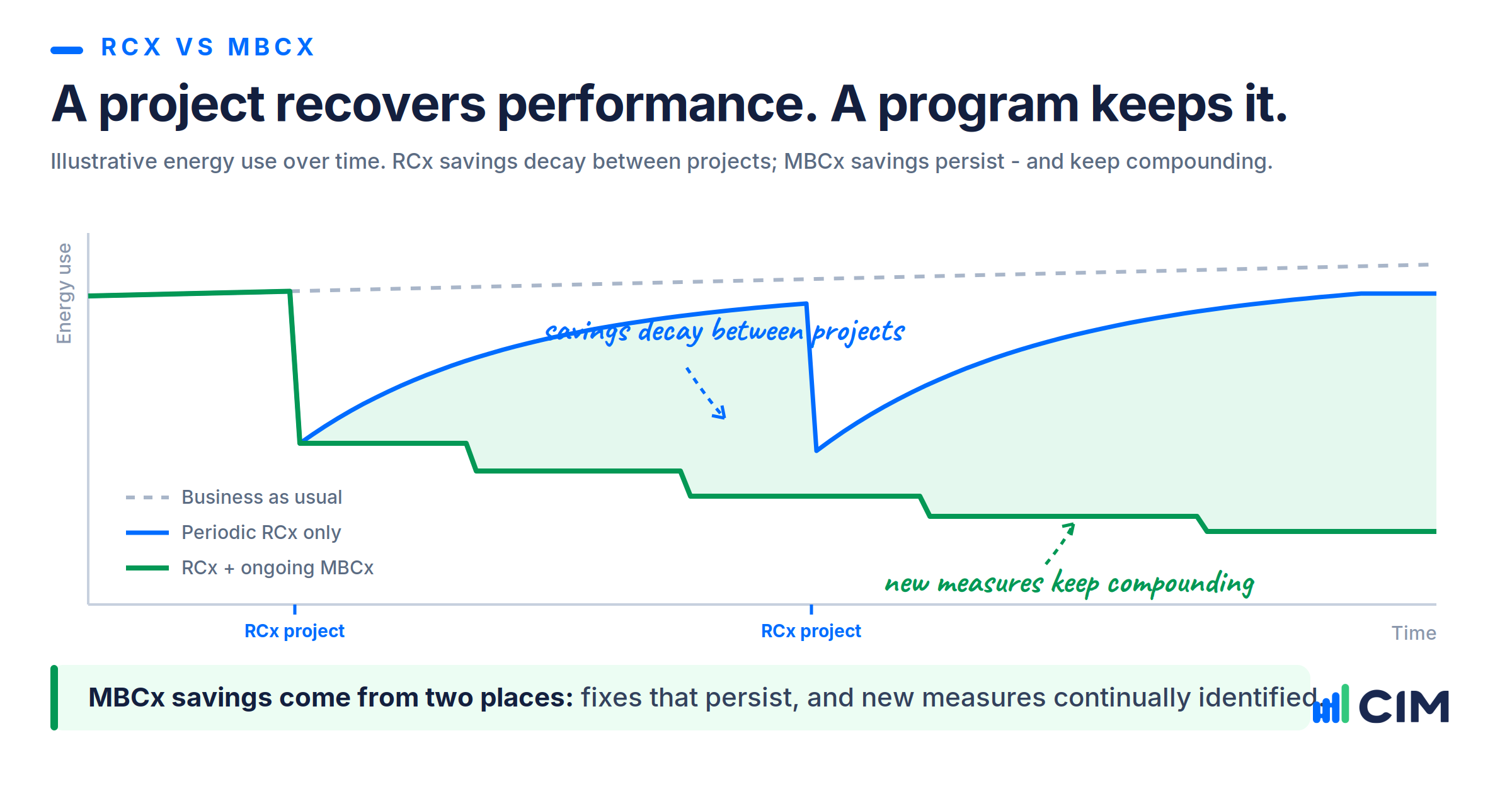
The two work best in sequence: RCx recovers the performance, MBCx holds it. Many firms now deliver them as a single continuous engagement, which is quietly reshaping how commissioning services get bought - from projects to retainers. For the practitioner's version of this discussion, our webinar on how FDD improves RCx and MBCx outcomes brings together Aero Performance Group, the Smart Buildings Academy and CIM on exactly this shift.
Why buildings drift
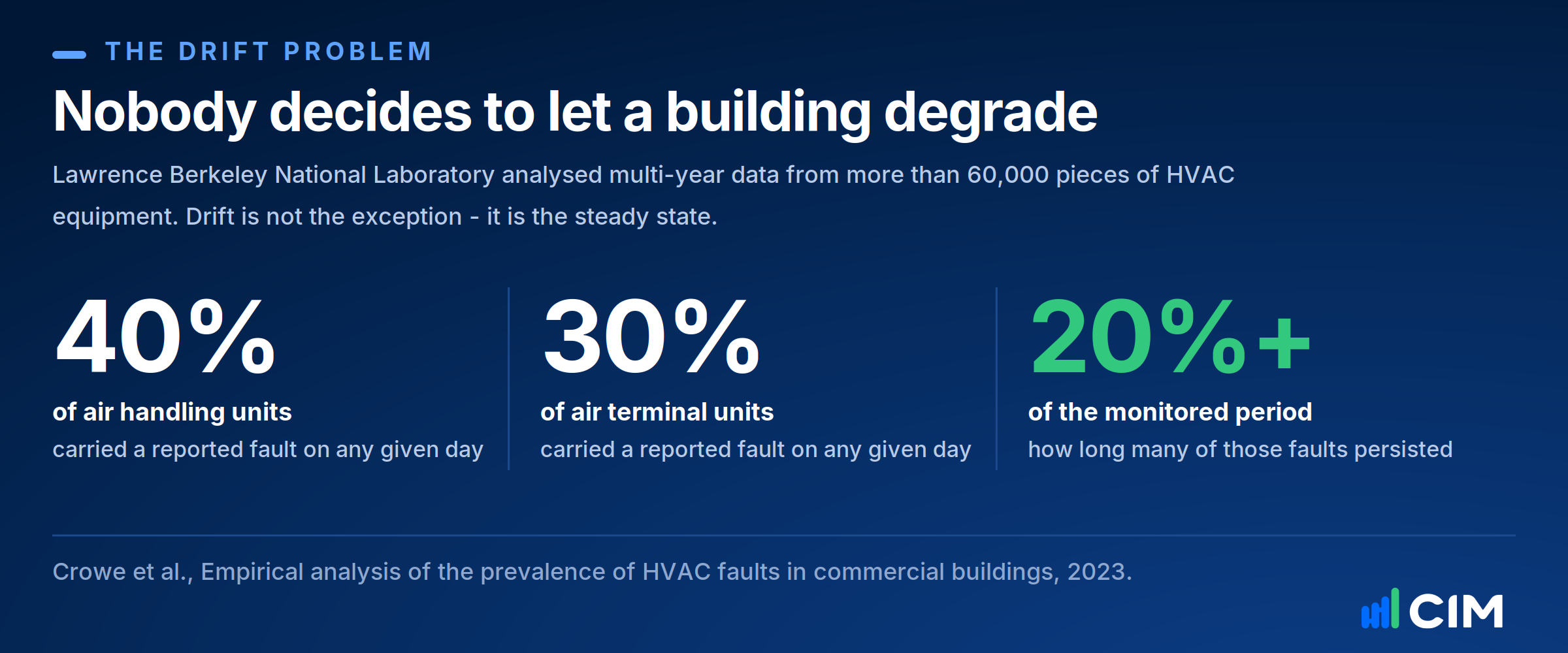
Nobody decides to let a building degrade. It happens one small decision at a time - a manual override during a complaint, a belt that stretches, a damper actuator that sticks at 80% and reads fine from the front end. Because the losses arrive gradually, monthly utility bills never show a step change worth investigating.
The evidence on how far this goes is now solid. Researchers at Lawrence Berkeley National Laboratory analysed multi-year monitoring data from more than 60,000 pieces of HVAC equipment and found that on any given day, 40% of air handling units and 30% of air terminal units were carrying a reported fault - many persisting for more than a fifth of the monitored period (Crowe et al., 2023). Not catastrophic failures: the quiet kind that waste energy, erode comfort and shorten equipment life without ever tripping an alarm.
Drift is especially dangerous for rated buildings. A NABERS 5-star asset doesn't announce that it's become a 4.5-star asset - it just quietly is one, and the owner finds out at the next assessment, after a year of underperformance is already priced into the energy bills. One example from CIM's own portfolio makes the pattern concrete: real-time anomaly detection that stopped an 8% energy drift caused by manual overrides before it took hold - a fault no alarm would ever have raised.
The alternative to catching drift early is reactive maintenance, and its costs go well beyond the repair bill: emergency call-outs at premium rates, equipment running degraded for months before failing outright, comfort complaints that damage tenant relationships, and an operations team permanently in firefighting mode.
How MBCx relates to other building technologies
MBCx is a program, not a product - and it sits on top of several systems that are often confused with it.
FDD. Fault detection and diagnostics is the engine that makes MBCx continuous rather than periodic. FDD finds and diagnoses individual faults; MBCx is the ongoing program - ownership, workflow, verification, review - built around that engine. You can run FDD without an MBCx program (many do, and get a dashboard nobody actions). You cannot run MBCx without FDD.
BMS / BAS. The building management system is the control layer: it runs the building and holds the data. Its job is control, not self-analysis. BMS alarms tell you something has broken; MBCx tells you something is wrong even though nothing has broken - which is also why MBCx reduces rather than adds to alarm fatigue.
CMMS and maintenance software. The work management layer tracks work orders and maintenance history. MBCx generates the evidence for the work order and verifies its outcome; the maintenance system manages its execution. The integration between the two is where much of the practical value sits.
Predictive maintenance. Forecasts when an asset will fail so it can be serviced beforehand. MBCx focuses on what is wrong now - and the same monitoring infrastructure feeds both.
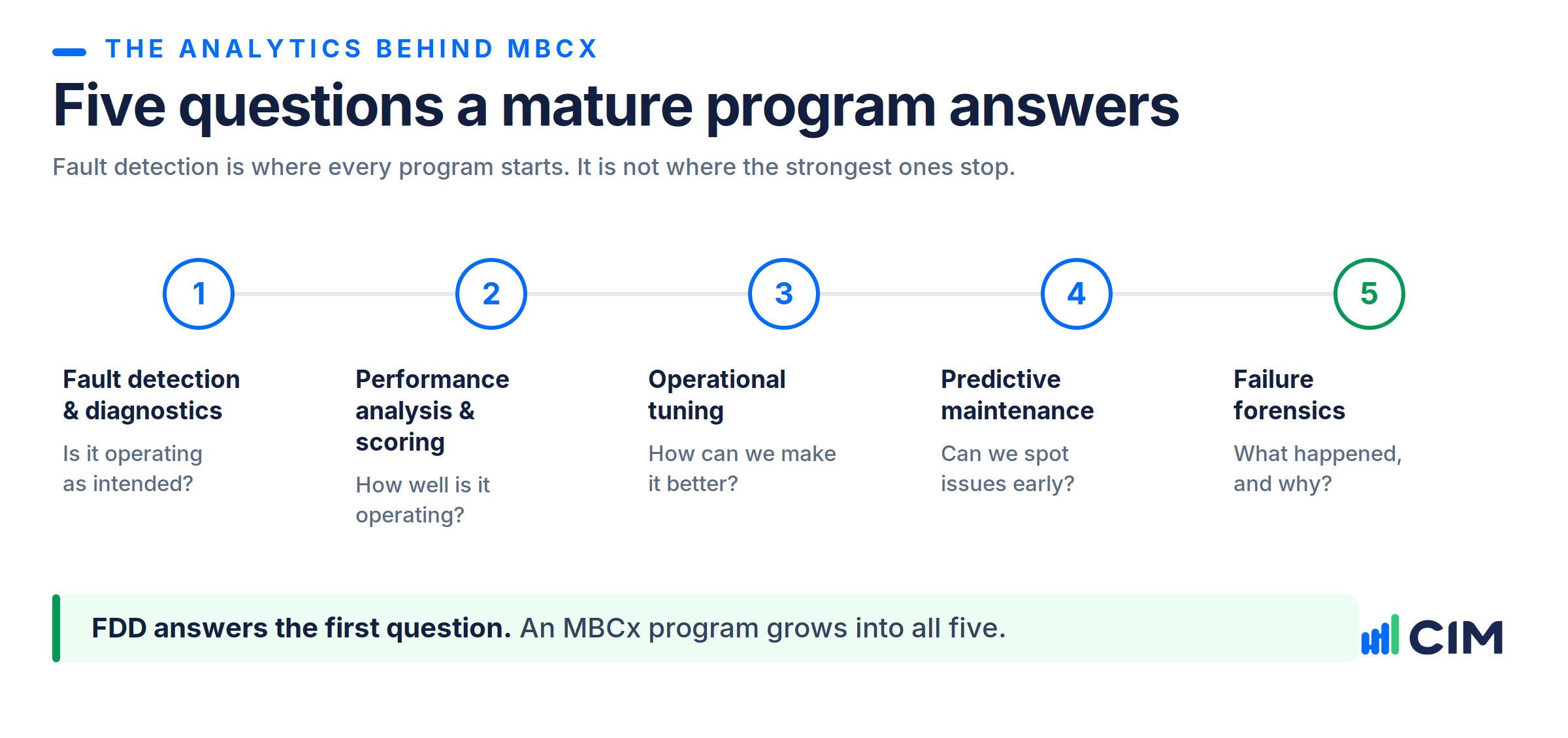
One way practitioners frame the analytics behind a mature program is as five questions, asked in rising order of ambition: is it operating as intended, how well is it operating, how can we make it better, can we spot issues early, and what happened when something went wrong. Fault detection answers the first. A program that lasts grows into all five.
The three components of a real MBCx program
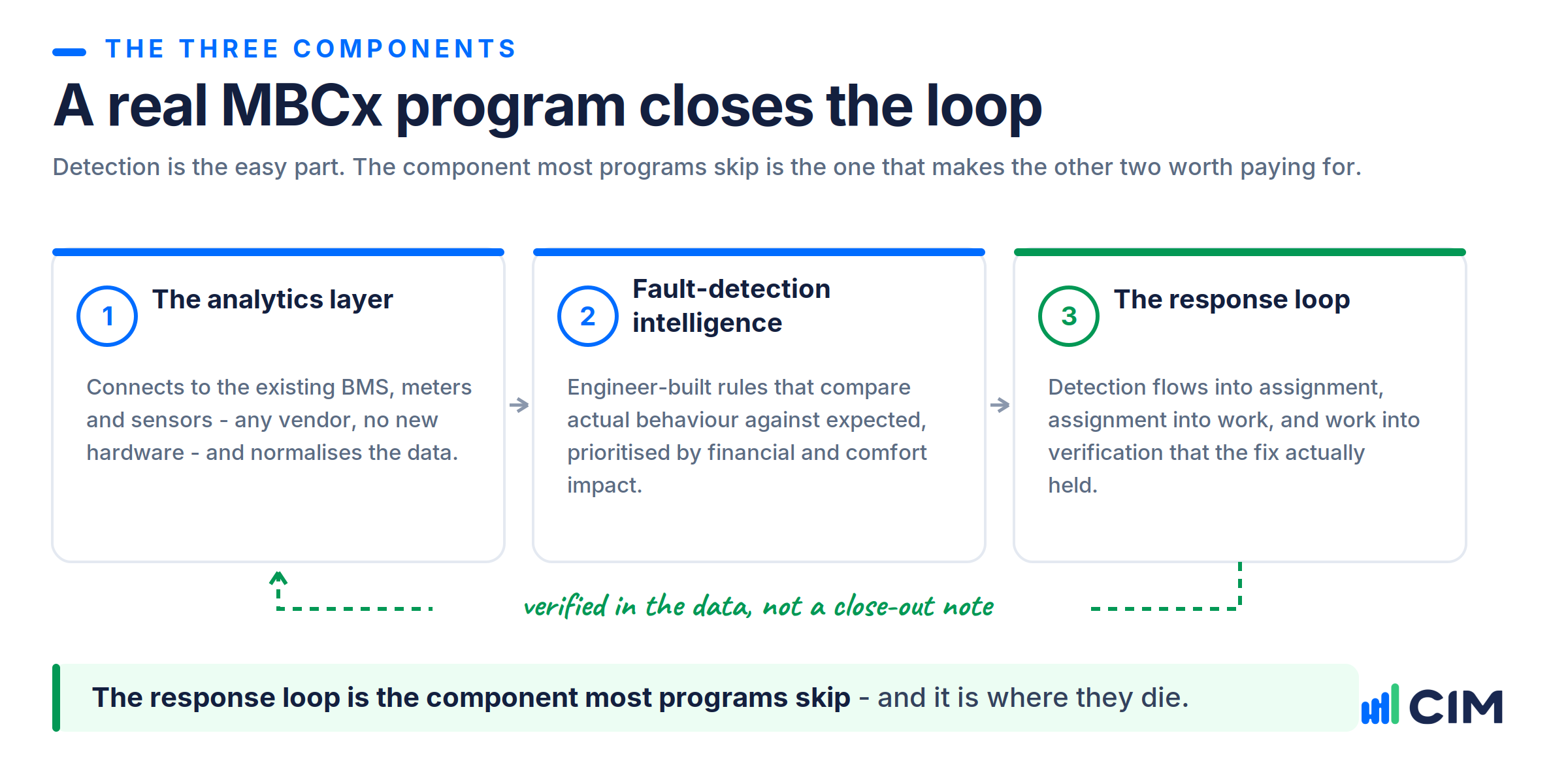
1. The analytics layer. A platform that connects to the existing BMS (whoever made it), utility meters and any additional sensors, normalises that data, and runs FDD rules against it continuously. The critical requirement is BMS-agnosticism and no forced capital works - an MBCx program that starts with a hardware retrofit is a program that starts next financial year.
2. The fault-detection intelligence. Rules that compare actual behaviour against expected behaviour: chillers running out of hours, simultaneous heating and cooling, economy cycles that never engage, sensors reporting the physically impossible. Quality matters more than quantity - badly tuned rules bury teams in false positives, and a team that has learned to ignore alerts has an expensive screensaver, not a commissioning program. Rules built and tuned by mechanical engineers, prioritised by financial and comfort impact, are what separate signal from noise.
3. The response loop. Detection has to flow into assignment, assignment into work, and work into verification that the fix actually held - timestamped, in the data, not in a contractor's close-out note. Without that last step, MBCx degenerates into a monthly PDF of findings that nobody actions, which is just traditional commissioning's report, delivered more often.
That verification step is also what makes commissioning honest. Commissioning has always been an independence discipline - the party verifying performance shouldn't be the party whose work is being verified. A contractor closing out their own faults in their own system is marking their own homework. An independent monitoring layer referees the loop for everyone: the owner sees verified outcomes, and good contractors get data that proves their work rather than assertions about it.
What an MBCx program actually finds
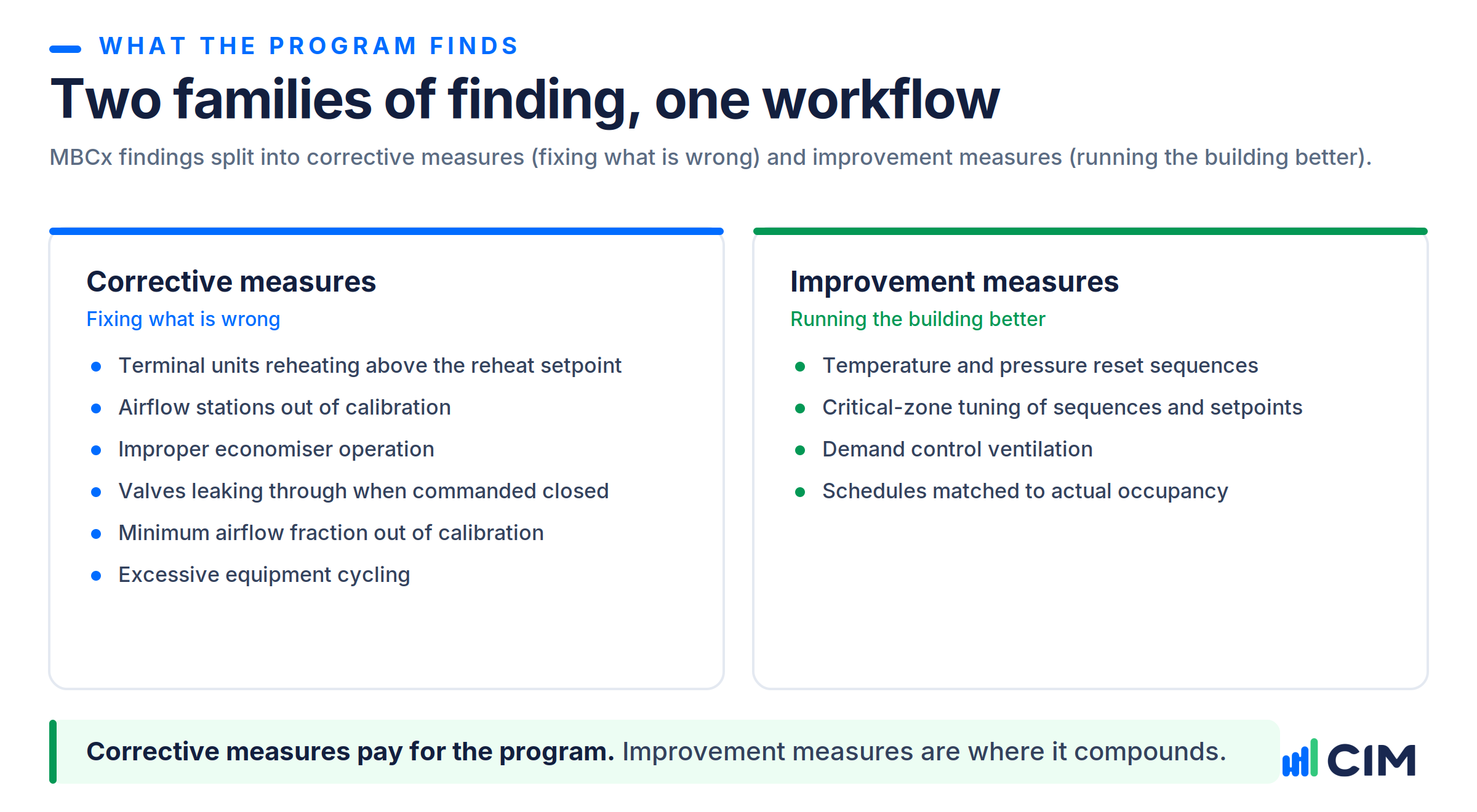
Findings from a running program split into two families, and mature programs deliver both.
Corrective measures fix what is wrong: terminal units reheating above the reheat setpoint, airflow stations out of calibration, improper economiser operation, valves leaking through when commanded closed, minimum airflow fractions out of calibration, excessive cycling. These are the faults behind the LBNL prevalence numbers, and they are where the early savings come from.
Improvement measures make a building run better than it did on day one: temperature and pressure reset sequences, identifying critical zones and using them to tune sequences and setpoints, demand control ventilation, schedules matched to actual occupancy. They tend to arrive later, once the corrective backlog is under control - and they are why a good program is still finding value in year three.
What MBCx is worth
The best available benchmark comes from a Lawrence Berkeley National Laboratory study published in Building and Environment (Lin, Kramer & Granderson, 2020), which surveyed 26 organisations running fault detection across 550 buildings totalling 97 million square feet. Those users achieved median energy savings of 8%, with results varying widely by how well-optimised the building was to start.
Energy is the easiest benefit to quantify, but rarely the only one that matters:
Rating protection. Operational ratings such as NABERS are calculated from measured consumption, so drift caught in week two rather than at the annual assessment is rating points preserved - tracked continuously rather than discovered retrospectively.
Maintenance efficiency. Technicians arrive knowing what's wrong instead of diagnosing on site, and faults are addressed while they're cheap - in a scheduled window, not an emergency call-out.
Asset life. Short cycling, hunting and running outside design conditions all shorten equipment life. Removing them defers capital replacement - and equipment that keeps flagging is telling you something about its remaining life, turning replacement debates into evidence.
Contractor accountability. Continuous monitoring makes it visible whether work was completed and whether it worked. For good contractors that's an upgrade, not a threat: verified performance data proves the value of their work in a way a service report never could.
From recommendation to expectation
Ongoing commissioning is steadily moving from good practice into frameworks and obligations. Green building rating systems including LEED offer credits for ongoing commissioning and monitoring-based approaches. Operational rating schemes like NABERS, and disclosure and performance regimes emerging across the US, UK and Australia, all measure buildings on how they actually run - which is a measurement MBCx exists to manage. The direction of travel matches what's happening in FDD requirements more broadly: continuous performance verification is becoming the expectation, not the differentiator.
Implementing MBCx: six steps
1. Define goals and scope. Energy intensity, NABERS protection, comfort complaint reduction, maintenance cost - pick the metric that matters and let it drive which assets go first. Buildings with known issues, high energy intensity or an approaching rating assessment are natural starting points.
2. Baseline current performance. Document how systems actually run today - not design intent, reality. The baseline isn't a target; it's the reference that makes both improvement and drift measurable.
3. Integrate the data. Connect BMS points, meters and weather feeds into one normalised dataset. This is where timelines blow out on most platforms - months of manual point-mapping. Modern ML-assisted tagging compresses it to weeks; ask any vendor for their median contract-to-live time and treat evasion as data.
4. Tune the fault detection. Thresholds calibrated to the actual building, not the design manual. The same rule needs different tuning in a Brisbane shopping centre and a Melbourne office tower, and the first month of tuning determines whether the team trusts the system in month six.
5. Establish the response process. Who triages alerts, who assigns, how contractors receive and close work, what the escalation path is, and how fixes are verified in the data. Write it down; train everyone. Consistency beats heroics.
6. Review and compound. Monthly or quarterly reviews of open faults, resolution rates and performance trends, with findings fed into capital planning and contractor reviews.
Common failure modes
Messy data. Point names that match no documentation, uncalibrated sensors, gaps when systems drop offline. Fix it systematically at onboarding - validate the critical points first - rather than discovering it fault by fault.
Alert fatigue. Start with high-impact rules only, tune hard in the first weeks, expand as trust builds. An ignored alert system is worse than none, because it manufactures false confidence.
Nobody owns the list. The most common cause of failure isn't technical. Faults arrive, nobody owns triage, the list grows, people stop looking. Name the owner before go-live.
Skipping verification. Without confirming faults cleared in the data, you cannot distinguish a working program from an ignored one - and savings claims rest on assumption.
Organisational resistance. Contractors fear the accountability; site staff fear the implication. The honest answer is that the data helps good operators and exposes only the other kind - lead with quick wins that make the site team look good, and bring contractors in as participants in the loop, not subjects of it.
Evaluating platforms for MBCx
Five questions do most of the work:
- Can it connect to what exists? Any BMS, no new sensors as a precondition, gaps and messy data handled gracefully.
- Is the fault detection engineered or just relayed? Analysing behaviour the BMS can't see, rules customisable without coding, a credible story on false-positive reduction.
- Do alerts arrive with answers? Cause, impact in dollars or comfort terms, recommended fix, mobile access for the people actually on site.
- Does the loop close? Task assignment, progress tracking, and automated verification that the repair restored normal operation - the feature that separates an MBCx platform from a dashboard.
- Who stands behind it? Qualified engineers who tune rules and interpret the ambiguous cases, or a help desk reading the same screen you are.
Where CIM's PEAK Platform fits
PEAK was built as the continuous layer this guide describes: BMS-agnostic data extraction with no new hardware, onboarding in weeks via ML-assisted tagging, thousands of engineer-built FDD rules tuned per building, and a closed workflow that runs from alert through assignment to verified resolution - with NABERS tracked monthly to decimal precision so drift is caught long before an assessment. Every customer gets a dedicated engineer with mechanical or mechatronic qualifications, and across more than 100 million square feet monitored, assets average 19% energy savings - savings that persist precisely because the monitoring does.
It's also how commissioning firms themselves deliver MBCx at scale. Aero Performance Group, an Illinois RCx and MBCx leader, runs its client portfolio on PEAK - growing active projects 50% without adding an engineer and winning their utility's Top Performer award for most kWh saved three years running. For owners, that's the model working; for commissioning providers, it's the build-versus-buy answer - and you can hear Aero's commissioning manager talk through how FDD changed their RCx and MBCx delivery in our joint webinar.
The bottom line
Drift is not the exception in commercial buildings; it is the steady state. With 40% of air handling units carrying a fault on any given day, the question for most owners isn't whether their buildings have drifted from their commissioned state - it's whether anyone would know.
MBCx makes that knowable, and the economics are unusually clear: a median 8% energy saving against a modest operating cost, plus rating protection, asset life and comfort benefits that are harder to price but easy to feel. The programs that work share one trait: they close the loop - from data to fault to fix to proof. The ones that don't produce very sophisticated descriptions of problems nobody solved.
See what a closed loop looks like on your portfolio
PEAK runs the loop this guide describes - from detection through to the verified fix. If you're a commissioning firm weighing build versus buy, the partner team is the right door.
Watch a PEAK demoTalk to our partner teamFAQs about monitoring-based commissioning
What's the difference between MBCx and retro-commissioning?
RCx is a one-time project that restores an existing building to optimal performance; MBCx is the ongoing program that keeps it there. RCx fixes accumulated problems, MBCx catches new ones as they develop. The strongest results come from running RCx first and MBCx permanently after.
What's the difference between MBCx and FDD?
FDD is the software capability - finding and diagnosing faults automatically. MBCx is the program built around it: ownership, response workflow, verification and review. FDD without MBCx is a list nobody works; MBCx without FDD isn't possible. Our complete guide to FDD covers the engine in depth.
How long does implementation take?
With ML-assisted point tagging and no new hardware, initial onboarding now takes weeks rather than months, with first fault-detection rules live within about 30 days of starting integration. Full tuning and workflow bedding-in typically takes a few months more.
Does MBCx require new sensors?
Usually not. Modern platforms extract from the existing BMS, meters and sensor networks. Targeted sensor additions can sharpen specific monitoring later, but they're an optimisation, not a prerequisite.
What ROI should operations teams expect?
The best benchmark, from Lawrence Berkeley National Laboratory's survey of 550 buildings, is a median 8% whole-building energy saving, with results varying by how well-optimised the building was to start. Further returns come from avoided emergency repairs, extended equipment life and protected sustainability ratings.
Which buildings benefit most?
Anything with complex HVAC - offices, retail centres, hotels, hospitals, airports, universities. The strongest paybacks come in buildings with high energy intensity, ambitious rating targets, or a history of comfort complaints.
How does MBCx change the contractor relationship?
Work shifts from calendar-based inspections to condition-based responses to specific, evidenced faults - and resolution becomes measurable. For good contractors that's an upgrade, not a threat: verified performance data proves the value of their work in a way a service report never could.
.avif)
Unlock the power of building analytics. Discover how data-driven insights can optimize building performance, reduce costs, and improve sustainability.
Real-time detection flagged manual overrides instantly, preventing wasted energy and stopping an 8% energy spike before it took hold.
Read the story →