Commissioning comes in several forms, and the acronyms do not help. Cx, RCx, ReCx, EBCx, MBCx and continuous commissioning all describe ways of making a building's systems work as they should, but they apply at different points in a building's life, cost different amounts and deliver savings that last for very different lengths of time.
This guide compares them side by side: what each type is, when it applies, what it costs and saves according to the largest published study, how they relate to each other, and which one a US commercial building actually needs.
Key takeaways
- Commissioning (Cx) is for new buildings. Retro-commissioning (RCx), re-commissioning (ReCx) and monitoring-based commissioning (MBCx) are for existing ones.
- RCx and ReCx are projects; MBCx is continuous. Projects recover performance at a point in time. MBCx keeps checking and verifies that fixes hold.
- Existing-building commissioning is cheap and pays back fast. Lawrence Berkeley National Laboratory (LBNL) found a median cost of $0.26 per square foot and a median payback of 1.7 years.
- Monitoring makes savings stick. In LBNL's data, MBCx utility programs achieved median savings of 9%, against 5% for standard utility commissioning programs.
- Most existing buildings need RCx first and MBCx after it, particularly where incentives, performance standards or contracts require proof.
What are the main types of building commissioning?
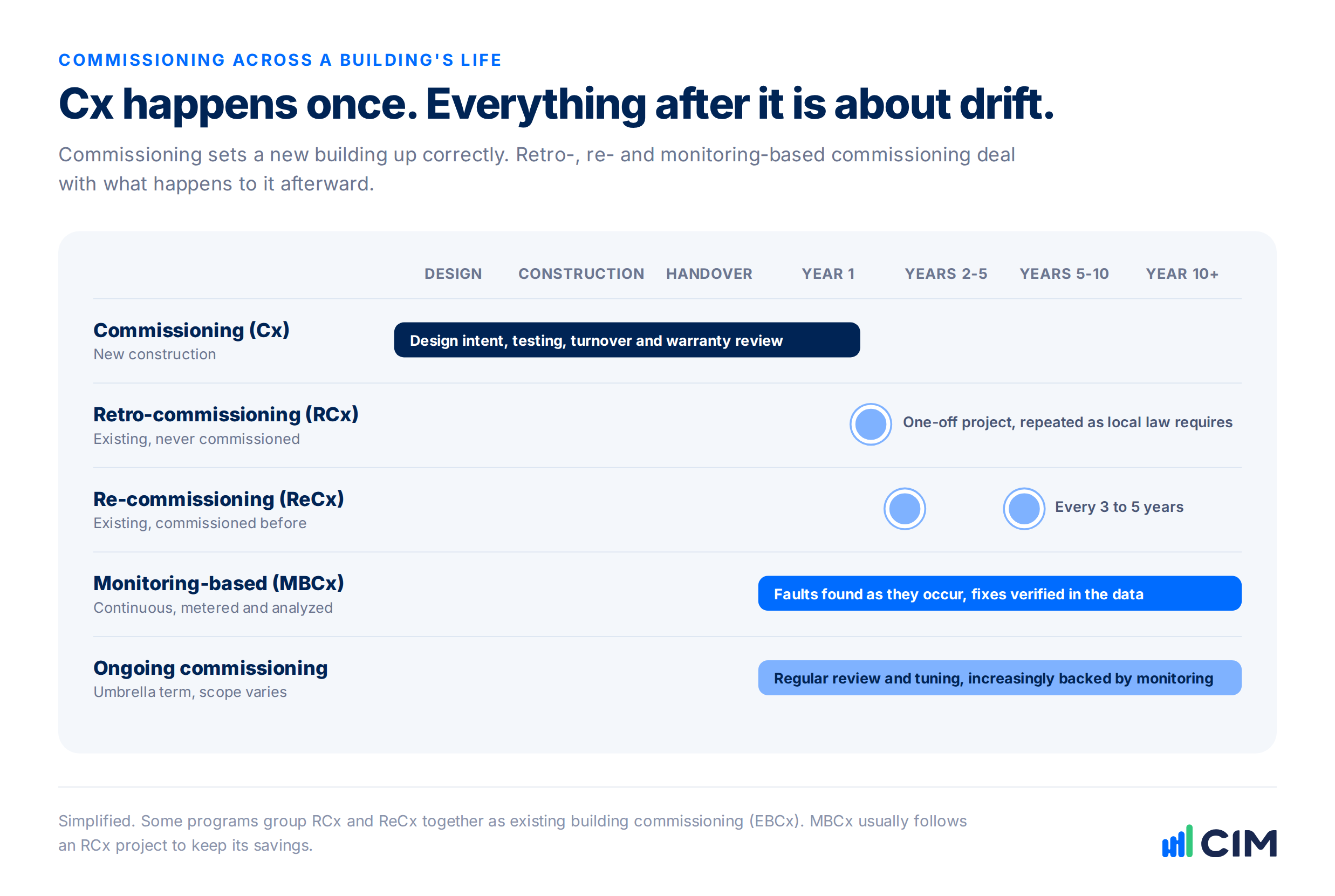
The main types are commissioning (Cx) for new construction, retro-commissioning (RCx) for existing buildings never commissioned, re-commissioning (ReCx) for existing buildings commissioned before, and monitoring-based commissioning (MBCx), which uses permanent metering and analytics to keep performance in place continuously. Ongoing commissioning is the umbrella term for continuous approaches.
Scroll sideways to compare all four types.
| Compared | CxCommissioning | RCxRetro-commissioning | ReCxRe-commissioning | MBCxMonitoring-based commissioning |
|---|---|---|---|---|
| Applies to | New build or major renovation | Existing, never commissioned | Existing, commissioned before | Existing, usually after RCx |
| When | Design to end of warranty | One-off project | Every 3 to 5 years | Continuous |
| How issues are found | Design review and functional tests | On-site investigation and short-term trends | As RCx, against the original Cx record | Permanent metering and FDD analytics |
| Median cost | $0.82/sq ft | $0.26/sq ft* | $0.26/sq ft* | RCx cost plus software and analyst time |
| Median savings | Not usually measured | 5% to 14%* | 5% to 14%* | 9% in MBCx programs |
| Do savings last? | Drift starts at handover | Fade without monitoring | Fade without monitoring | Yes, fixes verified continuously |
Medians from LBNL's analysis of 1,500 North American buildings (Crowe et al., 2020). *LBNL reports RCx and ReCx together as existing building commissioning. Savings range from 5% in utility programs to 14% outside them. Ongoing commissioning, the umbrella term for continuous approaches, is covered below.
What is the difference between commissioning and retro-commissioning?
Commissioning (Cx) is a quality process for new buildings that checks systems are designed, installed and tested to meet the owner's requirements, from design through the warranty period. Retro-commissioning (RCx) applies to an existing building that was never commissioned, and tunes its systems for how the building is used today.
Cx is defined by standards such as ASHRAE Standard 202 and ASHRAE Guideline 0, and is led by a commissioning authority who documents the owner's project requirements, reviews the design, witnesses functional testing and hands over a systems manual. RCx starts from a working building instead: it investigates how systems actually behave, finds the operational problems and fixes them, usually without new equipment. Our guides to building commissioning and HVAC commissioning cover Cx in detail, and our guide to retro-commissioning covers the RCx process step by step.
What is the difference between retro-commissioning and re-commissioning?
Retro-commissioning applies to an existing building that was never commissioned. Re-commissioning applies to an existing building that was commissioned before and has since drifted. The process is largely the same, which is why many programs group both as existing building commissioning (EBCx).
The US Department of Energy draws the distinction in its EISA section 432 guidance. In practice the difference is the starting point: a re-commissioning provider can compare current operation with the original commissioning record, while a retro-commissioning provider usually has to reconstruct what the systems were meant to do.
What is the difference between RCx and MBCx?
RCx is a project that finds and fixes problems at a point in time. MBCx uses permanent metering and analytics to find problems as they occur, verify that fixes hold and account for savings from measured data. RCx recovers performance; MBCx keeps it, and usually follows an RCx project.
LBNL's foundational benchmarking study of 24 MBCx projects described MBCx as combining three things: permanent energy information and diagnostic tools at whole-building and system level, retro-commissioning based on what those tools reveal, and ongoing commissioning with measurement-based savings accounting. The approach grew out of a problem with one-off RCx. An ACEEE paper on the evolution of MBCx cites research from the early 2000s showing around 35% of RCx savings lost over time when nobody kept watching.
| Compared | RCxRetro-commissioning | MBCxMonitoring-based commissioning |
|---|---|---|
| Format | Project with a start and end | Continuous program or retainer |
| Data | Short-term trending during the investigation | Permanent metering and BMS trend data |
| How problems are found | Investigation by the provider | Automated fault detection, reviewed by engineers |
| Verification | Post-implementation check | Continuous: fixes confirmed in the data and reopened if faults return |
| Savings over time | Fade as settings drift back | Held, with new measures added as the program runs |
| Median savings in utility programs | 5% (standard commissioning programs) | 9% (MBCx programs) |
Utility program medians from LBNL (Crowe et al., 2020).
For the full picture of MBCx, including software, US utility programs and how engineering firms deliver it, see our complete guide to monitoring-based commissioning.
Is MBCx the same as ongoing or continuous commissioning?
Not quite. Ongoing commissioning is the umbrella term for any continuous approach. Continuous Commissioning® is a specific process registered as a trademark by Texas A&M's Energy Systems Laboratory. MBCx is the version driven by permanent metering and analytics. Many utilities use MBCx and ongoing commissioning interchangeably.
The Tennessee Valley Authority's EnergyRight commissioning program, for example, describes monitoring-based commissioning as also known as ongoing commissioning. The Texas A&M Energy Systems Laboratory describes its Continuous Commissioning process as an ongoing process to resolve operating problems, improve comfort and optimize energy use, and licenses it to engineering firms. Because that name is a registered trademark, this guide uses ongoing commissioning as the generic term.
How much does each type of commissioning cost and save?
LBNL's analysis of 1,500 buildings found median costs of $0.26 per square foot for existing buildings and $0.82 per square foot for new construction, with a median payback of 1.7 years for existing buildings. Median existing-building savings ranged from 5% in utility programs to 14% outside them, with MBCx programs at 9%.
Source: LBNL, Crowe et al., 2020 (1,500 buildings, 2018 data). Earlier benchmark, LBNL 2009 (2009 dollars): existing buildings $0.30 per sq ft, 16% savings, 1.1-year payback; new construction $1.16 per sq ft, 13% savings, 4.2-year payback.
LBNL notes that energy savings are rarely estimated for new construction commissioning, because its value lies mostly in problems avoided. Its 2009 study found that first-cost savings, such as right-sized heating and cooling equipment, cut the net median cost of commissioning substantially. For existing buildings the case is simpler: at the median cost, commissioning a 100,000 sq ft office costs around $26,000. Our RCx guide and MBCx guide break down costs in more detail.
Which commissioning approach does a US building need?
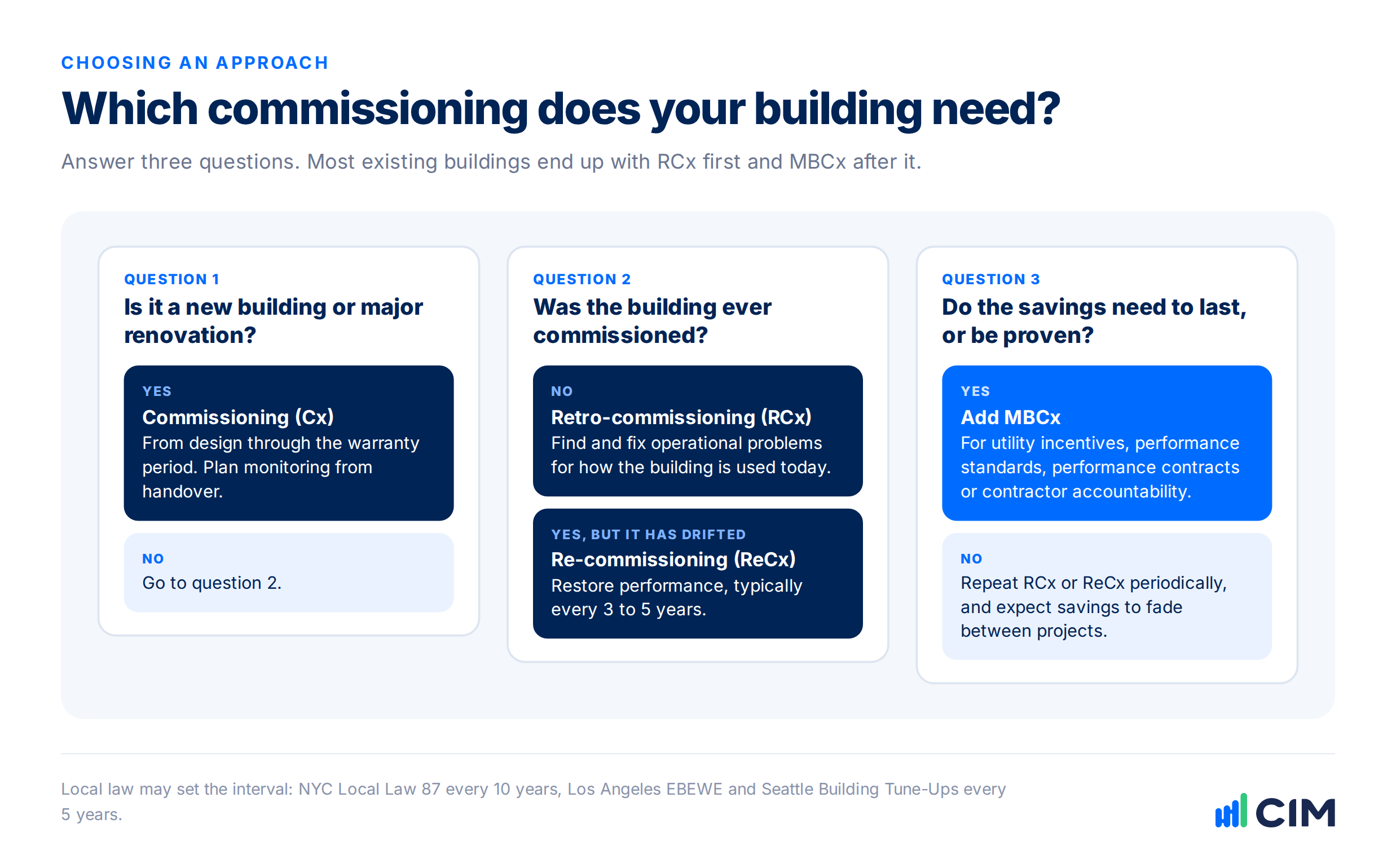
New buildings need commissioning (Cx). Existing buildings that were never commissioned need retro-commissioning (RCx), and those that were commissioned but have drifted need re-commissioning (ReCx). Where savings must last or be proven, for incentives, performance standards or contracts, add monitoring-based commissioning (MBCx) after the project.
In many US cities the decision is partly made by law:
| Requirement | What it asks for | Interval |
|---|---|---|
| New York City Local Law 87 | Energy audit and retro-commissioning for buildings over 50,000 sq ft | Every 10 years |
| Los Angeles EBEWE | Energy audits and retro-commissioning for covered non-residential buildings | Every 5 years |
| Seattle Building Tune-Ups | Tune-up for non-residential buildings of 50,000 sq ft or more; completed RCx and ongoing commissioning can count as alternative compliance | Every 5 years |
| US federal facilities, EISA section 432 | Comprehensive energy and water evaluations, with recommissioning and retro-commissioning measures implemented | Every 4 years |
Building performance standards such as NYC Local Law 97 and Boston's BERDO go further: they set limits a building must meet every year from measured data, which favors approaches that keep performance in place rather than restore it every few years. LEED also recognizes the difference, with monitoring-based commissioning available as a path within its Enhanced Commissioning credit.
How do RCx and MBCx work together?
RCx clears the backlog of existing problems; MBCx stops the building drifting back and finds new problems as they appear. Many US utility programs are built around that sequence, funding an RCx project first and MBCx afterward, and some require a recent RCx before they will support MBCx.
Colorado's Efficiency Works Building Tune-Up program offers retro-commissioning and MBCx as separate pathways and positions MBCx as the way to sustain and deepen RCx savings. TVA's EnergyRight program lets some projects qualify for both RCx and MBCx incentives through separate applications.
The sequence matters because verification is where one-off projects most often fall short. In a CIM sample of closed fault tickets, about 1 in 6 were closed before the building data confirmed the fix, as we explain in how to verify a contractor actually fixed a fault. Continuous monitoring catches those closures, and catches the overrides, schedule changes and drifting sensors that undo an RCx project's work over the following months. Proving the resulting saving is a separate discipline, covered in our guide to measurement and verification.
What software supports each type of commissioning?
Commissioning management software, with checklists, issues logs and test scripts, supports new construction Cx. Trend logging and fault detection and diagnostics (FDD) software support the RCx investigation and are the core of MBCx. Measurement and verification tools quantify the savings. Most programs use more than one.
For RCx and MBCx, the deciding questions are how much of the BMS the software analyzes, how it handles inconsistent point naming, whether it verifies that fixes held, and whether it is independent of the equipment and contractors it is assessing. Our comparison of FDD and building analytics platforms sets out how the main vendors differ, and our building analytics RFP guide provides evaluation questions and a scoring matrix.
Where does CIM's PEAK Platform fit?
CIM's PEAK Platform supports commissioning in existing buildings, not new construction. Commissioning and engineering firms use it to replace most of the manual investigation in RCx with a ranked, diagnosed fault list across every BMS point, to verify each fix in the data, and to carry the same building on as an MBCx service after the project ends.
Aero Performance Group, a Chicago-area RCx and MBCx provider, grew its active project portfolio by 50% without adding resources and now verifies around 6 million kWh of energy-saving incentives a year for its clients; its team explains how in our webinar on how FDD improves RCx and MBCx outcomes. See how PEAK supports retro-commissioning and MBCx work, read how engineering firms run RCx and MBCx on FDD, or find quick answers in the CIM and PEAK FAQ.
Frequently asked questions
What does Cx stand for in building commissioning?
Cx is shorthand for commissioning, the quality process that checks a building's systems are designed, installed, tested and able to operate as the owner requires. Related abbreviations add a prefix: RCx for retro-commissioning, ReCx for re-commissioning, EBCx for existing building commissioning and MBCx for monitoring-based commissioning.
What is the difference between Cx, RCx and MBCx?
Cx applies to new construction, from design through the warranty period. RCx applies to existing buildings that were never commissioned and is a project at a point in time. MBCx applies to existing buildings continuously, using permanent metering and analytics to find problems as they occur and verify that fixes hold.
What is EBCx?
EBCx stands for existing building commissioning. It is an umbrella term that groups retro-commissioning and re-commissioning, because both apply to buildings already in operation and follow largely the same process. Lawrence Berkeley National Laboratory reports cost and savings benchmarks for existing buildings on this combined basis.
Is MBCx the same as continuous commissioning?
Not exactly. Continuous Commissioning is a process registered as a trademark by Texas A&M's Energy Systems Laboratory. Ongoing commissioning is the generic term for continuous approaches, and MBCx is the version driven by permanent metering and analytics. Many utilities use MBCx and ongoing commissioning interchangeably.
Does MBCx replace retro-commissioning?
No. MBCx usually follows retro-commissioning. The RCx project clears the existing backlog of problems, and MBCx then keeps the building from drifting back and finds new issues as they appear. Some utility programs require a recent RCx before they will fund MBCx.
Which is cheaper, RCx or MBCx?
RCx is cheaper up front, at a median of $0.26 per square foot for existing buildings in LBNL's data. MBCx adds software and analyst time, but in LBNL's data MBCx utility programs achieved median savings of 9% against 5% for standard utility commissioning programs, and its savings are designed to persist rather than fade.
How often should a building be recommissioned?
A common rule of thumb is every three to five years, or sooner after a change of use or major tenant turnover. Some US jurisdictions set the interval by law, such as every ten years in New York City and every five years in Los Angeles and Seattle. MBCx makes the process continuous instead of periodic.
Does LEED require monitoring-based commissioning?
LEED does not require MBCx, but it rewards it. Fundamental commissioning is a prerequisite for LEED certification, and monitoring-based commissioning is available as a path within the Enhanced Commissioning credit, alongside enhanced systems commissioning and envelope commissioning.
Who performs monitoring-based commissioning?
MBCx is usually delivered by a commissioning provider or engineering firm that reviews analytics output, diagnoses root causes and works with the building's operators and contractors to fix problems. Some owners with in-house engineers run MBCx themselves, using fault detection software to do the continuous analysis.

.avif)