A fault ticket gets closed. The work order says complete, the monthly report counts it as resolved, and the invoice gets paid. Nobody has checked whether the building agrees.
That gap is where contractor accountability in building maintenance usually breaks down. So we took the action tickets closed across CIM's monitored portfolio on the PEAK Platform over the last twelve months, more than 25,000 of them, and compared the closure records with what the building data actually showed. This article sets out what we found, and what a closure you can trust looks like.
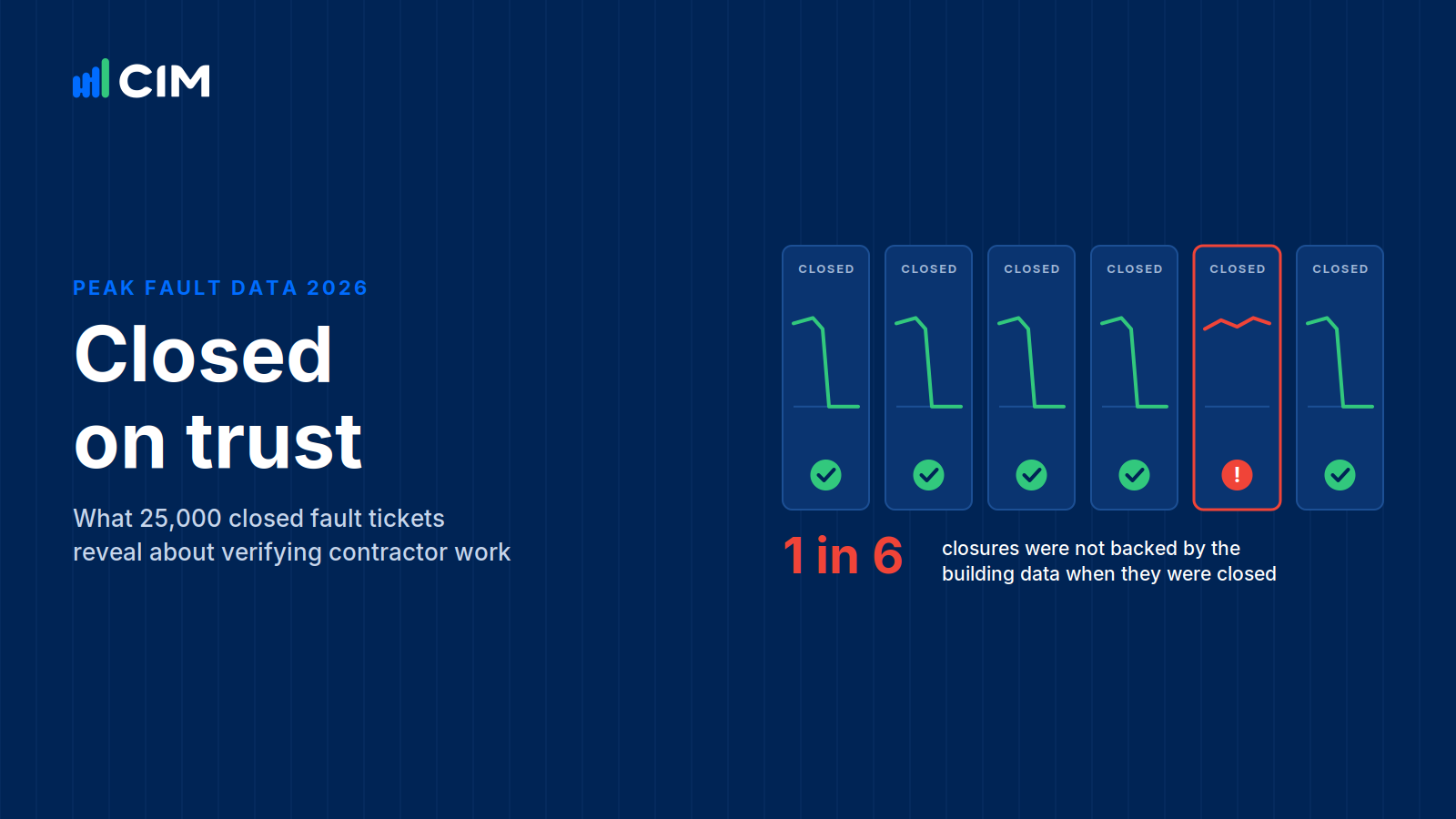
The short answer: you know a contractor has fixed a fault when the building data shows the fault condition has stopped across a full operating cycle, and the ticket holds evidence of what was found and done on site. A self-reported work order on its own is a claim, not proof. In a CIM sample of closed tickets, about 1 in 6 were closed before the data confirmed the fix.
Key findings
- About 1 in 6 fault tickets were closed before the building data showed the fault had cleared, in a CIM sample of 111 closed tickets from across the year. Most of those faults cleared days later. Around 5% of closures were made while the fault was still active, and it never cleared.
- One in three closed tickets has no record of what was done. Of 25,269 action tickets closed across CIM's portfolio in twelve months, 33% carry no note of what was found, what was done or who attended.
- Work order dates and building data disagree. In the same CIM sample, verified fixes were closed a median of about nine days after the fault had already cleared, and more than a quarter over a month later. SLA reports built on ticket dates are measuring paperwork.
- Open work ages quietly. As of September 2026, 56% of the 2,732 open remedial actions across CIM's portfolio had been open for more than 90 days, and 16% for more than a year.
- Some faults are created by the visit itself. About 1 in 25 action tickets raised across CIM's portfolio concerned an override left in place: a point put into hand during a callout and never released.
- Most work is done properly. 77% of sampled closures were fully backed by the data. The problem is not that most faults go unfixed. It is that without independent verification, nobody can tell which closures are sound and which are not.
What is contractor accountability in building maintenance?
Contractor accountability means a maintenance provider is measured on outcomes the building can confirm, rather than on work it reports as done. In practice that requires three things: a clear record of what was found and done, a closure that depends on evidence, and a check by someone other than the party that did the work.
Most maintenance programmes have the first only in part, and the other two not at all. Contractors report through a CMMS, a CAFM system or a spreadsheet, the ticket is closed by the person who attended, and the SLA report counts closures. That is self-reporting, however good the people involved are.
A verified closure is one where the building data confirms the fault condition has stopped before the ticket is closed. Closed-loop fault verification is the process that enforces it: every ticket stays linked to the fault that raised it, and the loop only closes when the data says so.
Why is a closed ticket not evidence?
A work order records a claim: somebody has said the job is done. That claim is usually honest. It is also usually made at the end of a site visit, before the building has run through a full operating cycle, and often by the same party that will be paid for the work.
This is not a new observation. Reviewing earlier research on how retro-commissioning results persist, Lawrence Berkeley National Laboratory summarised a Texas A&M study of ten buildings. About 80% of the savings were still present three to four years after commissioning, but several control fixes had been defeated along the way, and building operators had no feedback on how their actions affected energy use, so they were unaware that performance had changed (Bourassa, Piette and Motegi, 2004).
More recent evidence points the same way. Across the US Department of Energy's Smart Energy Analytics Campaign, covering 104 organisations and 6,500 buildings, users of fault detection software banked a median 9% energy saving, and Lawrence Berkeley National Laboratory noted that building data does not typically lead to corrective action unless it is analysed and prioritised (Kramer et al., 2020). Finding faults is the start. Acting on them, and proving the action worked, is where value is won or lost.
Some funders now build that into their programmes. Seattle City Light's monitoring-based commissioning incentive requires the fault detection software to track resolved faults over time, and asks participants to submit reports showing issues identified and resolved, not only detected.
Continuous fault data is what makes that possible. On the PEAK Platform every action ticket stays linked to the fault condition that raised it, so for every closure we can ask one question: had the fault actually cleared when the ticket was closed?
How often are fault tickets closed before the fault is fixed?
We sampled 111 closed action tickets from three points across the year and checked each one against its underlying fault data.
| What the data showed at closure | Share of closures |
|---|---|
| Fault had already cleared (verified closure) | 77% |
| Fault cleared within hours of closure | 7% |
| Fault cleared more than a day after closure | 11% |
| Fault still active at closure, and still active now | 5% |
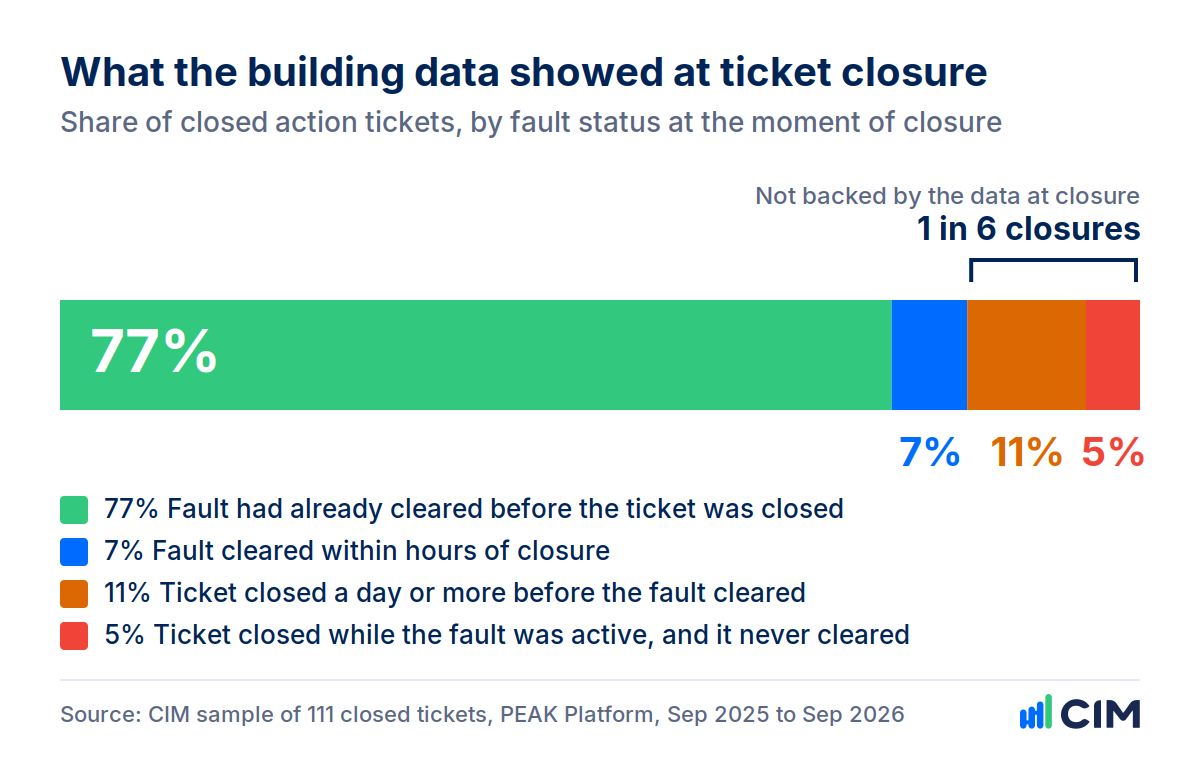
Put simply: 77% of closures were verified, 7% were closed within hours of the fault clearing, 11% were closed more than a day before it cleared, and 5% were closed on faults that never cleared. The first two groups are what good practice looks like.
The third group is the interesting one. These tickets were closed a median of 9.5 days before the fault actually cleared. Most were probably fixed properly in the end. But on the day they were closed, the claim was not supported by any evidence, and if the fix had failed the record would still say resolved.
The fourth group is the one that costs money. One ticket in the sample was closed while its fault had been running continuously for seven months. That fault is still running.
How many closed tickets record what was actually done?
Across the full twelve-month population, not a sample, 33% of closed action tickets on CIM's platform contain no human comment at all. No diagnosis, no reading, no photo, no note of who attended.
A ticket closed without a record cannot be audited, challenged or learned from. If the same fault returns in three months, the next engineer starts from scratch. If a dispute arises over whether the work sat inside the PPM contract or was chargeable remedial work, there is nothing to settle it with. We cover where that boundary sits in costing remedial works from FDD.
Do work order dates show when a fault was actually fixed?
No. In the same sample, where closure was verified, the fault had cleared a median of about nine days before the ticket was closed, and 28% of those tickets were closed more than a month after the building had already been fixed.
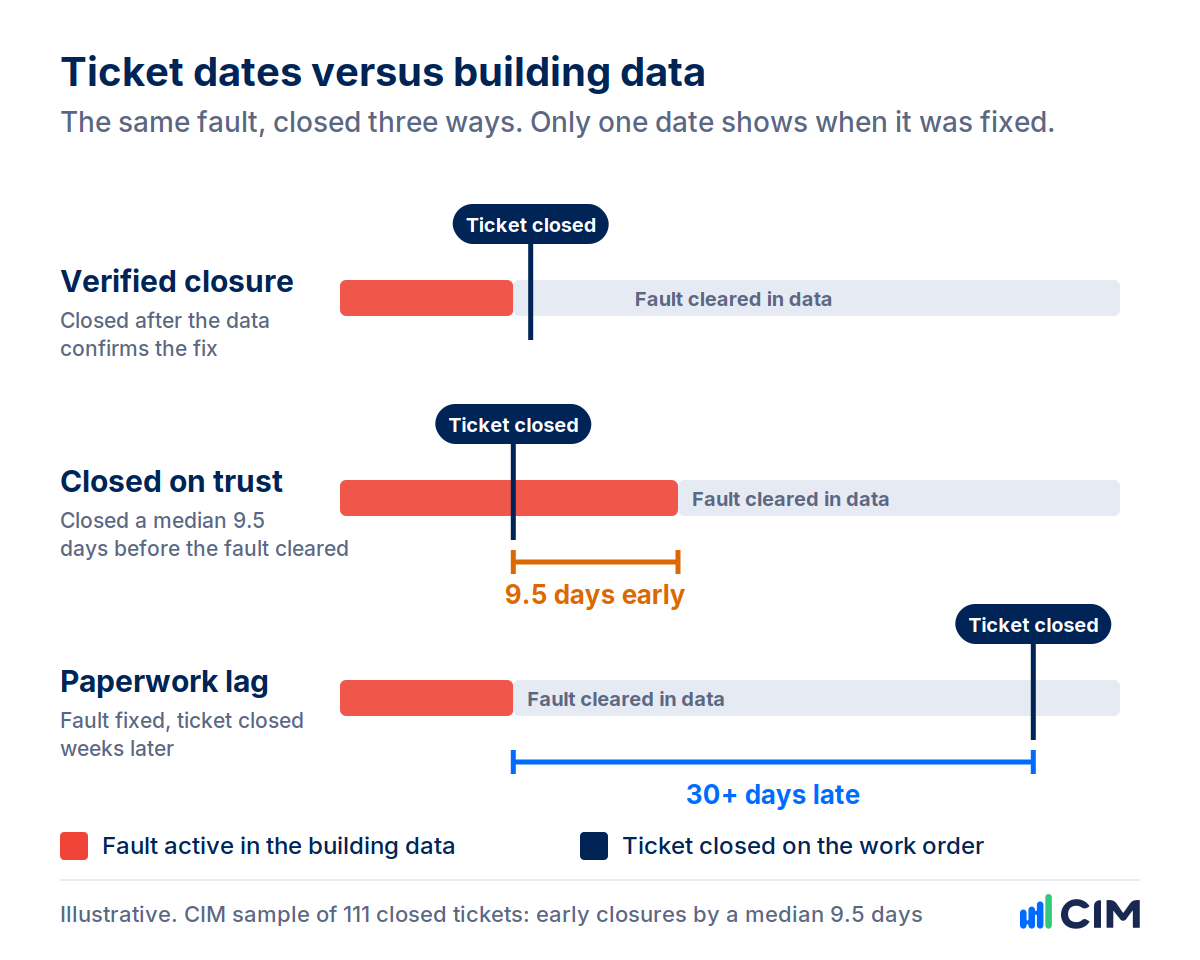
The lag runs in both directions. Some tickets close before the fault clears, as the previous section shows, and many close long after it has. Any contractor performance or SLA report built on work order dates is therefore measuring paperwork, not performance. A contractor who fixed a fault on day two but closed the ticket on day forty looks slow. A contractor who closed a ticket on day one, but whose fix only held on day twelve, looks fast.
The only reliable measure of response time is when the fault condition actually stopped. That comes from the building data, not the ticket.
How long do remedial actions stay open?
As of September 2026 there were 2,732 open action tickets across CIM's portfolio. 56% had been open for more than 90 days, and 16% for more than a year.
Some of that is legitimate. A failed actuator waiting on capital approval should stay open until the money is released. But an open ticket with no owner, no next step and no review date is not a plan. It is deferred maintenance with a reference number.
Which faults are caused by the maintenance visit itself?
Overrides. 1,310 action tickets raised across CIM's portfolio in the last twelve months, about 1 in 25, concerned an override left in place. A point is put into manual control during a callout, a commissioning exercise or a comfort complaint, the immediate problem is solved, and nothing in the process brings the point back to automatic.
These are some of the most expensive faults we see. Individual sites have closed tickets worth A$40,865 a year for fan speed overrides and A$12,300 a year for a single pump drive left overridden on. Detecting them is straightforward, because the BACnet priority array shows whether a person or the control programme is setting a value. Preventing them is a process question: every point placed in override is released before the visit is closed.
Is it acceptable to decide not to fix a fault?
Yes, as long as the decision is recorded. 4% of resolved tickets (1,034) were marked Not Doing, and in most of the cases we sampled the underlying fault was still active.
Not every fault is worth fixing, and a small fault on plant due for replacement next year may not justify the spend. What matters is that the decision is explicit: a reason, an owner and a date to revisit it, rather than a fault that quietly drops out of view.
Is this a contractor problem or a process problem?
It would be easy to read these numbers as a verdict on contractors. We do not think they are.
Most of the engineers and maintenance providers working on our platform do good work, and 77% of closures show exactly that. The gaps above are structural. Closure happens at the end of a site visit, before the building has proven anything. Records are optional. Nobody independent checks the outcome. In almost any other field, the party doing the work is not the party that signs it off. In building maintenance, it routinely is. Nobody should be marking their own homework, and independent verification is how that stops.
For contractors, independent verification is a protection rather than a threat. It gives them proof that their fix held, evidence to settle disputes over scope, and a verified performance record to show clients instead of a list of closed jobs. We have written about this from the partner side in how engineering firms run RCx, MBCx and data-driven maintenance on FDD, and CIM's Partner Program supports engineering and maintenance firms delivering verified remedial works.
What does a verified closure look like?
A closure you can rely on has six parts:
- The fault and the data that raised it. The ticket links to the specific fault condition, not a loose description of it.
- What was found on site. Measurements rather than impressions: the control signal at the actuator, the actual valve stem position, the temperature across the coil. Photos where they help.
- What was done. The repair, parts replaced, setpoints changed, and every point placed in override and then released.
- Who attended, and when.
- Confirmation from the data that the fault has cleared, across a full operating cycle rather than only at the moment of the visit.
- If the fault is not being fixed: the reason, the risk being accepted, who made the decision and when it will be reviewed.
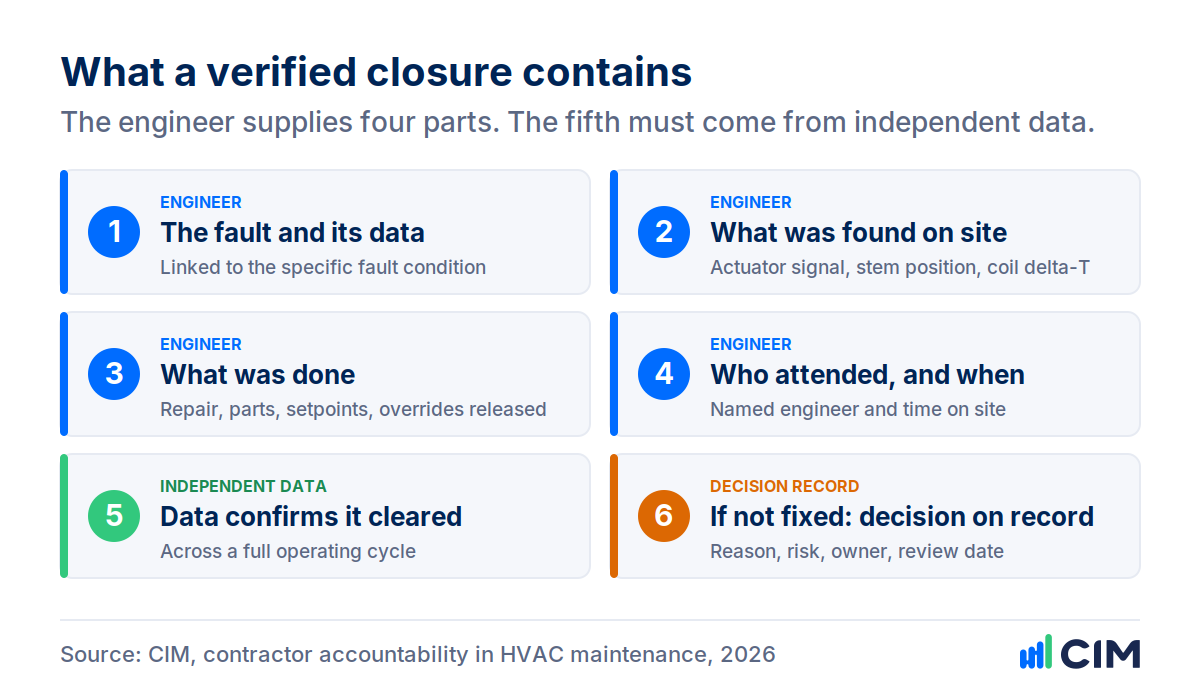
Items one to four come from the engineer. Item five has to come from somewhere else, and that separation is the point of independent building monitoring.
Here is what it looks like in practice. During a first training session at a commercial tower in London, the platform raised a live alert on a fresh air unit: the chilled water valve was commanded shut, but supply air was running more than 3°C below outside air. Two engineers took the alert to the plant room, measured 6.1 VDC at the actuator, confirmed the valve stem was sitting 40% open, and posted the diagnosis and photos into the ticket 98 minutes after the session began. The estimated saving once rectified was £25,053 a year. Every part of that closure record can be audited.
How do you measure contractor performance from building data?
Whether your contractors report through a CMMS, a CAFM system or a spreadsheet, these measures tell you far more than closure counts:
- Time to verified fix: from the fault being raised to the data confirming it has cleared, not to the ticket being closed.
- Verification rate: the share of closures supported by the building data at the moment of closure. In CIM's sample it was 77%.
- Recurrence rate: the share of fixed faults that return within 30 and 90 days.
- Evidence rate: the share of closures carrying site findings and actions.
- Ageing: open actions older than 90 days, by priority, each with a named owner.
- Overrides: overrides placed versus overrides released, per site visit.
None of these depend on anyone's word, which is what makes them useful in an SLA or contract review and fair to a good contractor. They are also the reporting backbone of a monitoring-based commissioning programme and of data-driven maintenance.
Detection is not the finish line
Fault detection and diagnostics is largely a solved problem. As we showed in the most common HVAC faults in commercial buildings, the valuable faults are well understood and the rules that find them are mature. The harder part, and the part the industry underplays, is knowing the fault was actually fixed and stayed fixed.
The building data can do the marking, continuously, for every ticket. For the practical version, our FDD Playbook for building performance engineers covers taking a fault from detection through to verified rectification, and our guide to measurement and verification of energy savings covers how the saving itself is proven.
Frequently asked questions
How do you hold a maintenance contractor accountable for fault fixes?
Hold contractors to outcomes the building data can confirm, not to closed tickets. Link every fault ticket to the data that raised it, require site evidence on closure, and treat a fault as resolved only when the data shows the condition has stopped across a full operating cycle. Report verification rate and time to verified fix rather than ticket counts.
Who should verify a maintenance contractor's work?
Someone other than the party that did the work. Contractor accountability works best when fixes are confirmed independently, by continuous monitoring of the building data, rather than self-reported on a work order. The engineer supplies the site evidence; the data confirms whether the fault actually cleared.
How do you know if a contractor actually fixed an HVAC fault?
Compare the closure with the building data. A fault is fixed when the condition that raised it, such as a valve passing while commanded shut, no longer appears in the data across a full operating cycle. A work order marked complete records a claim that the work was done. The building data confirms or disproves it.
What is closed-loop fault verification?
Closed-loop fault verification means a fault is not treated as resolved until the building data confirms the fault condition has cleared. Each fault ticket stays linked to the data that raised it, so closure depends on evidence rather than on a report that the work was done.
How often are fault tickets closed before the fault is fixed?
In a CIM sample of 111 closed action tickets drawn from across twelve months, about 1 in 6 were closed before the building data showed the fault had cleared. Most of those faults cleared days later. About 5% of closures were made while the fault was still active, and the fault never cleared.
Why is a closed work order not proof a fault was fixed?
A work order is usually closed at the end of a site visit, before the building has run through a full operating cycle, and often by the party that did the work. It records that someone reported the job complete. It does not record whether the fault condition actually stopped.
What evidence should a contractor provide when closing a fault ticket?
A reliable closure includes the fault and the data that raised it, what was found on site with measurements, what was done including any overrides released, who attended and when, and confirmation from the data that the fault has cleared. If the fault is not being fixed, the record should state the reason, the risk being accepted, who made the decision and a review date.
How should you measure maintenance contractor performance?
Measure outcomes from building data rather than ticket counts: time to verified fix, verification rate, recurrence within 30 and 90 days, the share of closures carrying site evidence, open actions older than 90 days, and overrides placed versus overrides released.
Why don't work order dates match when faults were actually fixed?
Closing a ticket is an administrative step that often happens well before or well after the fault clears. In CIM's sample, verified faults had cleared a median of about nine days before their tickets were closed, and more than a quarter of those tickets were closed over a month later. SLA reports built on work order dates measure paperwork, not response.
What is an override left in place and why does it matter?
An override is a point put into manual control, often during a callout or a comfort complaint, so the control programme can no longer adjust it. When nobody releases it afterwards, plant runs outside its control strategy, sometimes for months. About 1 in 25 action tickets raised across CIM's portfolio in twelve months concerned an override left in place.
Does fault verification benefit contractors?
Yes. Verification gives contractors proof that their fixes held, evidence to resolve disputes over scope and chargeable work, and a verified performance record they can show clients instead of a list of closed jobs.
What is independent building monitoring?
Independent building monitoring means the party checking whether building systems are performing is not the party doing the maintenance work. The monitoring platform confirms faults and fixes from the building data, so outcomes do not depend on self-reporting.
Method: analysis of action and alert tickets on the PEAK Platform raised between September 2025 and September 2026 across CIM's monitored portfolio. Population figures (closed tickets, comment rate, Not Doing, open backlog and override tickets) are counts across all tickets in the period. Verification outcomes and closure timing are based on a sample of 111 closed action tickets drawn from three points across the year, each compared against the fault status of its linked alerts. Savings are verified outcomes from completed rectification work, stated in Australian dollars unless marked otherwise. All figures are de-identified. Last updated September 2026.

A practical playbook for the engineers who deliver building performance. Learn how to run retro-commissioning, monitoring-based commissioning and data-driven maintenance on an FDD platform: compress the RCx cycle from 12-18 months to 3-5, close the loop from alert to verified fix, and turn fixed-term projects into recurring revenue. Written for RCx and MBCx firms, engineering consultancies, and BMS and mechanical contractors.
A sceptical engineering team put PEAK to the test during their first training session — and confirmed a live £25,053-a-year chilled water valve fault within 98 minutes.
Read the story →