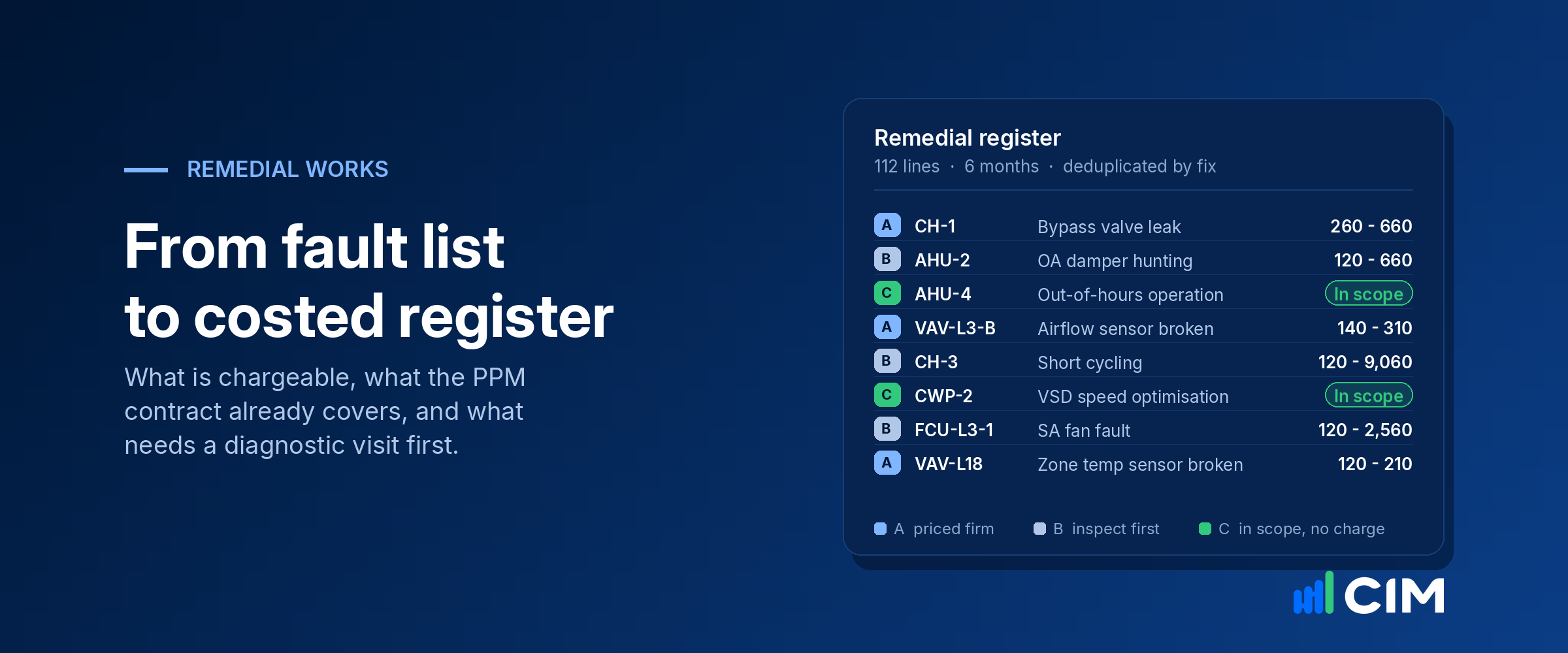
A fault list is not a quote.
That single gap is where most analytics programmes stall, and it is also where the commercial opportunity sits for engineering partners. Fault detection and diagnostics will tell you that AHU-3's outside air damper is hunting, that a VAV box is leaking air, that a chiller bypass valve is passing. What it does not tell you, out of the box, is which of those the client is already paying you to fix, which need a diagnostic visit before anyone can put a number on them, and what the rest are actually worth.
Answer those three questions and a fault list becomes a works register. A works register is a document a client can approve.
On this page
The detection gap is a revenue gap
The research on this is blunt. Lawrence Berkeley National Laboratory's field work on fault correction states that FDD tools can inform operators of faults, but an action is always required to correct the fault before any saving is generated, and that the need for human intervention often results in delay or inaction.
The numbers bear it out. Correcting common building faults is estimated to deliver 5 to 30 percent whole-building energy savings. What FDD users actually bank, measured across the Smart Energy Analytics Campaign's 104 organisations and 6,500 buildings, is a median of 9 percent. An earlier LBNL study of 26 organisations across 550 buildings put the figure at 8 percent.
The distance between the 30 percent ceiling and the 9 percent median is not a detection problem. It is a remedial works problem.
For an owner, that gap is lost savings. For an engineering partner, it is unconverted scope. Faults that sit in a list for six months are jobs that were never quoted.
What a remedial works register is
A remedial works register is a priced, scope-classified list of the corrective work a building needs, generated from its fault data rather than from a walk-round. Each line names the equipment, the fault, the likely intervention, a cost range, and crucially whether the work is chargeable or already covered by the planned maintenance contract.
It differs from a fault list in three ways.
It is deduplicated by fix, not by fault. Three fault categories on the same air handling unit that all resolve to one damper actuator replacement become one line, priced once. Registers that price per fault inflate, and clients notice.
It is scope-classified. Every line is either chargeable remedial work or in-scope planned maintenance at zero cost, with a citation for why.
It carries honest uncertainty. Work that can be priced firm is priced firm. Work that cannot be priced until someone has been to the plant room is priced as a diagnostic visit, with the likely repair shown as the upper bound.
PPM vs remedial works: which FDD faults are chargeable
This is the part that wins the conversation, and it is simpler than most contract debates suggest. One rule does most of the work.
Inspect, clean, calibrate or adjust is in scope. Replace, repair or diagnose is remedial.
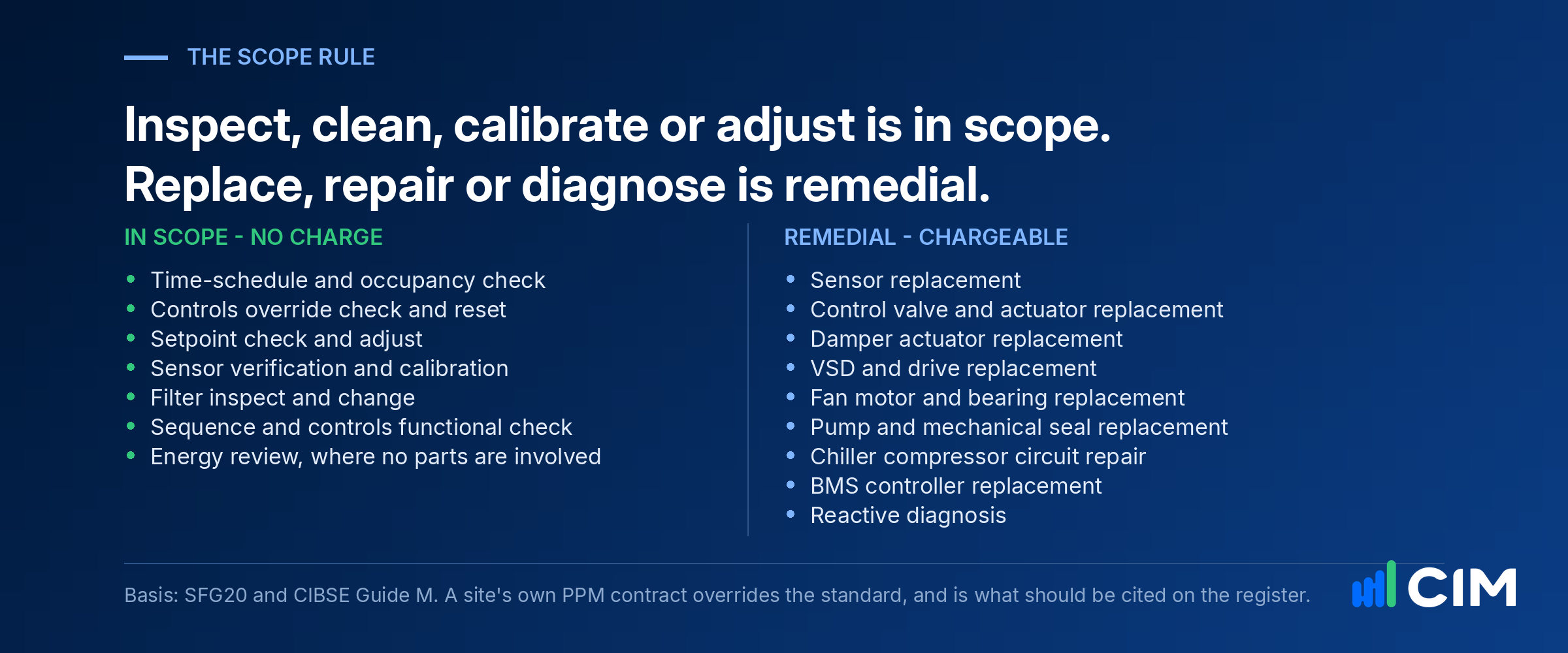
Planned preventive maintenance (PPM) is the calendar-based servicing a contract already pays for. Remedial works are the corrective jobs that fall outside it. The line between them is drawn by the action a fault requires, not by the fault itself, and in the UK the reference points are SFG20, the industry standard maintenance specification, and CIBSE Guide M.
| In scope: PPM, no charge | Remedial: chargeable |
|---|---|
| Time-schedule and occupancy check | Sensor replacement (temperature, airflow, pressure, CO2, humidity) |
| Controls override check and reset | Control valve and actuator replacement |
| Setpoint check and adjust | Damper actuator replacement |
| Sensor verification and calibration | VSD and drive replacement |
| Filter inspect and change | Fan motor, belt and bearing replacement |
| Sequence and controls functional check | Pump and mechanical seal replacement |
| Energy review where no parts are involved | Chiller compressor circuit repair |
| BMS controller replacement | |
| Reactive diagnosis |
That means a large share of what an FDD platform raises is not chargeable. Out-of-hours operation on an AHU is a schedule correction. Economy mode overridden off is a controls check. A pump drive running at a fixed inefficient speed is controls optimisation. A zone setpoint left too low after a complaint is a setpoint adjustment. All of that sits inside the contract.
What falls outside scope is component-level work, and reactive diagnosis of a fault whose cause the data cannot settle on its own.
Being the partner who volunteers that distinction, rather than the one who quotes for everything and gets challenged line by line, is the difference between a register that gets approved and one that gets sent back.
A worked example: 120 alerts, 112 register lines
Here is what this looks like on a live site. The example is a prime CBD office tower of 38 levels with three chillers, ten air handling units and several hundred VAV boxes. The register was built from six months of alert data. Site anonymised.
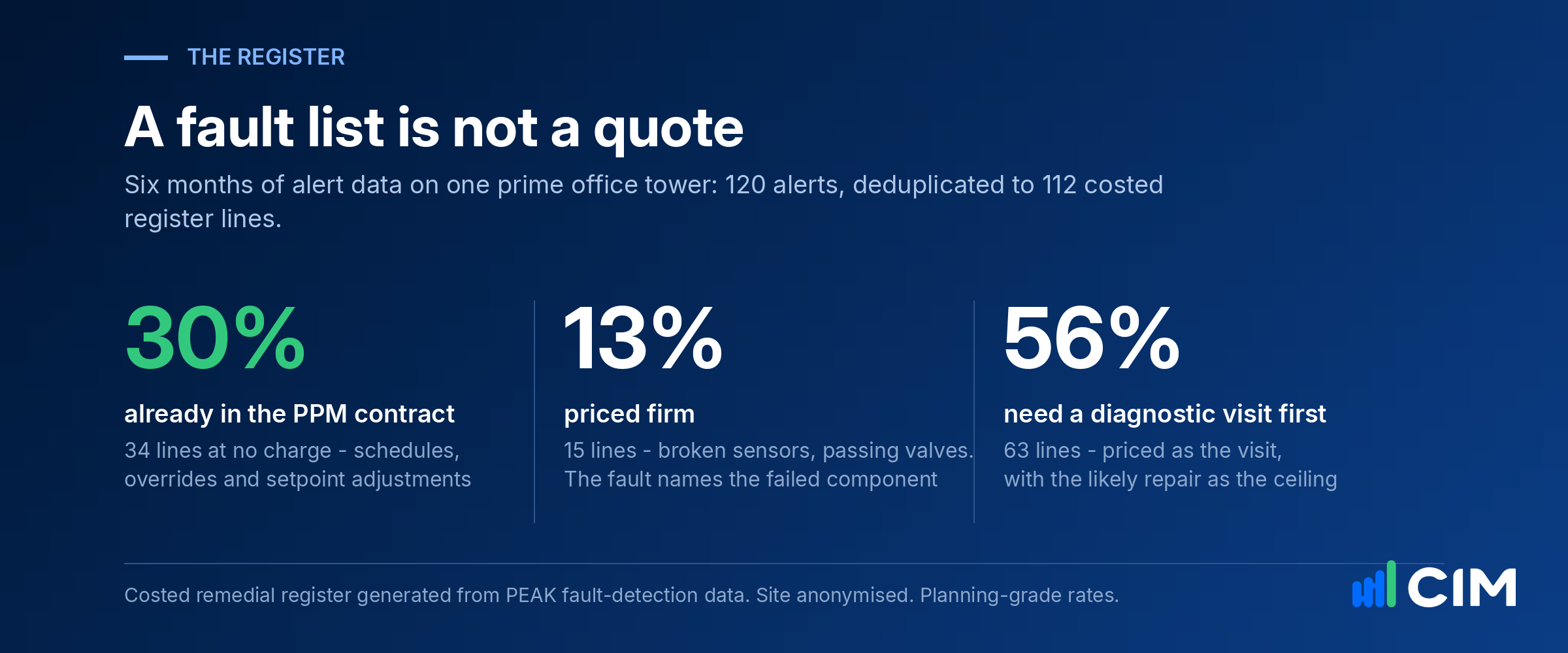
| Category | Lines | Share |
|---|---|---|
| A. Chargeable remedial, priced firm | 15 | 13% |
| B. Chargeable, diagnostic visit needed first | 63 | 56% |
| C. In-scope PPM, no charge | 34 | 30% |
Three things are worth pulling out of that table.
Thirty percent of the register carries a zero. Thirty-four lines, mostly out-of-hours operation, economy mode overrides, drive speed optimisation and setpoint corrections, are work the maintenance contract already covers. They still appear on the register, with the standard or contract clause cited next to them, because a client who can see what they are not being charged for trusts the rest of the document.
Only 13 percent could be priced firm. Those were the unambiguous ones: broken zone temperature sensors, broken airflow sensors, a broken chilled water return sensor, three chiller bypass valve leaks. The fault names the failed component, so the fix and the price follow.
Fifty-six percent needed a visit before they could be quoted honestly. Damper hunting, fan faults, insufficient heating, short cycling, airflow block and leak. FDD narrows these to one piece of plant and one probable failure mode, which is a long way from where a manual investigation starts, but it does not replace putting a meter on the actuator.
The largest single line on that site was a chiller compressor circuit repair, and it is exactly the line nobody should quote before diagnosis. A register that prices it firm is a register that will be wrong by five figures in one direction or the other.
What the whole portfolio says
One site is an example. The portfolio is the evidence. As of September 2026, across the commercial buildings CIM monitors, 8,221 alerts were in fault and had been updated in the previous six months. Setting aside 1,336 metering and connectivity alerts, which are a data-integrity workflow rather than plant remedial work, leaves 6,885 live HVAC faults. Classified with the same rule set used for the site above, the split is as follows.
| Category | Live faults | Share |
|---|---|---|
| A. Chargeable remedial, priced firm | 2,275 | 33% |
| B. Chargeable, diagnostic visit needed first | 2,993 | 43% |
| C. In-scope PPM, no charge | 1,617 | 24% |
Two things move between the single site and the portfolio. The in-scope share is stable at roughly a quarter to a third, which is the number to remember: around one in four live FDD faults on a commercial portfolio is work the maintenance contract already covers. The firm-priced share is much higher across the portfolio than on the single site, at a third rather than 13 percent, because broken sensors are the single most common fault mode in commercial HVAC and a broken sensor is the one fault the data can price without a visit.
Method note: alert titles were classified against the same keyword rule set that drives the register. Counts are at alert level, not deduplicated by fix, so they slightly overstate line counts relative to a register. The figures are a snapshot of active faults, not a rate of new faults.
How to price the faults you cannot price yet
The inspection category is where most registers either overclaim or go blank. The approach that survives client scrutiny is to price the visit as the floor and the likely repair as the ceiling.
One mechanic matters more than it sounds: the investigation portion of the call-out is deducted from the repair when the works proceed, so diagnosis is never billed twice. Clients notice that, and it removes the most common objection to attending in the first place.
On UK planning-grade rates, with a call-out of GBP 120 made up of GBP 60 attendance and GBP 60 investigation, the arithmetic runs as follows.
| Intervention | Repair band | Line total, incl. call-out, less investigation |
|---|---|---|
| Zone or space temperature sensor replacement | GBP 60 to 150 | GBP 120 to 210 |
| 2-port control valve replacement | GBP 200 to 600 | GBP 260 to 660 |
| Damper actuator replacement | GBP 200 to 600 | GBP 260 to 660 |
| Fan or motor replacement | GBP 500 to 2,500 | GBP 560 to 2,560 |
| VSD or drive replacement | GBP 500 to 3,000 | GBP 560 to 3,060 |
| Chiller compressor circuit repair | GBP 3,000 to 9,000 | GBP 3,060 to 9,060 |
Those are planning-grade bands for illustration. Substitute your own schedule of rates and the register becomes your numbers rather than an estimate, which is what makes it defensible in front of a client.
The contract mechanics behind remedial works
None of this is a new commercial instrument. UK and Irish facilities management contracts have carried remedial works machinery for years: remedial work arising from PPM tasks, a remedial backlog programme handed over at mobilisation, completion periods by category, all tracked on the client's CAFM system. At the centre sits the remedial work proposal: the priced, scoped submission a supplier makes for approval before chargeable work proceeds. A remedial works register is, in effect, a batch of remedial work proposals with the evidence attached. HVAC and BMS contracts are routinely tendered as planned maintenance plus responsive remedial works, with the potential for additional project works.
What changes with FDD is the quality of evidence behind each proposal, and the volume of proposals you can generate without adding survey hours.
One thing to check before the backlog builds is whether the maintenance contract obliges anyone to respond to analytics-driven findings at all. If resolving a fault needs a contractor who is not contracted to act on fault data, the diagnosis is wasted. This is normally a variation rather than a renegotiation, but it needs doing early, and it is the same doorway that leads to data-driven maintenance.
The regulatory direction helps. Under the recast EU Energy Performance of Buildings Directive, non-residential buildings with heating or air conditioning above 290 kW must have a building automation and control system capable of continuous monitoring and logging, detecting efficiency losses and faults, and informing building managers of improvement opportunities. The threshold drops to 70 kW by 2030. Detection is becoming a compliance baseline. Acting on what is detected, and being able to show it, is where differentiation moves next.
What it takes to build a register
Three inputs, in order of how much they improve the output.
1. Alert data. Six to twelve months from the platform, filtered on last-updated rather than created, so a long-running fault that is still live still counts.
2. The site PPM contract or task schedule. This is what moves the in-scope line from a standards default to the actual contract clause. It changes which lines carry a zero, and it is the part clients challenge.
3. Your priced schedule of works. This replaces planning-grade bands with your rates.
With nothing beyond the alert data you get a planning-grade register, which is good enough to open a conversation. With all three you get a document that can be issued.
This is also the point where a register stops being a one-off exercise. Run it quarterly and it becomes the reporting spine of a monitoring-based commissioning programme, or the investigation phase of a retro-commissioning engagement that no longer needs to start from scratch.
Proving the remedial work was done
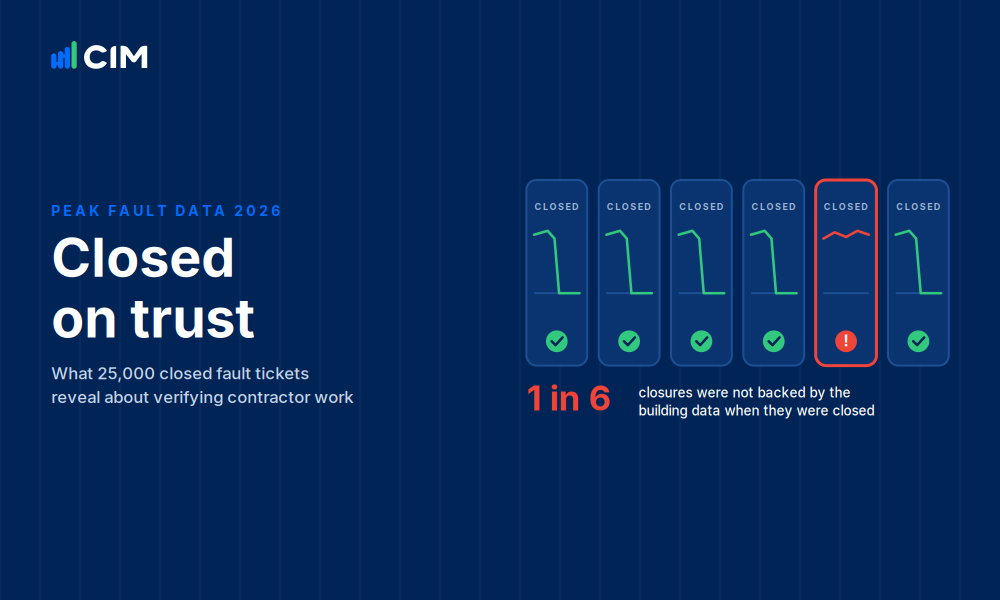
A register gets approved on the strength of its scope. It gets renewed on the strength of its verification. The step most remedial programmes skip is showing that the fix landed, and it is the step that decides whether next quarter's register gets signed. In a CIM sample of closed tickets, about 1 in 6 were closed before the building data confirmed the fault had cleared, which is why verifying that a fault was actually fixed matters as much as scoping it.
Verification has three parts, and FDD makes all three cheap.
The fault clears in the data. The same rule that raised the alert should stop firing once the component is replaced. If a chilled water valve was passing at 40 percent against a closed command, the supply air temperature stops dropping below outside air. That is a closed fault, and it is visible without a return visit.
The evidence is on the ticket. Actuator readings, photographs, the part fitted, the time on site. When the engineer records that from the plant room, the register line and the completion record are the same document. There is no reconciliation afterwards.
Recurrence is tracked. A fault that clears and returns within weeks is either a poor repair or a design problem. Either way it should not be re-quoted as new work, and the history is what tells you which it is.
Verifying the fix is not the same as verifying the saving. Where a client, funder or incentive programme needs the energy saving itself proven, that is done under an agreed methodology such as IPMVP, which we cover in measurement and verification of energy savings.
This is the part of the process that funders and programmes increasingly require. Seattle City Light's monitoring-based commissioning incentive, for example, requires the FDD software to track resolved faults over time and asks for reports showing issues identified and resolved, not detection alone. A contractor who can hand that over is a contractor who is difficult to replace at tender. PEAK's workflow integrations exist so that the ticket, the evidence and the verification live in one place rather than three.
What this looks like on site
Darrell Keenan, Facilities Manager at Connaught House, reviewing PEAK on Capterra, described it as picking up BMS anomalies that would not normally be spotted without a BMS engineer running a deep dive, and said it "pinpoints how and where the works have to be carried out", saving time and money.
That is the operative point. The value is not the fault. It is the specificity of the scope that follows it.
The same pattern shows up in the field. At one London tower, engineers took a live chilled water valve alert from their first PEAK session, walked to the plant room, and confirmed a valve sitting 40 percent open against a zero percent command. The diagnosis and photographic evidence were in the ticket 98 minutes after the demo started. A fault became a scoped, evidenced remedial job inside two hours.
Frequently asked questions
Are FDD faults covered by the planned maintenance contract?
Some are, and it depends on the action rather than the fault. Measured against SFG20 and CIBSE Guide M, tasks that inspect, clean, calibrate or adjust generally sit within a routine PPM scope: schedule corrections, controls override resets, setpoint adjustments, sensor calibration, filter changes. Work that replaces, repairs or diagnoses a component is normally out of scope and therefore chargeable remedial work. The site contract overrides the standard, so the contract clause is what should be cited on the register.
What is the difference between PPM and remedial works?
PPM, planned preventive maintenance, is the scheduled servicing a maintenance contract already covers: inspections, cleaning, calibration, adjustments and consumables on a fixed calendar. Remedial works are corrective jobs outside that scope, typically replacing or repairing a failed component or diagnosing a fault the routine visit cannot settle. PPM is paid for in the contract price. Remedial works are quoted, approved and invoiced separately, usually through a remedial work proposal.
What is a remedial work proposal?
A remedial work proposal is the priced, scoped submission a maintenance supplier makes to a client for approval before chargeable remedial work proceeds. In UK facilities management contracts it typically follows a PPM finding, sits alongside a remedial backlog programme and is tracked on the client's CAFM system. A remedial works register generated from FDD data is a batch of remedial work proposals with the diagnostic evidence attached.
What is the difference between a fault list and a remedial works register?
A fault list reports what the analytics detected. A remedial works register converts that into approvable scope: deduplicated by fix rather than by fault, classified as chargeable or in-scope, and costed, with work that needs investigation priced as a diagnostic visit plus a likely repair ceiling.
How do you price a fault that has not been investigated yet?
As a range with the visit as the floor. The low figure is the diagnostic attendance. The high figure is the attendance plus the most probable intervention for that fault mode. The investigation element is then deducted from the repair if the works proceed, so diagnosis is not billed twice.
Why do most FDD programmes underdeliver on savings?
Because detection alone banks nothing. Correcting common building faults is estimated to deliver 5 to 30 percent whole-building savings, but the median achieved by FDD users in Lawrence Berkeley National Laboratory's Smart Energy Analytics Campaign was 9 percent. The shortfall comes from faults that are detected but never resolved, usually because nobody owns triage, the contract does not oblige anyone to act on analytics output, or the fault was never turned into quotable scope.
Does a remedial works register replace a site survey?
No. It replaces the guesswork about where to survey. Roughly half the lines on a typical register still need someone in the plant room, but they arrive knowing the equipment, the fault mode and the probable component, which is a materially shorter visit than an open-ended investigation.
How do you verify that remedial works were completed?
Three ways, and an FDD platform makes all three cheap: the rule that raised the fault stops firing once the component is replaced, so the fault clears in the data without a return visit; the engineer records readings, photographs and the part fitted on the ticket from the plant room, so the completion record and the register line are the same document; and recurrence is tracked, so a fault that returns within weeks is flagged as a poor repair or a design problem rather than re-quoted as new work.
Who builds the register, the platform or the contractor?
The platform supplies the ranked, diagnosed faults. The scope classification and the pricing belong to whoever holds the maintenance contract and the rate card, because those are the two documents that make the register defensible. In practice it is a joint output, and it works best when the contractor's own rates and PPM scope are loaded in rather than approximated.
The bottom line
Every fault list in every portfolio contains three things mixed together: work you are already paid to do, work you can quote today, and work you need to look at first. Left mixed, the list stalls. Separated, it is a pipeline.
The separation is not difficult. It takes the alert data, the maintenance contract, and a rate card, and it produces a document a client can sign rather than a report they can file.
Turn your fault backlog into a costed register
CIM's Partner Program supports engineering consultancies, RCx and MBCx firms, and BMS and mechanical contractors delivering remedial works from PEAK fault data, using your PPM scope and your rates.

A practical playbook for the engineers who deliver building performance. Learn how to run retro-commissioning, monitoring-based commissioning and data-driven maintenance on an FDD platform: compress the RCx cycle from 12-18 months to 3-5, close the loop from alert to verified fix, and turn fixed-term projects into recurring revenue. Written for RCx and MBCx firms, engineering consultancies, and BMS and mechanical contractors.
A sceptical engineering team put PEAK to the test during their first training session, and confirmed a live £25,053-a-year chilled water valve fault within 98 minutes.
Read the story →