Most maintenance contracts are renewed or lost on a question the service report cannot answer: what did the owner actually get for the money? A report that says a technician checked an air handling unit, verified the sensor readings and closed the job at 14:20 records activity. It does not show whether anything in the building improved, or whether the fault stayed fixed.
This guide is for BMS, controls and HVAC contractors who want to change that. It sets out the evidence building owners now expect, the KPIs that prove maintenance value, what a verified fix looks like, how to put a number on the result without overstating it, and how to package it all into a one-page monthly report that wins renewals and tenders. It also covers how UK contractors can evidence PPM and remedial works to landlords.
Key takeaways
- Owners buy outcomes, not visits. Lower running costs, fewer failures, fewer complaints and lower risk are what renew a contract.
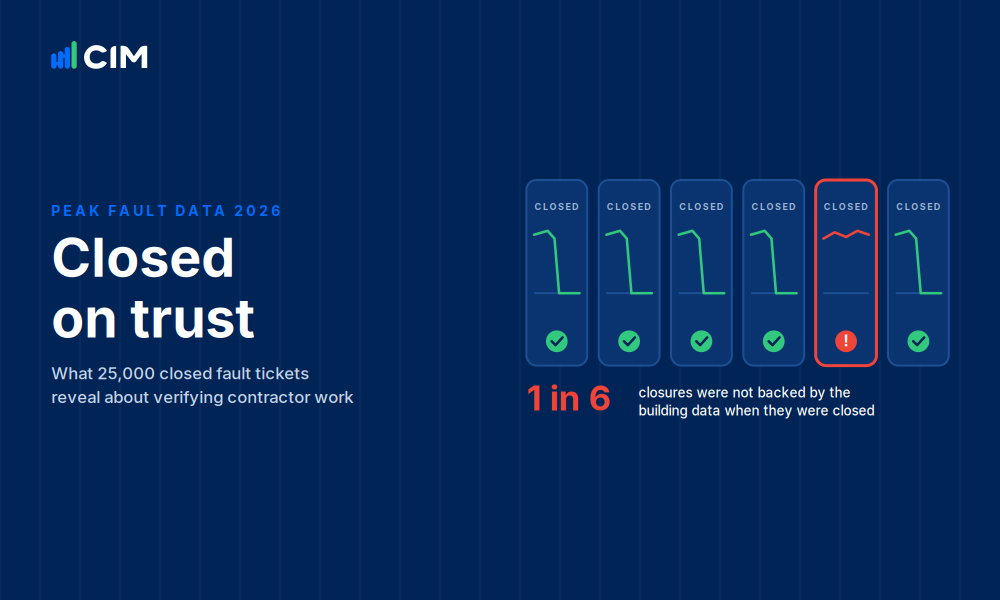
- A closed ticket is not proof. In a CIM sample of closed fault tickets, about 1 in 6 were closed before the building data confirmed the fix.
- Verification is the contractor's opportunity. A contractor who can show a fault cleared in the data, and stayed cleared, stands apart from one who can only show a job sheet.
- Separate measured from estimated. Value claims survive scrutiny when every number is labelled and the method is stated.
- One page beats thirty. A monthly report that answers what was found, what was fixed and proven, and what is still at risk does more for a renewal than a full service log.
Why doesn't a service report prove the value of maintenance?
A service report records what a technician did, not what changed in the building. It lists tasks completed, but cannot show whether energy use fell, whether a fault stayed fixed or whether occupants noticed. Owners renew contracts on outcomes, so a contractor who relies on job sheets is asking to be judged on price alone.
Owners have not become more demanding for the sake of it. Building performance standards, net zero commitments, operational ratings such as NABERS and ENERGY STAR, and tighter operating budgets all push them to ask what each dollar of maintenance spend achieves. When the only evidence is a stack of service reports, the easiest comparison in a tender is price. Contractors who can show what their work changed get compared on value instead.
The gap is rarely effort. Most contractors do far more than their reports capture. It is evidence. The fix that stopped a chiller running all weekend looks identical, on paper, to a routine filter change.
What evidence do building owners want from their maintenance contractor?
Owners want five things evidenced: whether the building costs less to run, whether failures and emergency call-outs are falling, whether comfort complaints are reducing, whether operational risk is under control, and whether faults stay fixed once closed. Each needs data the owner can check for themselves, not a statement from the party being paid.
- Cost: energy use and out-of-hours runtime trending down, adjusted for weather and occupancy.
- Reliability: fewer repeat faults and emergency call-outs, and less equipment downtime.
- Comfort: fewer complaints and fewer hours with zones outside their setpoint band.
- Risk: a visible, shrinking list of open faults ranked by consequence, with owner decisions flagged.
- Durability: proof that closed faults stayed closed.
That last point is why independence matters. Evidence is most persuasive when it comes from a source neither party controls: the building's own data, monitored by a layer that is not the BMS vendor and not the contractor. That protects good contractors as much as owners, because it lets the work speak for itself. We set out the case in seven things to know about independent building monitoring.
Which KPIs prove maintenance value?
The KPIs that prove maintenance value measure outcomes rather than activity: weather-normalised energy use and out-of-hours runtime, repeat faults and emergency call-outs, comfort complaints, controls health, response and resolution times, and the share of closed faults verified in the data. Choose five to eight, agree them with the owner and report them consistently.
Scroll sideways to see all columns.
| Outcome | KPI | Where the data comes from | What it proves |
|---|---|---|---|
| Energy | Weather-normalised energy use; out-of-hours plant runtime | Utility and sub-meters, BMS run status | The building costs less to run |
| Reliability | Repeat faults within 30 or 90 days; emergency call-outs | Fault and work order history | Problems are fixed at the root, not patched |
| Comfort | Comfort complaints; hours zones spend outside setpoint band | Help desk logs, zone temperatures | Occupants notice the difference |
| Controls health | Points left in manual override; failed or drifting sensors | BMS point data, fault detection | The BMS is controlling the building as designed |
| Responsiveness | Time to attend and time to resolve critical faults | Work orders, fault timestamps | The contract SLA is being met |
| Proof of fix | Share of closed faults verified in the data | Fault detection history | Closures reflect real fixes, not paperwork |
ANSI/ASHRAE/ACCA Standard 180 sets minimum HVAC inspection and maintenance requirements to preserve comfort, energy efficiency and indoor air quality. Outcome KPIs show whether that maintenance is achieving its purpose.
The last row is the one most contract reports leave out, and the one owners increasingly ask about. It is also the hardest for a competitor without the right tools to match.
What does a verified fix look like?
A verified fix has five links in its evidence trail: the fault detected and what it was costing, who attended and when, what work was done, confirmation that the fault condition cleared in the building data across a full operating cycle, and the resulting value recorded as measured or estimated. If the fault returns, the record reopens.

Step four is what separates proof from paperwork. A fault that clears for an afternoon and returns overnight was not fixed. In CIM's analysis of closed fault tickets, about 1 in 6 were closed before the building data confirmed the fix, which we examine from the owner's side in how to verify a contractor actually fixed an HVAC fault. For contractors that number is an opportunity. Owners increasingly know that a closure and a fix are not the same thing, and the contractor who can show the difference wins the argument.
Verification also protects the contractor from their own misdiagnoses. In one building on the PEAK Platform, an air handling unit fault was marked resolved twice: first after a pressure sensor was replaced, then after the fan was found running at full speed. The data kept flagging it. An on-site airflow measurement eventually found 32,460 m³/hour of actual airflow against a BMS reading of 12,782 m³/hour, which explained months of fan failures. The full story is in how PEAK uncovered a costly oversight. Catching that on the second visit is far cheaper than the fourth.
How do you put a dollar value on maintenance work without overstating it?
Value maintenance work by agreeing a baseline before the change, measuring the after-state under comparable conditions, and labelling every figure as measured or estimated. Adjust energy comparisons for weather and occupancy, count each saving once and state the method. Credible small numbers renew contracts; inflated ones end them.
- Baseline first. Capture runtime, energy and fault data before the fix, not after someone asks.
- Compare like with like. Normalise for weather, occupancy and operating hours, or the result is noise.
- Label every number. Measured runtime change and estimated cost saving are different claims. Say which is which.
- Count each saving once. Two fixes on the same plant do not each get the full credit.
- Check persistence. Re-check the data weeks later. A saving that has drifted back is not a saving.
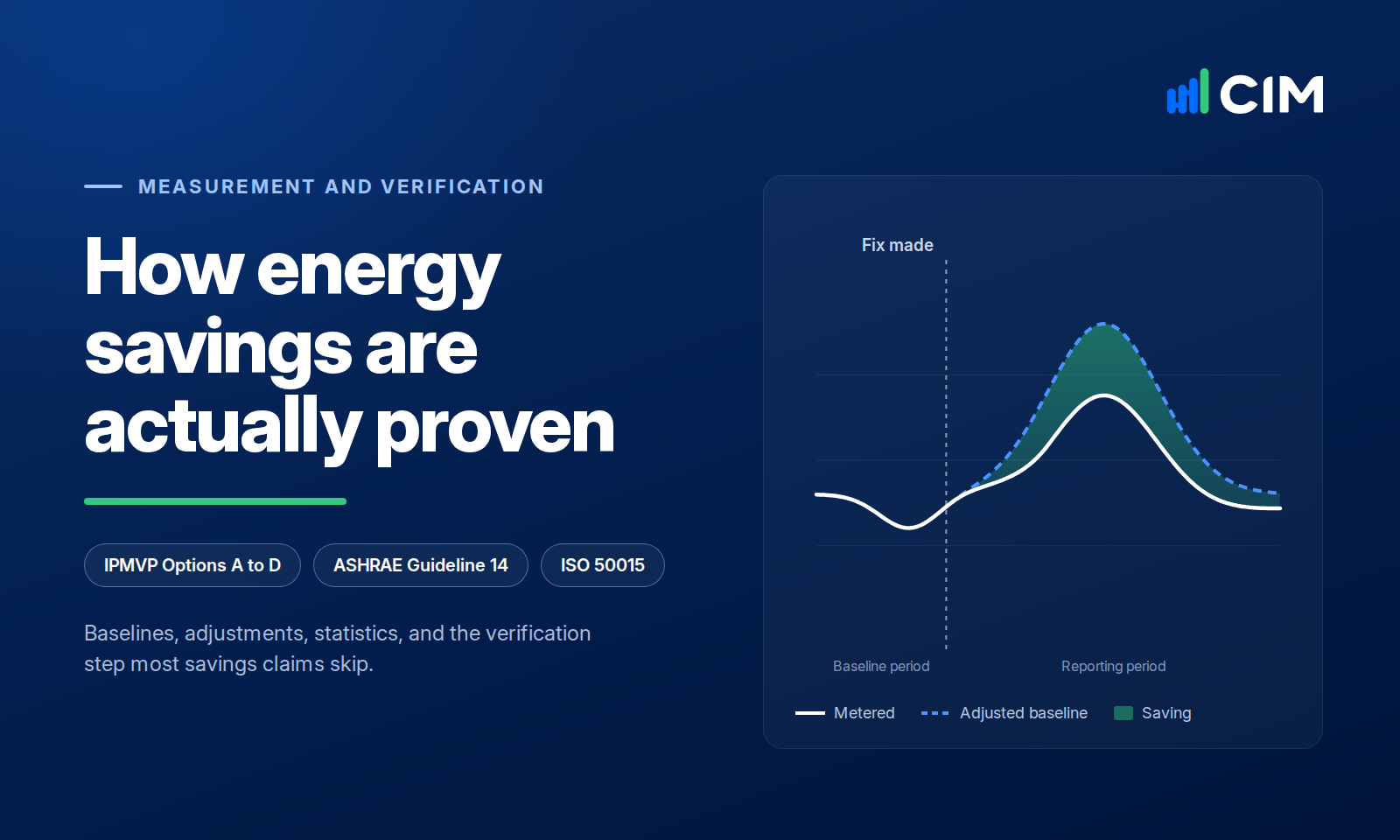
For formal savings claims, the US Department of Energy's FEMP M&V Guidelines (version 5.0) cover savings from improved operation and maintenance, and ASHRAE Guideline 14 sets out the statistical methods. Our guide to measurement and verification explains the options in plain terms.
An illustrative example: an air handling unit found running every weekend, at an average 20 kW of fan and cooling load for 48 hours a week, uses roughly 50,000 kWh a year it does not need to. At $0.15 per kWh that is about $7,500 a year. If trend data shows the corrected schedule held for three months, the report should state a measured runtime change and an estimated cost saving, exactly in those words.
What should a monthly owner value report contain?
A monthly owner value report should fit on one page and answer three questions: what was found, what was fixed and verified, and what is still at risk. Lead with four or five headline KPIs, list the verified fixes with their value, flag open risks and decisions the owner needs to make, and recommend next actions. Service logs belong in an appendix.
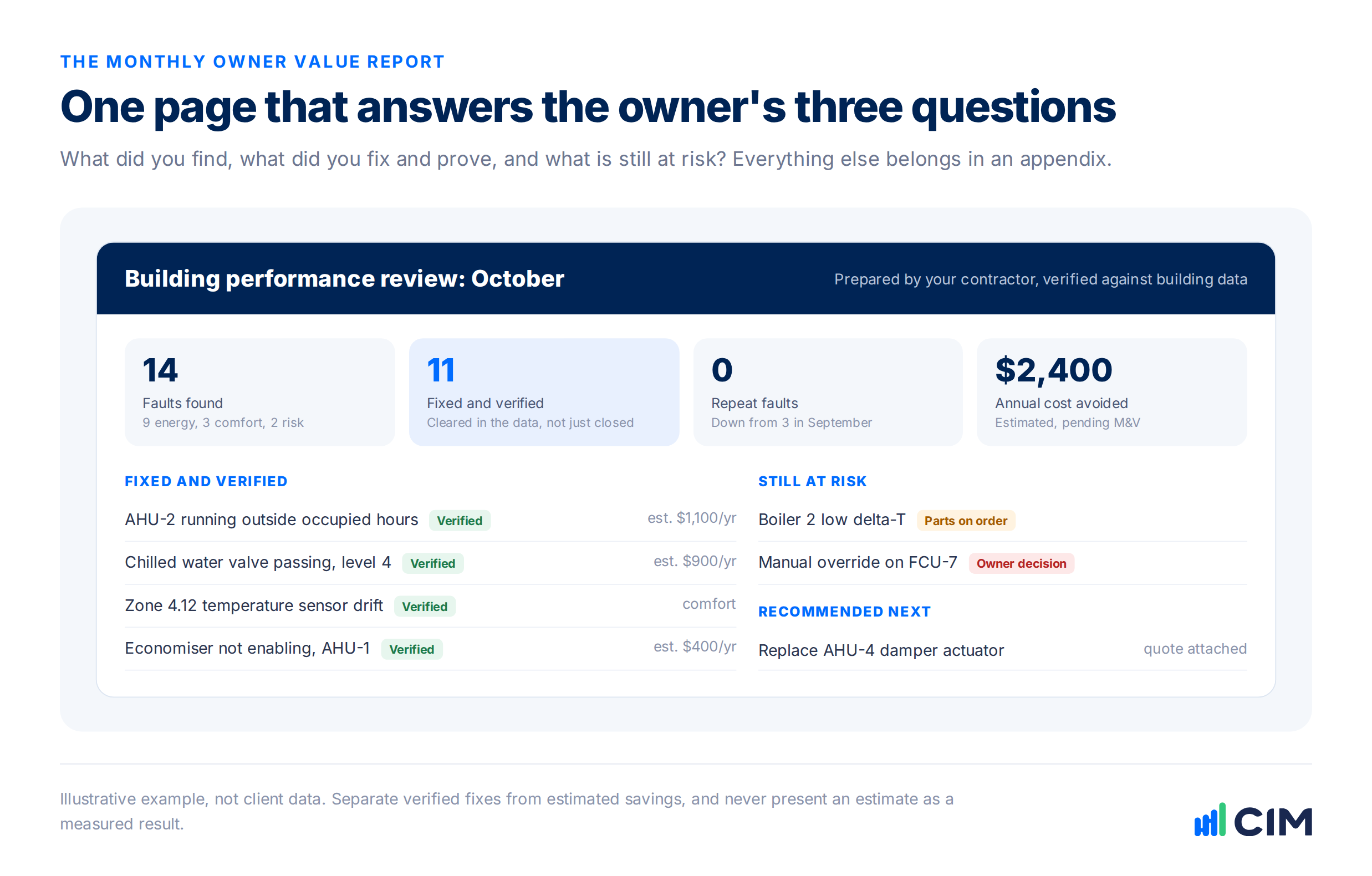
Three habits make the report work. Keep the same KPIs every month so trends are visible. Show owner decisions explicitly, because an override the owner chose to keep is not the contractor's failure. And hold a short quarterly review in person, where the report becomes the agenda and the conversation turns to next year's priorities rather than this month's invoice.
How does proven value help contractors win and keep contracts?
Proven value moves the renewal conversation from price to results, and increasingly decides tenders. Owners and their consultants now ask whether a contractor has fault detection capability, whether field teams can use it without hand-holding, whether it is integrated into the maintenance workflow, and whether the contractor can show portfolio-level data. Contractors with evidence can answer all four.
Those four questions are appearing in integrated maintenance tenders because owners have been burned by contracts that delivered visits rather than performance. As we put it to our own partners: contractors who start this work now will walk into those tenders with evidence. Those who wait will walk in with a proposal.
Evidence also changes what a contractor can sell. Once value is visible, a maintenance contract can be structured in tiers, from compliance-led PPM, to performance reporting with verified fixes, to continuous optimisation driven by fault detection, with each tier priced on what it delivers. We explore how partners are building recurring revenue and turning projects into ongoing engagements in our Partner Value Series on revenue and retention. Aero Performance Group is a good example: it grew its active project portfolio by 50% without adding resources, and more of its fixed-term projects now extend into longer-term engagements.
How can UK contractors evidence PPM and remedial works to landlords?
UK contractors evidence PPM by showing tasks were completed to the agreed specification, usually SFG20, and evidence remedial works with a register that separates in-scope PPM fixes from chargeable works, each with its status verified in building data. Statutory compliance records are kept separately, because they answer a different question: is the building safe and legal?
SFG20, created by the Building Engineering Services Association, is the industry standard for building maintenance specification and is written into many tenders. Task compliance against SFG20 proves the schedule was followed. Outcome evidence proves it worked. Landlords increasingly want both, particularly where MEES, net zero commitments or operational ratings put energy performance under scrutiny.
The remedials register is where most disputes start, so make it unambiguous. Each item should show the fault, the evidence, whether it falls within PPM scope or is chargeable, the price, and its verified status. Our guide to costing remedial works from fault detection sets out how to separate the two.
Evidence can be captured fast. At a commercial tower in London, two engineers who had been sceptical of fault detection took a live chilled water valve alert to the plant room, confirmed the valve was 40% open when the BMS was calling for no cooling, and posted the diagnosis and photos into the ticket 98 minutes after their first training session began. The fault was worth an estimated £25,053 a year. That is the story in sceptical engineers confirm a £25,000 fault in 98 minutes.
How can contractors start proving value in 90 days?
Start small. In the first 30 days, agree five to eight KPIs with the owner and baseline them. In days 31 to 60, fix the highest-value faults and record before-and-after evidence. In days 61 to 90, issue the first one-page value report and agree next quarter's priorities. Expand once the owner trusts the numbers.
| Days | Focus | Output |
|---|---|---|
| 1 to 30 | Agree KPIs with the owner, connect the data, baseline current performance and the open fault list | KPI definitions and a baseline the owner has signed off |
| 31 to 60 | Fix the highest-value and highest-risk faults first, recording before-and-after trends for each | A list of verified fixes with evidence attached |
| 61 to 90 | Issue the first one-page value report and hold a review with the owner | Agreed priorities for the next quarter, and the basis of the renewal case |
Where does CIM's PEAK Platform fit?
More than 20 engineering partners use CIM's PEAK Platform as the independent verification layer behind their maintenance and commissioning work. PEAK reads the existing BMS across all major brands without new hardware, raises engineer-built fault rules ranked by cost and comfort impact, routes each fault to the right contractor, and confirms in the data that the fix held, reopening it if the fault returns. The evidence trail in the first figure above is built automatically for every fault, and the monthly value report draws on the same record.
In practice that shortens the loop. At a Perth office building moving to a data-driven maintenance model, PEAK flagged a failed 24/7 air handling unit as critical and routed it straight to the mechanical contractor, who diagnosed and resolved it within three days. CIM monitors more than 700 commercial buildings and licenses PEAK to engineering partners per data point, so the platform cost scales with each client's building. See how partners deliver data-driven maintenance, read how engineering firms run RCx, MBCx and data-driven maintenance on FDD, or our view on how engineering firms should choose a building analytics platform.
Turn your maintenance work into evidence
PEAK gives contractors a verified record of every fault found, fixed and held, ready for the owner's monthly review and the next tender.
Talk to our partner teamWatch a partner demoFrequently asked questions
How can BMS and controls contractors prove the value of their maintenance work?
By reporting outcomes instead of activity. That means agreeing outcome KPIs with the owner, baselining them, recording a verified evidence trail for every significant fault, labelling savings as measured or estimated, and summarising it all in a one-page monthly report. Evidence from independently monitored building data is the most persuasive.
What KPIs should a maintenance contractor report to a building owner?
Report five to eight outcome KPIs: weather-normalised energy use and out-of-hours runtime, repeat faults and emergency call-outs, comfort complaints, controls health such as manual overrides and failed sensors, response and resolution times, and the share of closed faults verified in the building data.
How do you prove a maintenance contractor actually fixed a fault?
Confirm in the building data that the fault condition cleared and stayed cleared across a full operating cycle, rather than relying on a closed ticket. A verified record links the original fault, the work done and the data showing the condition resolved, and reopens automatically if the fault returns.
How do you calculate the savings from maintenance work?
Agree a baseline before the change, measure the result under comparable conditions, adjust for weather and occupancy, count each saving once and label every figure as measured or estimated. For formal claims, follow recognised methods such as the FEMP M&V Guidelines, IPMVP or ASHRAE Guideline 14.
What should a monthly maintenance report to a building owner include?
One page that answers three questions: what was found, what was fixed and verified, and what is still at risk. Include four or five headline KPIs, the verified fixes with their value, open risks and owner decisions, and recommended next actions. Detailed service logs belong in an appendix.
How can UK maintenance contractors evidence PPM and remedial works to landlords?
Show PPM tasks were completed to the agreed specification, usually SFG20, and keep a remedials register that separates in-scope fixes from chargeable works, with each item's status verified in building data. Keep statutory compliance records separately, and add outcome evidence such as energy and comfort trends.
How can HVAC service providers use building analytics to win and retain contracts?
Analytics gives service providers evidence that their work changed building performance, which moves renewals from price to results. It also answers the questions owners now ask in tenders: whether the contractor has fault detection capability, uses it in the field, integrates it into the workflow and can show portfolio data.
Who should verify a maintenance contractor's work?
Verification is most credible when it comes from a source neither party controls, such as building data monitored by an independent platform rather than the BMS vendor or the contractor. That protects the owner from unverified closures and gives good contractors objective proof of their work.