Your BMS generates thousands of data points a day. Your maintenance contractor sends you reports telling you the work got done. Your energy bills arrive telling you something else. Somewhere between those three sources sits the truth about how your buildings are actually performing — and none of the parties holding the data is a neutral witness.
That's the problem independent building monitoring exists to solve. But "independent" has become a label vendors attach to anything that isn't a BMS, so it's worth being precise about what it means, what it doesn't, and how to tell a platform that delivers it from one that just borrows the word.
Here are the seven things that matter.
1. Independent means no one is marking their own homework
Start with the word itself, because it's doing more work than most people realise.
A BMS vendor cannot referee its own equipment. A maintenance contractor cannot verify its own work. An FM provider reporting on building performance is reporting on its own performance. None of these parties is dishonest — but none of them is neutral either, and when the data that proves performance is held by the party whose performance is being measured, you don't have monitoring. You have self-assessment.
Independent monitoring means the layer that watches your buildings has no stake in what the data shows. It doesn't sell the chillers, doesn't hold the maintenance contract, and doesn't lose revenue when a fault is found. That independence is what makes the data usable — in contractor conversations, in board reporting, in NABERS submissions, in capex decisions.
If you take one question into your next vendor evaluation, make it this one: who else in my supply chain does this platform answer to? If the answer is anyone but you, it isn't independent.
The principle matters most where the stakes are highest. In a data centre, a monitoring layer that cannot change the plant is also the safest one to connect, which is why we argue for read-only FDD for data centres as the way to keep cooling redundancy verified after commissioning.
2. It should connect to what you already have - no rip-and-replace, no new sensors
Most commercial portfolios run a mix of BMS vendors. One site on Honeywell, another on Siemens, a third on something the original contractor installed twenty years ago and nobody fully documents. An independent platform has to work across all of it, or the "portfolio view" it promises is really a view of whichever buildings happened to have the right controls.
In practice that means:
- Multi-protocol connectivity — BACnet, Modbus and the rest, without caring who made the controller
- Data normalisation — raw feeds from different systems translated into metrics you can actually compare across sites
- No capital works to get started — the platform extracts from the BMS, meters and equipment you already own, rather than asking you to fund an IoT retrofit before you've seen a single insight
The no-CAPEX point matters more than it sounds. It's the difference between onboarding a portfolio in weeks and running a year-long hardware project — and it's the difference between a business case your CFO signs this quarter and one that waits for the next budget cycle.
3. Fault detection is table stakes - the question is what happens after the alert
Every platform in this category detects faults. AI-driven anomaly detection, engineering rule libraries, prioritised alert queues — these are no longer differentiators; they're the price of entry.
The differentiator is what happens next. Most platforms surface the anomaly and stop. The fault becomes an email, the email becomes a backlog, and six months later the same fault is still being "detected" because nobody closed the loop.
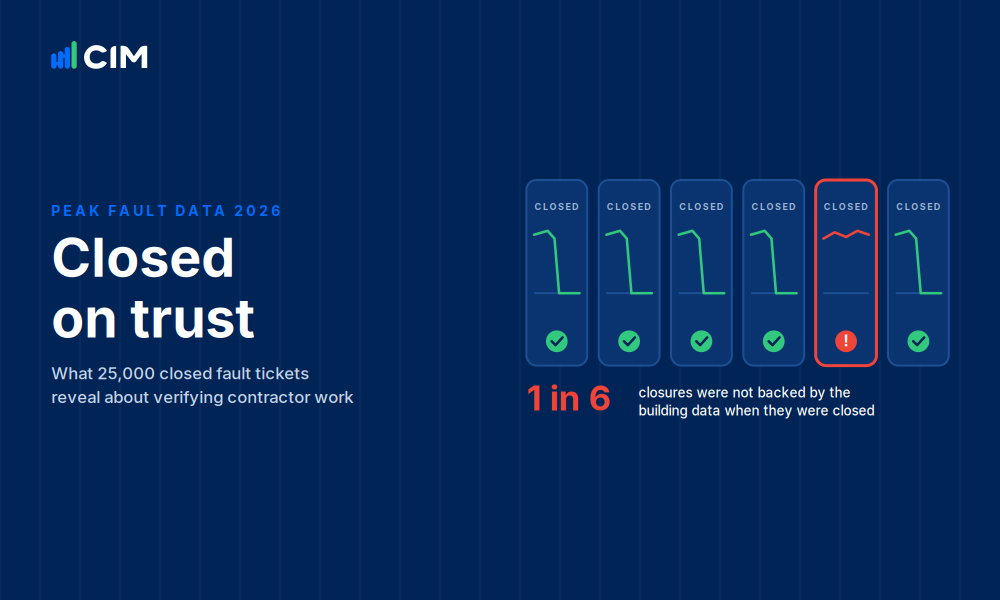
Ask instead: when the platform finds a fault, does it identify the cause, recommend the fix, route it to the right person, track the work, and — this is the part almost everyone skips — verify the fix actually held? Detection tells you something is wrong. Closed-loop resolution tells you it got fixed, who fixed it, how long it took, and whether it stayed fixed. In CIM's own ticket data, about 1 in 6 sampled closures were made before the building data confirmed the fix, which we cover in contractor accountability and how to verify a fault was actually fixed.
That last step is where the economics live. A detected fault costs you nothing less than an undetected one. A resolved fault is where the energy savings, the avoided breakdown and the retained tenant actually show up. And where those savings have to be proven to a client or funder, the method is measurement and verification against an adjusted baseline.
4. Data without context is homework, not intelligence
There's a fashionable idea that if you pour enough building data into a lake, the AI will sort it out. It won't. Rubbish in, rubbish out — and in an AI environment, the rubbish compounds faster, because guesses get built on guesses.
Independent monitoring done properly creates trusted intelligence: data an experienced engineer can act on without re-verifying it first. That requires context. A chiller consuming 5% more energy than last month might be a fault, or it might be a heatwave. An AHU running outside occupied hours might be a control fault, or a tenant fit-out. The platform should know the difference — and when it flags something, it should arrive with the cause, the impact in dollars or comfort terms, and the recommended action attached.
The test: when an alert lands, does your team act on it, or investigate it? If every alert triggers an investigation journey, the platform isn't augmenting your engineers. It's assigning them homework.
5. A building only makes sense next to other buildings
Inside a single building, a 5% equipment fault rate sounds acceptable. Against a benchmark showing comparable buildings run at 3%, it's a 40% underperformance — and a specific, addressable problem.
That's the case for portfolio-level and industry-level context. Independent monitoring should tell you not just how each asset is performing, but which assets are your outliers, which sites' operational practices are worth replicating, and how your portfolio sits against the wider market. It's also how you catch the conversation the industry rarely has: over-servicing. Benchmarking doesn't just find the buildings getting too little attention — it finds the ones paying for attention they don't need.
For a national operations manager, this is the difference between managing buildings and managing a portfolio.
6. The platform is half the answer - engineering expertise is the other half
Software alone doesn't tune fault-detection rules to a 1980s office tower with a 2015 chiller retrofit. People who understand HVAC do.
The implementations that deliver pair the analytics layer with qualified engineers — people who calibrate the detection thresholds to each building, interpret the genuinely ambiguous fault patterns, and help site teams build the habit of acting on what the platform finds. Without that, even a good platform drifts into alert fatigue within a quarter, and adoption quietly dies.
When you're evaluating, ask who does the tuning, what their qualifications are, and whether they're included or an add-on. A platform that arrives without engineers is a platform that expects your team to become the engineers.
7. Demand proof, not promises
The final thing to know is how to pressure-test everything above. Five questions, borrowed from the way we advise buyers to evaluate any data-driven maintenance claim:
- Are you independent of my BMS vendors and my maintenance supply chain — commercially, not just technically?
- Can you connect to my existing systems without new hardware, and how long until my first site is live?
- When you detect a fault, show me how it gets to a verified fix — not an alert queue.
- What's your benchmark for good performance, how is it tracked, and how would my buildings compare?
- What measurable results — energy, maintenance cost, downtime — will you commit to in writing?
A platform built for independent monitoring answers all five quickly. One built for demos gets vague around question three and changes the subject by question five.
Where CIM's PEAK Platform fits
CIM built the PEAK Platform to be exactly this independent layer. It connects to virtually any BMS without new sensors or capital works, monitors every asset continuously, and closes the loop from detection through to verified resolution — task assignment, progress tracking and confirmation the fix held, all in one workflow. Every customer gets a dedicated engineer with mechanical or mechatronic qualifications who tunes the platform to their buildings, and portfolio benchmarking comes standard, including NABERS tracking with decimal-level monthly estimates.
Across more than 100 million square feet of monitored commercial property, PEAK delivers an average 19% energy saving per asset. As Damien Stacey, National Capital & Planning Manager at QIC, puts it: "Scheduled maintenance is now a thing of the past as PEAK helps us determine precisely when and where maintenance is needed."
FAQs about independent building monitoring
What is independent building monitoring?
Independent building monitoring is a performance layer that sits above your BMS and maintenance systems, run by a party with no commercial stake in what the data shows - not the BMS vendor, not the maintenance contractor. It continuously analyses building data to detect faults, verify fixes and benchmark performance across a portfolio.
How is it different from a BMS?
A BMS controls equipment in real time and raises alarms when thresholds are breached. It tells you what's happening, not whether what's happening is efficient or getting worse. Independent monitoring analyses BMS data (and more) to find faults, quantify their impact, and track them through to verified resolution.
Do I need new sensors or hardware?
Not with modern platforms. The leading approach extracts data from your existing BMS, meters and equipment, which is why onboarding that used to take months can now be completed in weeks, with no capital expenditure.
Can it work across buildings with different BMS vendors?
Yes - that's much of the point. A BMS-agnostic platform normalises data across Honeywell, Siemens, Johnson Controls and other systems into consistent metrics, so a mixed portfolio can be benchmarked on equal terms.
What results should I expect?
Independent research puts fault detection and diagnostics at a median 9% whole-building energy saving, with upper bounds around 30% in poorly optimised buildings. Beyond energy: fewer emergency call-outs, fewer tenant comfort complaints, and equipment that lasts longer because faults are caught early and verified fixed.


.png)