Every visit starts with the fault already found.
PEAK checks every point on your clients' building management systems every 15 minutes, sends each fault to the right technician with the evidence, and confirms the fix in the same data. Your contract becomes a record of faults closed, not visits made.






Same technicians, same sites. A different start to the week.
Your contracts already ask for more checks than a service team can staff. PEAK takes the checking off the roster and leaves your people the part clients pay for.
 On PEAK
 Start of day
Hundreds of alarms, most of them noise, and no way to tell which ones cost the client money.
Diagnosed faults across every client site, the nuisance alarms already filtered out.
 Hidden faults
A valve passing, a schedule running long. Nothing crosses a threshold until a tenant complains.
Each piece of plant is checked every 15 minutes against how it should be running.
 Where visits go
Technicians go where the PPM schedule says, whether or not that plant has a problem.
The scheduled work still happens. The extra visits go to the plant that needs them.
 Proof of work
The client has to take your word that the fault is gone.
The fault closes when the client's own data says it is fixed.
What changes for your service team, day by day
One example week at a contractor running PEAK across its maintenance contracts. Same technicians, same sites. The difference is where each day starts and what proves it is finished.
The overnight list is already sorted.
PEAK ran every rule against every point across your client sites overnight and ranked what it found by impact. Your service manager opens one list, not a dozen BMS front ends.

The technician arrives knowing what to fix.
Each job carries the equipment, the trend that raised it and the likely cause. Less time finding the fault on site, more time fixing it.

Fixed, then proven.
After the work, PEAK keeps watching the same points. The fault closes only when the data is back in range, so "done" means the same thing to you and your client.

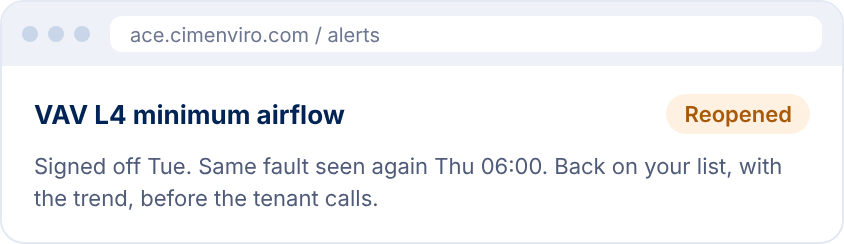
A fix that did not hold comes back to you first.
If a fault returns, it reopens on your list with the data that shows why. You hear about it before the client does.
The client report is already written.
Every fault found, fixed and verified goes into the month's review with its evidence. The renewal conversation starts from what you closed.

Live on a client site in 4 to 5 weeks
Most client buildings are live in 4 to 5 weeks from signing, because CIM does the connecting, tagging and commissioning. Hoffman's site took under 20 days.

Connects, tags and hosts
- Reads the BMS you already service: BACnet, Modbus, Niagara and meter feeds
- Every point auto-tagged against one ontology
- 6,000+ FDD rules running from day one

Validates, then gets on with the work
- Confirms the BMS connection once
- Works from the ranked list of diagnosed faults
- Delivers the fixes, the tuning and the upgrades

Keeps the building as it is
- Read-only: the control strategy stays where it is
- No programming and no downtime
- Sees the same live view you do
Which systems connect: BMS integrations · How the two fit together: PEAK vs a BMS
Weeks like this, on real sites

Hoffman ran its own HQ on PEAK first
Live across 180,000 sq ft in under 20 days. One AHU fix cut fan power by 58%.
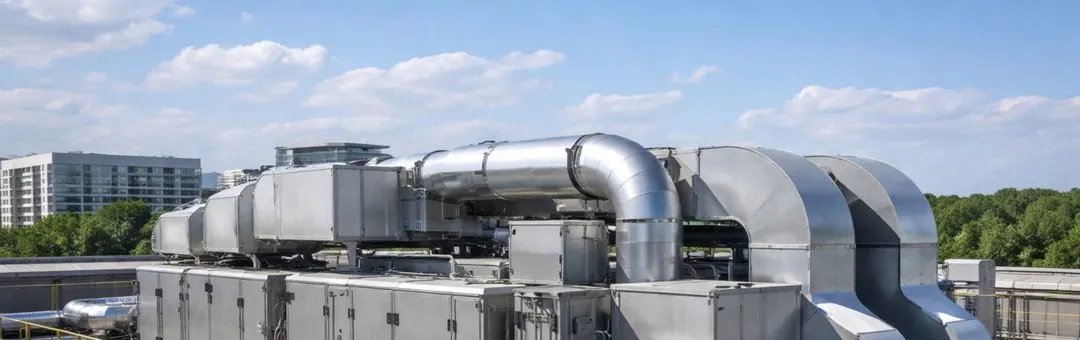
A failed 24/7 AHU, routed straight to the contractor
PEAK flagged the failure as critical and sent it to the mechanical contractor with no manual triage in between.

The fix that looked closed
The new pressure sensor had a 0 to 5,000 Pa range; the BMS was still scaled for 0 to 1,600 Pa. PEAK kept the alert open until the cause was found.
What the week adds up to

Engineer productivity up
Up to 5x more buildings per engineer. PEAK does the looking, so your engineers spend their hours on the faults worth a visit.
The capacity maths →
Renewals secured
The client sees every fault you closed and the data that proves it. The renewal starts from that record, not from price.
Why clients stay →
Quotes for additional work
Faults outside the maintenance scope arrive with their evidence attached, ready to scope and quote before anyone drives out.
How partners earn →Built for the firms that already look after the plant

BMS and controls contractors
You already hold the BMS. PEAK turns that access into a monitoring service the client pays for every month.

Mechanical service contractors
Technicians arrive with a triaged list and the fix is verified in the data before the job closes.

HVAC maintenance providers
Maintenance that follows equipment condition as well as the calendar, with energy and comfort findings you can quote.
Commissioning or energy engineering firm? See PEAK for commissioning firms
PEAK ProfessionalWe do the platform. You keep the client.
The same partnership terms every PEAK partner runs on, whether you look after five buildings or five hundred.

Your relationship
You hold the contract, the margin and the renewal. In the markets we cover, CIM does not sell direct against partners or approach your clients.

Your rules
Rules your engineers write on top of the shared library stay inside your firm.

A team behind your team
24/5 support from CIM engineers, comprehensive training and a partner portal.

Wholesale pricing
Per-point wholesale pricing, with the full split of what is included on the economics page.
For the service manager
Analytics-backed maintenance contracts
How to structure a maintenance contract around outcomes.
How contractors prove the value of maintenance work
Evidence a client accepts at review time.
BMS alarm fatigue
Why the alarm list stops being useful, and what replaces it.
What is PEAK for HVAC, BMS and mechanical contractors?
PEAK Professional is the version of PEAK, CIM's Full Loop Building Operations System, that contractors deliver to their own clients. CIM connects the client's BMS, PEAK checks the plant every 15 minutes, diagnoses faults and verifies each fix in live data, and your firm runs the maintenance contract and the client relationship.
Does PEAK replace or control the BMS?
No. PEAK reads the BMS data and leaves the control strategy where it is. The BMS keeps running the building; PEAK assesses how well it is running, finds what is going wrong and manages the work until the fix is verified.
Which building management systems does PEAK work with?
PEAK connects to BACnet, Modbus and Niagara systems and to meter feeds. The BMS integrations page lists the systems in detail.
How quickly is a client site live?
Most client buildings are live in 4 to 5 weeks from signing, because CIM does the connecting, tagging and commissioning. Hoffman Building Technologies had its 180,000 sq ft headquarters live in under 20 days.
How does PEAK know a fix worked?
An action only closes as Verified when the live trend is back in its normal range, not when the job is marked as fixed. If the fault returns, the action reopens on your list.
Who owns the client relationship?
Your firm does. You hold the contract, the margin and the renewal. In the markets we cover, CIM does not sell direct against partners or approach your clients.