US school districts are one of the most under-served segments in building analytics, and one of the few where a third party will pay for the work. For an engineering firm with a fault detection and diagnostics (FDD) practice, that combination is unusual: a large estate of similar buildings, a predictable calendar, measurable operational waste, and a utility programme willing to fund the engineering.
This is written for the partner side of that transaction, not for the district. It covers how the funding works, what the data finds in schools, what a first project looks like end to end, how to get through a district's IT review, and how one school turns into a portfolio. The worked example throughout is Joliet Central High School in Illinois, delivered by CIM partner Aero Performance Group under the ComEd Energy Efficiency Program.
Key takeaways
- The funding already exists. Utility monitoring-based commissioning (MBCx) programmes fund the engineering study in full and offer per-kWh incentives against implementation, so the district can pay nothing.
- Schools waste energy in a very specific way. The common finding is not broken plant but equipment running when nobody is in the building, often because a safety workaround was never undone.
- Low-cost, high-kWh measures are the sweet spot. Scheduling fixes cost little to implement and save a great deal, which is exactly the shape a per-kWh incentive rewards.
- IT review is the real gate, not procurement. Read-only access, no new hardware and no student data are the three answers a district security team needs.
- One school is a reference, not a project. Districts buy school by school, and the second building is where the margin is.
Why are US school districts a strong segment for an FDD practice?
School districts combine scale, repetition and a funded route to market. According to ENERGY STAR, US K-12 districts spend over US$8 billion a year on energy and more than 30% of that is wasted, with 10% recoverable through low-cost measures. Few other segments combine that much addressable waste with a third party willing to fund the engineering.
Three structural features make the segment work for a service business rather than a one-off project business.
The first is repetition. A district's schools were often built to a handful of designs, by the same contractors, with the same controls. Rules tuned on the first school transfer to the next one with little rework, so the engineering cost per building falls as the portfolio grows. That is the opposite of a commercial portfolio assembled by acquisition, where every building is a surprise.
The second is the calendar. Schools are predictably empty: nights, weekends, holidays and the long summer. That makes out-of-hours waste both large and easy to evidence, and it gives you a natural implementation window when disruption is cheapest.
The third is that the buying unit is the district, not the building. A facilities director with 27 schools is one relationship, one approval path and one IT review. In commercial property you would be dealing with 27 owners.
There is an obvious constraint worth naming early: districts have little appetite for capital projects and a long approval cycle for anything that spends money. That is precisely why the funding mechanism matters more here than the technology.
What does building data actually find in schools?
The dominant finding is operational, not mechanical: HVAC running outside occupied hours, schedules disabled or overridden, and setpoints that no longer match how spaces are used. At Joliet Central, every HVAC system on a 550,000 sq ft campus had run 24 hours a day, seven days a week, for years. Nothing was broken and no alarm was firing.
The reason that fault survived is worth understanding, because it repeats across the segment. The building automation system had no scheduling function, so the facilities team could not set time-of-day control. Separately, schedules had been disabled years earlier after a coil-freezing incident. Nobody chose round-the-clock operation. A precaution taken for a good reason outlived the reason, the people who made the decision moved on, and the plant kept conditioning empty classrooms every night and weekend.
This class of fault is invisible to the three things districts already do. It does not raise a BAS alarm, because nothing has failed. It does not generate complaints, because comfort is fine. It does not show up in planned maintenance, because the equipment is working as installed. It only appears when someone compares what the plant is doing against what the building actually needs, which is the definition of fault detection and diagnostics.
The same pattern shows up at portfolio scale. In a pilot across five schools on the US west coast, a CIM partner monitored 417 HVAC plant assets and closed 74 improvement opportunities, cutting energy consumption 29.5%. The measures were unglamorous: stopping unnecessary overnight operation, correcting faulty CO2 sensors and optimising schedules. You can read the detail in the school building performance case study.
Two further findings are specific to schools and worth looking for deliberately. New plant is one: a recently installed chiller at a US high school had been faulting and dropping offline, and was caught on a morning when the district's own BAS front-end was down. Handover is the other: a defects liability period review of a student facility found system gaps while they were still the contractor's problem rather than the district's.
How do utility programmes pay for the work?
Under a utility MBCx programme the engineering is funded by the utility, the partner delivers it, and the district keeps the savings. ComEd funds the engineering study in full and offers incentives of US$0.04 per kWh and US$0.15 per therm against implementation costs. At Joliet Central the US$17,480 implementation was covered entirely, so the district paid nothing.
The rules are published. ComEd sets them out in its MBCx participant manual, and comparable programmes run in other territories on their own terms. This is the part that changes the sales conversation. A facilities director who has no capital budget and no appetite for a procurement exercise can still say yes, because the ask is access and staff time rather than money. Understanding exactly which lines the programme covers, and which it does not, is what separates a partner who can quote this work from one who cannot.
Rates and rules are those published in ComEd's 2025 MBCx participant manual and 2026 incentive application. Other utilities run comparable programmes on different terms. Check the current manual before quoting.
The economics of the measure mix are the thing most firms get wrong. A scheduling fix is cheap to implement and saves an enormous number of kilowatt hours, so a per-kWh incentive pays out several times its cost. A plant replacement is the reverse. At Joliet Central the implementation cost US$17,480 and the verified result was 2,010,323 kWh and 3,839 therms a year. Applying ComEd's published incentive rates to those verified quantities gives roughly US$80,000, comfortably more than the implementation cost. That is illustrative arithmetic using published rates rather than the settlement figure, but it explains why the district paid nothing.
Not every school qualifies. The thresholds are set per facility, which in practice means large high schools clear them and individual elementary schools usually do not.
| ComEd MBCx eligibility | Threshold |
|---|---|
| Peak demand | Greater than 100 kW |
| Annual energy use | Greater than 3,000,000 kWh |
| Floor area | Greater than 150,000 sq ft air-conditioned and/or greater than 500,000 sq ft total |
| Controls | A working building automation system and accessible, up-to-date building records |
| Condition | No major problems requiring capital projects and no planned system renovations |
Joliet Central is 550,000 sq ft, which is why it cleared comfortably. If you are prospecting a district, start with the high schools and the combined middle and high school campuses, prove the model there, then use the result to argue for the smaller sites through whatever route your utility offers.
What does a first school project look like, start to finish?
A utility MBCx project runs on programme-defined phases, and the whole commitment is 12 months of service after integration. Joliet Central moved from MBCx integration in July 2025 to implementation in October and verified savings in November, which is under five months to a proven result on the first measure set.
Phase durations from ComEd's MBCx participant manual. Dates and quantities from the Joliet Central project. Phases 2 to 4 repeat as further measures are identified across the 12 month service period.
Two details from Joliet are worth copying directly. The first is sequencing: Aero confirmed the BAS had working freeze protection sequences before restoring any schedule, which removed the exact concern that had caused 24/7 operation in the first place. Turning the plant off overnight without doing that would have recreated the original risk and lost the facilities team's confidence permanently.
The second is the baseline. Pairing BAS trend data with historical utility meter data did two jobs at once: it proved the pattern was long-standing rather than a recent glitch, and it established the measured baseline the verification would later be judged against. If you skip that step you will be arguing about attribution at the end of the project. Our guide to measurement and verification of energy savings covers the methods, and the Joliet Central success story carries the full project detail.
How do you get through a district's IT and security review?
IT review, not procurement, is where school analytics projects stall. Districts carry strict student privacy obligations and a reflex to treat any new system as a risk to them. The three answers that move the conversation forward are read-only access to the existing building system, no new hardware, and no student data of any kind.
The practical mistake is treating this as a late-stage formality. A district IT department works to its own queue and its own calendar, and it does not care that your utility application has a clock on it. Start the security conversation in parallel with the application, not after the facilities director has said yes.
A preparation checklist for the partner, not a security specification. Take the technical detail for items 1, 3 and 5 from your platform vendor's own security documentation.
How does one school become a district?
Districts buy school by school, so the first building is a reference rather than a project. In a US west coast district, a CIM partner ran a pilot across five schools totalling 500,000 sq ft, had the first school live about two weeks after the purchase order and full pilot coverage inside 60 days, then began expanding toward 27 schools in a portfolio of more than 10 million sq ft.
What makes that expansion economic is that the second school costs less to onboard than the first. The pilot deployed 3,451 FDD rules across 417 HVAC plant assets, processing around 402,000 data points a day. Rules tuned on the first campus largely carry over, because district schools tend to share designs, controls and contractors. The engineering hours per building fall, and the margin is in buildings two through twenty-seven rather than building one.
Two sequencing choices separate partners who expand from partners who deliver one good project. ADG Energy, which runs a phased rollout across a US school district, supplies the equipment list with levels and zones before integration begins, so the mapping work does not become a bottleneck at every new site. It also takes a recommissioning-first path, fixing what the data finds before proposing anything that needs capital.
The commercial effect at the firm level is the point. Aero Performance Group grew its active project portfolio 50% without adding resources and now verifies around 6 million kWh of utility incentives a year, work recognised with utility Top Performer awards. That is a capacity story rather than a technology story: the platform absorbs the analysis so the engineers spend their time on decisions and client relationships. The full detail is in Aero Performance Group's case study, and our RCx Provider's Guide to Scaling MBCx covers how firms build utility-funded services on PEAK.
If you are structuring the offer itself rather than the delivery, turning RCx projects into recurring MBCx revenue and how engineering firms run RCx and MBCx on FDD go further into the service model.
What makes verified savings slide back, and how do you hold them?
A schedule change is easy to make and just as easy to undo. The threats are rarely dramatic: an override left in place after a visit, a ticket closed before the data confirmed anything, a cold snap that tempts someone back to continuous operation. Continuous monitoring after the project closes is what turns a one-off result into a held one.
Percentages are drawn from CIM platform data across a commercial and institutional sample, not from school buildings alone.
This is also where the commercial argument for continuing after verification lives. A district that has seen a 35.5% reduction verified has every reason to want it protected, and the partner who found it is the obvious party to protect it. The ongoing service is an easier sale after the first result than before it. We cover the mechanics in how to verify a contractor actually fixed a fault.
Where does CIM's PEAK Platform fit?
PEAK is the FDD and building analytics platform the partners in this article run their services on. It reads the existing building automation system with read-only access, needs no new hardware and is BMS-agnostic, which keeps integration fast on programme work with fixed timelines. CIM works with more than 20 engineering and service partners delivering services this way.
Two things matter for school work specifically. The first is onboarding speed, because utility programmes run to phase deadlines and summer is the only comfortable implementation window. PEAK deploys more than 5,000 engineering rules with AI-assisted point classification, and buildings are typically live within about 30 days. In the west coast district pilot the first school was live about two weeks after the purchase order.
The second is independence. CIM is not owned by any equipment, controls or BMS manufacturer, which is a cleaner answer in public sector procurement than a platform owned by a party that also sells the district plant. It also means the monitoring keeps running when the district's own tools do not, which is how a failed chiller was caught on a morning the BAS front-end was down. Our post on independent building monitoring covers why that separation matters.
Across the platform CIM monitors more than 700 commercial buildings and more than 100 million square feet, with 19% average energy savings. The Compliance Agent triages faults, assigns them, chases them and verifies the fix in the data, which is the layer that keeps a verified result from quietly unwinding after the project closes. The AI recommends and your engineers decide: the rules are transparent and tunable rather than a black box. There is more in the PEAK AI connector product update.
Partner enablement is deliberate. CIM's engineers sit behind the partner rather than in front of the client, covering onboarding, training and escalations, with the aim that the partner's own team runs the work. If you want to see the delivery side in practice, the retro-commissioning and fault detection and diagnostics solution pages set out how the platform supports it, and the complete guide to monitoring-based commissioning covers the discipline itself.
Frequently asked questions
How can a school district pay for building analytics?
Many US utilities fund monitoring-based commissioning through their energy efficiency programmes. ComEd funds the engineering study in full and offers incentives of US$0.04 per kWh and US$0.15 per therm against implementation costs. At Joliet Central High School the US$17,480 implementation was covered entirely, so the district paid nothing for the work.
Which schools qualify for a utility MBCx programme?
Thresholds are set per facility rather than per district. ComEd requires peak demand above 100 kW, annual energy use above 3,000,000 kWh, and more than 150,000 sq ft of air-conditioned space or 500,000 sq ft total. In practice large high schools qualify and individual elementary schools usually do not.
What does fault detection typically find in school buildings?
The most common findings are operational rather than mechanical: HVAC running outside occupied hours, schedules disabled or overridden, and setpoints that no longer match how spaces are used. At Joliet Central every system had run around the clock for years because scheduling was missing and had been disabled after a coil-freeze incident.
How long does a school MBCx project take?
Programme phases run roughly one week for application, 8 to 12 weeks for integration, 4 to 8 weeks to identify the first measures, 6 to 8 weeks to implement and 6 to 10 weeks to verify. Joliet Central went from integration in July 2025 to verified savings in November 2025.
How do engineering firms get client IT and cyber security approval for building analytics platforms?
Lead with read-only access to the existing building system, no new hardware and no student or personal data. Document named accounts and how access is revoked, agree data export on exit, and name the approver at the first meeting. Start the review alongside the funding application, not after it.
Can an engineering firm deliver school analytics without adding engineers?
That is the usual reason firms adopt a platform. Aero Performance Group grew its active project portfolio 50% without adding resources and verifies around 6 million kWh of utility incentives a year. Rules tuned on the first school largely transfer to the next, so engineering hours per building fall as a district rollout progresses.
What stops verified energy savings from slipping back?
Continuous monitoring after the project closes. The common causes are overrides left in place after a visit, work orders closed before the data confirmed the fix, and seasonal reversion to continuous operation. With monitoring in place a reversion arrives as a new alert rather than a slow climb back up the utility bill.
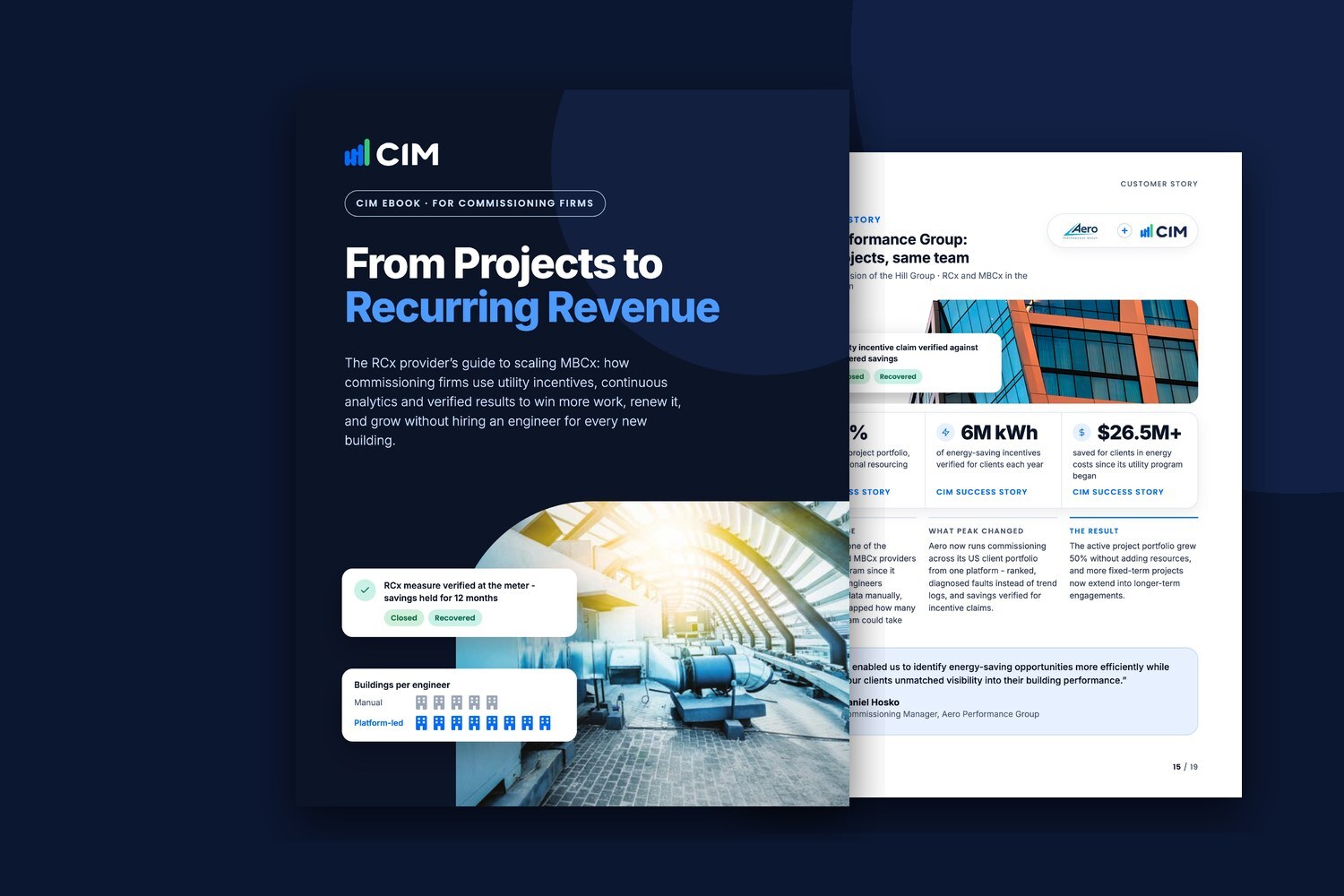
A practical, strategic guide for commissioning firms ready to grow beyond one-off projects. Learn where US utility incentives already pay for RCx and MBCx, what moving from five to eight buildings per engineer is worth, how to sell RCx and MBCx as one engagement and fix the renewal problem, and how to deliver at scale - with a customer story from Aero Performance Group and a 90-day launch plan. Written for principals, directors and commissioning leads at RCx, MBCx, Cx and energy engineering firms.
A new chiller failed at a US high school on the same morning its BAS front-end went dark. PEAK flagged it first thing, and the fix landed before anyone in class noticed.
Read the story →