Most commentary on AI in real estate is written for investment committees and development teams. This article is for the people who run buildings and the partners who maintain them: owners, asset and operations leaders, FM providers and engineering firms deciding where AI belongs in their operating model.
We write from CIM's position as an independent technology provider. PEAK monitors more than 700 commercial buildings and more than 100 million square feet, for direct customers and through more than 20 engineering and service partners, so we see where AI pays back in operations and where it quietly stalls. We use BCG's April 2026 real estate paper as a reference point, agree with most of it, and push back on two points.
Key takeaways
- Operations is where AI value is measurable now. BCG estimates 200 to 300 basis points of EBIT uplift for facility and property management, and the evidence for fault detection in existing buildings is already strong.
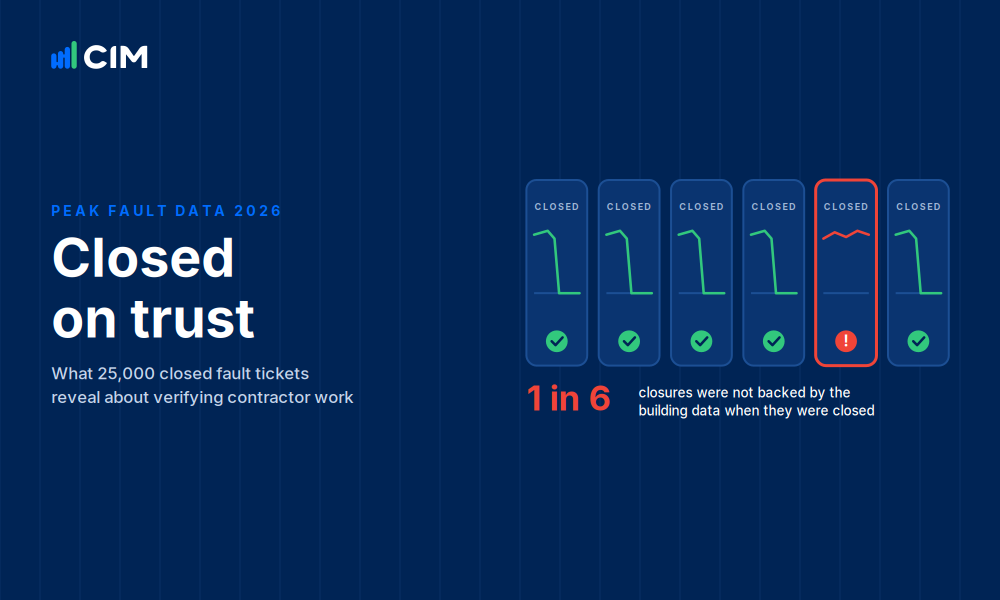
- Detection is not the bottleneck; follow-through is. In a CIM sample, about 1 in 6 closed fault tickets were closed before the data confirmed the fix.
- Agents earn their place in the middle of the workflow: triage, assignment, chasing and verification, with engineers making the decisions.
- For existing buildings, the data foundation is the live BMS stream, classified and normalised, not a BIM model last updated at handover.
- Value only sticks when contracts reward verified outcomes. Under cost-plus FM models, AI savings tend to be absorbed rather than shared.
What does AI-first mean for real estate operations?
AI in real estate operations is the use of rules, machine learning, language models and agents to detect, prioritise, assign and verify building performance issues across a portfolio. An AI-first operator runs that loop as its default way of working, with people setting priorities and making decisions, rather than adding AI as a dashboard on top.
BCG frames becoming AI-first as a structured journey: set a measurable ambition, make the CEO accountable, focus on two or three high-impact bets, upskill the workforce, create an AI delivery office and fix the data. It also shows that real estate is behind, and that the investment gap is set to widen.
Source: BCG, AI-First Companies Win the Future: Real Estate (April 2026). BCG estimates and illustrative figures; the real estate survey samples are small (n = 36), so treat them as directional.
For operations leaders, the practical reading is simpler. The sector is behind, and the fastest place to close the gap is where data already exists and decisions repeat every day: the building management system, the meters and the maintenance workflow around them. That is also where results can be checked, which matters when the board asks what the AI budget delivered. We made a similar argument about data quality and adoption in why most AI projects fail.
Where does AI create measurable value in building operations today?
The most proven value sits in fault detection and diagnostics on existing HVAC and building systems, prioritised by cost and risk, then verified in the data. Energy savings, longer asset life and fewer comfort complaints follow. Language models and agents add value on top by cutting the admin between an alert and a verified fix.
BCG's breakdown of a typical FM or property management P&L puts the largest AI effect in self-delivery labour, at 110 to 130 basis points, through automated ticket management, predictive maintenance and technician assistants. That matches what we see. The labour saved is rarely the fix itself. It is the hours spent finding the problem, working out whether it matters, finding the right person and checking back.
The energy evidence is independent of any vendor. In the US Department of Energy's Smart Energy Analytics Campaign, Lawrence Berkeley National Laboratory found that organisations using FDD achieved median energy savings of around 9%. Across PEAK customers, average energy savings are 19%. Individual results are often faster: a London headquarters cut electricity use by 14% in 11 weeks (measured), and engineers at a London tower confirmed a passing chilled water valve worth an estimated £25,053 a year within 98 minutes of their first PEAK session.
One nuance on method. BCG's maturity ladder runs from deterministic rules to probabilistic agents. Building operations needs both. Fault detection should run on transparent engineering rules that an engineer can read, challenge and tune per site. Probabilistic models belong where judgement under ambiguity helps: classifying thousands of inconsistently named BMS points, summarising evidence, or drafting the follow-up. The AI recommends. Your engineers decide. For the difference between finding faults and forecasting failures, see what FDD is and our guide to predictive maintenance.
Why do most building AI projects stall after the alert?
Because detection was never the hard part. Most portfolios already generate more alerts than their teams can work. Projects stall when nobody owns the alert, nobody chases it and nobody checks whether the fix held. Without a closed loop, savings are claimed on paper and quietly lost on site.
CIM's own data shows where the loop breaks. In a CIM sample, about 1 in 6 closed fault tickets were closed before the data confirmed the fix. About 1 in 25 action tickets concern an override left in place after a site visit. At last count, 56% of open remedial actions were older than 90 days. None of these is a detection problem. Each is a follow-through problem, and each erodes the savings that justified the investment. We cover the mechanics in how to verify a contractor fixed an HVAC fault and the cost of noise in BMS alarm fatigue.
BCG lists data traceability by design as a principle of an AI-ready technology stack: every output traceable to its source data so people can oversee it. Applied to maintenance, that means every closed action is traceable to the data that proves the fault cleared. It also argues for independence. Nobody should mark their own homework, and that includes the contractor who did the work and the manufacturer who supplied the plant. With Copeland completing its acquisition of Bueno Analytics in 2026, who owns the monitoring layer has become a fair procurement question. See what to know about independent building monitoring.
What changes when AI agents enter the maintenance workflow?
Agents take over the coordination work that consumes engineers' time: triaging alerts, assigning actions with evidence, chasing stale items, and closing or reopening actions based on what the data shows. Engineers keep the diagnosis and the decisions. Done well, this shortens the time from detection to a verified fix without removing human judgement.
BCG's illustrative FM ticket workflow halves end-to-end ticket time, from six days to three. Look at where the time goes: classification, prioritisation, dispatch and notification shrink by 50% to 80%, while the on-site work itself shrinks by about a third. That is the right expectation. AI compresses the admin around the fix far more than the fix.
The four layers of AI in building operations. Agents work mostly in layers 3 and 4; engineers own the judgement throughout.
In PEAK this works through two live agents. The Analyst Agent connects PEAK to Claude, ChatGPT and Microsoft Copilot through an MCP connector, with permissions that follow each user's PEAK login. At a recent engineering forum for a large property owner's building managers, our team asked it, live, what the team needed to focus on at one of the owner's buildings that day. It returned a prioritised fix list, each item linked to the evidence in PEAK. The Monday-morning question now gets an answer grounded in live plant data rather than last month's report.
The Compliance Agent works the governance layer. It follows up actions that have gone quiet, closes actions once recovery has held, and reopens closed actions when the data shows the fault is still there. An Optimisation Agent is in development. Agents can be switched on per site and per user group, and PEAK reads the BMS with read-only access: it recommends and verifies, it does not take control of plant. Read more in the PEAK AI Connector update.

Illustrative example, based on real Compliance Agent behaviour. Sites and names changed.
What data foundation does AI in existing buildings actually need?
Existing buildings need live, normalised operational data more than a perfect model. That means read-only access to the BMS and meters, every point classified to a consistent schema, rules deployed against that model, and a record of every fault, action and verification. BIM helps where it is maintained, but most operating assets cannot wait for it.
This is our first challenge to BCG. Its technology principles put a BIM-centric digital twin at the core, evolving from concept through construction and operations. For a development company that is sound advice. For an operator, most of the portfolio is buildings already in use, many with models that stopped being updated at practical completion, if a model exists at all. Meanwhile the BMS is already measuring how each building runs, every few minutes, on every connected point.
The obstacle is that BMS data is messy. The same supply air temperature can carry a dozen different point names across a portfolio. Open schemas such as Project Haystack and Brick give that data a common language, and this is where machine learning earns its keep in onboarding. PEAK uses AI to classify points, deploys more than 5,000 engineering rules automatically against the classified model, and gets buildings live within about 30 days. We explain the detail in BMS point naming and normalisation. We agree with BCG that asset and field data should be the input layer. We would simply start there, rather than wait for the twin.
Who captures the value: owners, FM providers or engineering partners?
It depends on the contract. BCG notes that under cost-plus FM models, AI savings are largely offset because costs flex with revenue, so efficiency gains can disappear into the margin structure. Value is captured and shared when contracts pay for verified outcomes, such as time to verified fix, repeat faults and measured energy savings.
This is our second challenge, and it is one BCG half-makes itself in a footnote. If an FM provider's fee rises and falls with the labour it deploys, an agent that saves labour also cuts revenue. The provider has little reason to adopt it, and the owner sees little of the gain. The fix is commercial, not technical: contracts that reward outcomes the owner can verify. We set out tiers, KPIs and clauses in how to build an analytics-backed maintenance contract.
Partners show what this looks like when it works. Aero Performance Group grew its active project portfolio by 50% without adding resources. Hoffman Building Technologies deployed PEAK on its own Charlotte headquarters first and cut fan power on one air handling unit by 58%. In the UK, CSR Sustain runs its own PEAK-based service and cut electricity at Exchange Quay in Manchester by 10.8% year on year in Q1 2026, worth an estimated £120,000 a year. For engineering firms choosing a platform, see partner tool or competitor.
How should executives start?
Pick two or three operational bets with a measurable baseline, such as verified fault closure, energy in priority buildings, or time to verified fix. Connect the data you already have, make one person accountable for the result, and measure value in the data rather than in activity. Scale only what the numbers prove.
BCG estimates that about 70% of the effort in an AI transformation sits in people and processes, 20% in technology and 10% in algorithms. In building operations that ratio holds. The software is the easy part. The work is agreeing who owns each action, what counts as done, and how results reach the people paying for them.
Where does CIM's PEAK Platform fit?
PEAK is an FDD and building analytics platform built as a full loop building operations system. It detects faults, decides what matters, assigns actions, chases them and verifies the fix in the data. It is BMS-agnostic, reads the existing BMS with read-only access, and comes with more than 5,000 engineering rules, AI point classification and live AI agents. Owners use it directly, and more than 20 engineering and service partners use it to deliver their own services. CIM is fully independent: it is not owned by any equipment, controls or BMS manufacturer. Explore the PEAK Platform overview, our approach to fault detection and diagnostics, or the partner programme.
See the full loop on your own buildings
Watch how PEAK detects, prioritises, assigns and verifies faults, with AI agents doing the chasing. Or talk to our partner team about running it as your own service.
Watch a demoTalk to our partner teamFrequently asked questions
How is AI used in commercial real estate operations?
AI is used to detect faults in building systems, prioritise them by cost and risk, assign them to the right person and verify that fixes held. Machine learning classifies building data, engineering rules detect faults, and AI agents handle follow-up. Language models let property teams ask questions of live building data in plain English.
What is the ROI of AI in facility management?
BCG estimates AI can add 200 to 300 basis points of EBIT in facility and property management, mostly through lower labour time on ticket management and maintenance. In building operations, return usually shows first as energy savings and avoided failures. PEAK customers achieve 19% average energy savings, and returns are only real when fixes are verified in the data.
What are AI agents in building operations?
AI agents are software that carry out multi-step tasks in the maintenance workflow, such as triaging alerts, assigning actions, chasing stale items and closing or reopening actions based on live data. In PEAK, the Compliance Agent follows up and verifies actions, and the Analyst Agent answers questions about live building data inside Claude, ChatGPT or Microsoft Copilot.
Is AI fault detection the same as predictive maintenance?
Not quite. Fault detection and diagnostics finds equipment that is already operating incorrectly or wasting energy, often long before anyone notices. Predictive maintenance forecasts failures before they happen. In existing buildings, FDD is usually the first step: it builds the clean, continuous equipment history that reliable prediction needs.
Do you need a digital twin or BIM model to use AI in an existing building?
No. Most AI value in existing buildings comes from live operational data: BMS points, meters and the history of faults and fixes. A maintained BIM model or digital twin adds context, but many operating assets do not have one. Classifying BMS points to a consistent schema gets most portfolios live in weeks.
Which AI platforms do property and FM teams use for building operations?
Most teams combine a BMS-agnostic fault detection and analytics platform, a work order or CMMS system, and AI assistants connected to live data. Look for transparent, tunable rules, prioritisation by cost and risk, automated follow-up, verification in the data and independence from equipment vendors. CIM's PEAK Platform is one example built around that closed loop.
How do you stop AI savings disappearing in a cost-plus FM contract?
Change what the contract pays for. Add KPIs that reward verified outcomes, such as time to verified fix, repeat faults and overrides released, and share measured energy savings against an agreed baseline. Independent monitoring gives both sides the same evidence, so gains are visible and can be priced into renewals.