
At an office tower in Sydney's CBD, the building's outside air temperature sensor had been installed inside a riser. The BMS had been making economy cycle and chiller decisions based on air that wasn't outside. Relocating the sensor was one of nine winter optimisation strategies that together cut chiller runtime by 88% year on year.
At a glance
- 88% reduction in chiller runtime, June to August 2025 against the same period in 2024
- 12% reduction in business-hours electricity, 12,114 kWh over three months
- $3,392 saved in business-hours energy costs over the same three months
- 4°C or more of error in the outside air reading before the sensor was moved
- Nine strategies delivered on site, without remote BMS access
Challenge
In May 2025, ahead of winter, CIM rolled out its autumn and winter optimisation program to see how much energy could be saved across the season. CIM's customer success engineer met the building's facilities manager on site and walked through nine strategies covering schedules, global temperature setpoints, chilled water inefficiencies, air handling unit economy cycle performance, and heating and cooling calls.
There was a complication. The building had no remote access to its BMS, so every change meant rolling up the sleeves and working through it on site with the facilities manager and the BMS technician.
What PEAK found
Working through PEAK actions and trend analysis, CIM flagged several inefficiencies that were linked to each other:
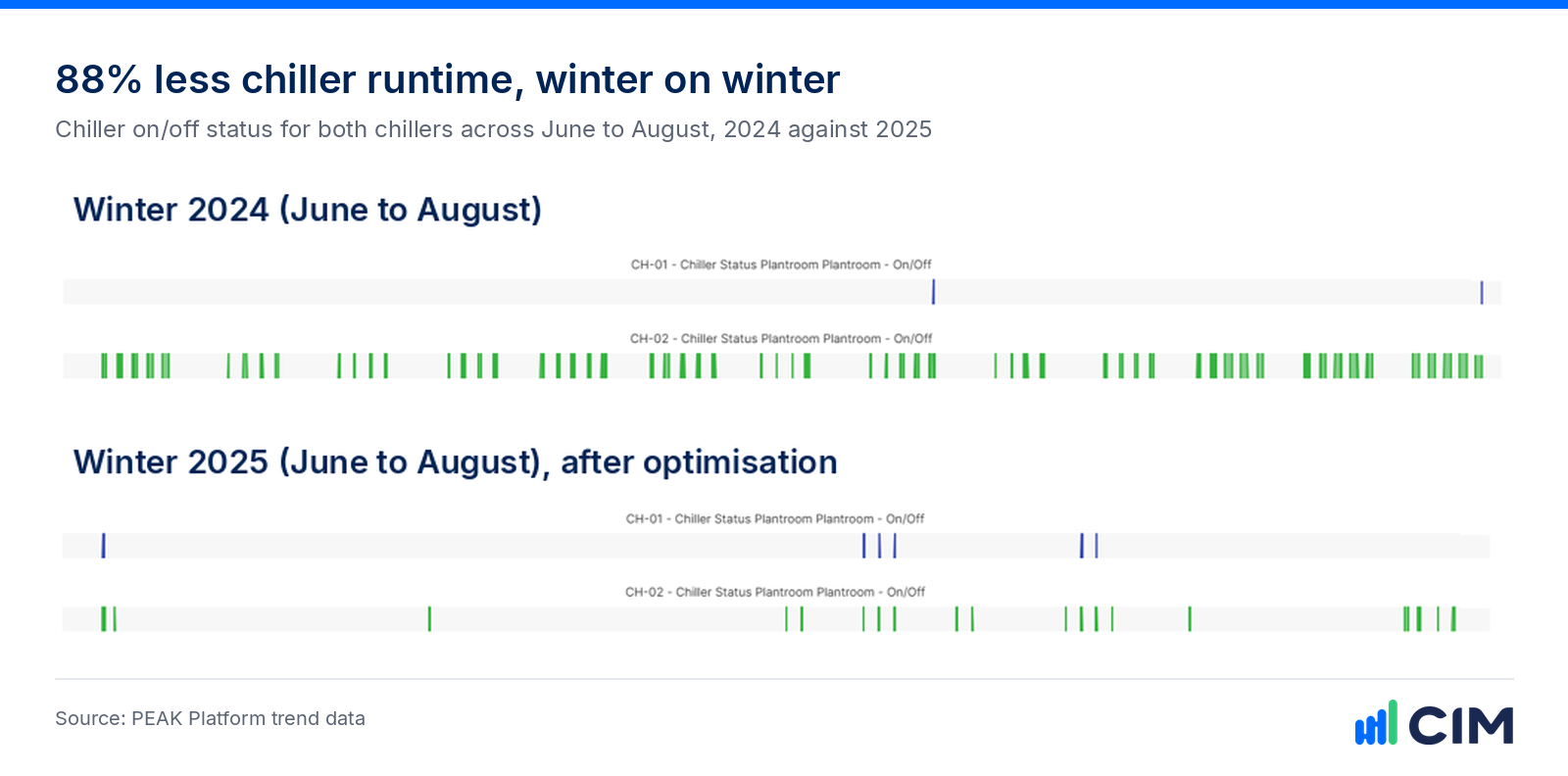
- No effective chiller lockout. Both chillers had lockout points configured, but they were still operating in cool weather.
- A poorly performing economy cycle. The control logic was in place, but free cooling often wasn't happening.
- Faulty weather data. Comparing the building's outside air reading against independent weather data showed large anomalies, reading warmer than reality overnight and cooler on hot afternoons.
- Long AHU schedules. Morning and evening operation extended well beyond actual occupancy.
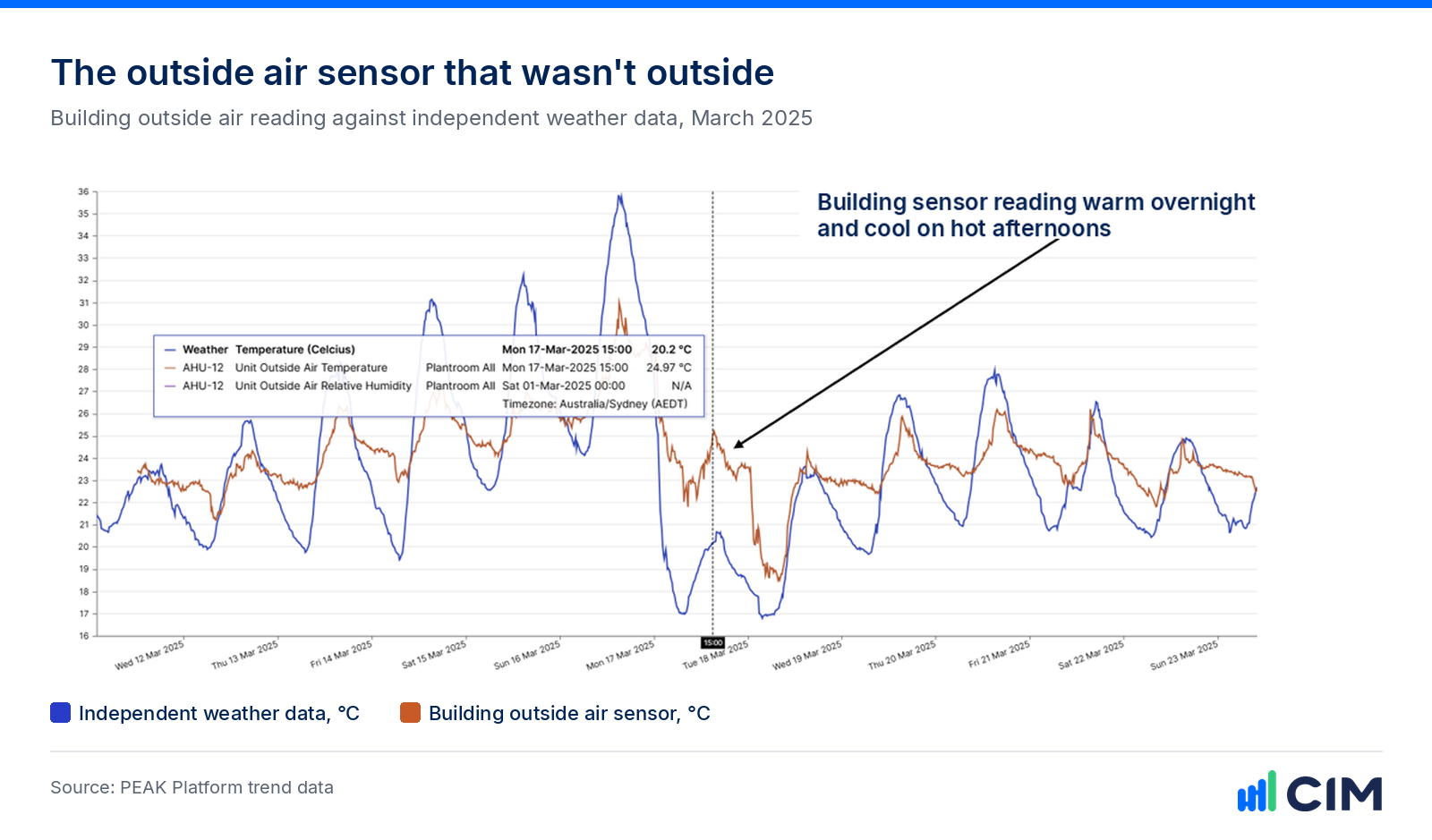
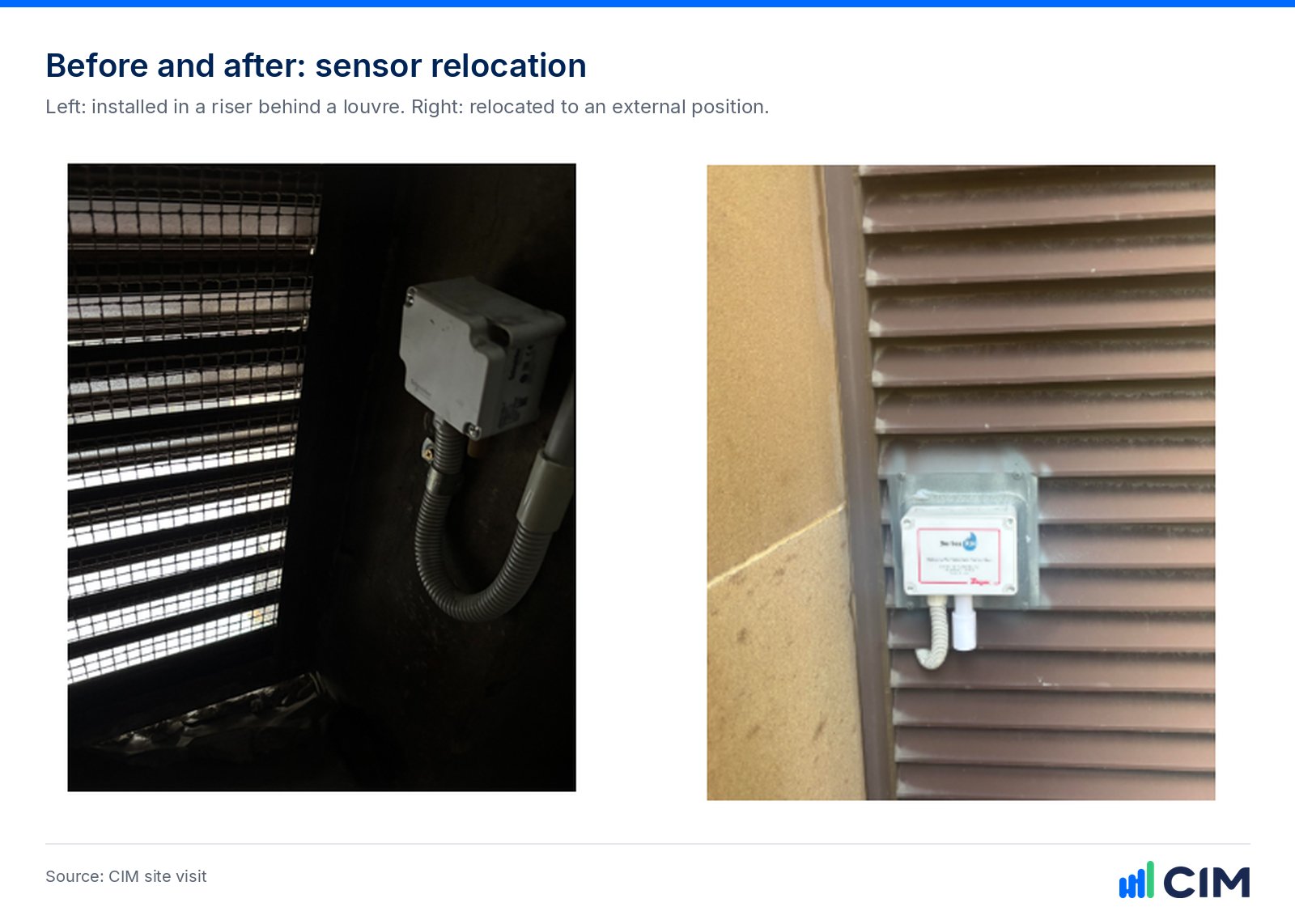
The weather data turned out to be the thread connecting the first three. When the team went looking for the sensor, they found it installed in a riser, sheltered behind a louvre. It had been feeding the BMS readings that were regularly out by 4°C or more. A controller that thinks it is warmer outside than it really is will keep chillers enabled and shut the door on free cooling.
Why does outside air sensor location matter?
The outside air temperature sensor drives decisions across the whole plant: when the economy cycle enables free cooling, when chillers are locked out, and how supply air and chilled water setpoints reset. A sensor inside a riser, in direct sun or near an exhaust reads the wrong air, and every one of those decisions goes wrong with it, while the BMS reports that everything is running as programmed.
That is why ASHRAE Guideline 36, the industry reference for high-performance HVAC control sequences, builds automatic fault detection into its air handling unit sequences, comparing outside, return and mixed air temperatures to catch exactly this kind of error. We cover how contractors are putting those sequences to work in ASHRAE Guideline 36 as a business driver for engineering and controls contractors.
What changed
- The outside air sensor was relocated to a proper external position on the roof.
- The BMS technician repaired the economy cycle logic, updated control points and fine-tuned setpoints.
- The facilities manager reviewed AHU schedules and, within tenant requirements, pushed the morning start back from 7:30am to 8:00am.
- A winter chiller lockout strategy was implemented, preventing chiller operation below 17°C outside air temperature.
Impact
The result was verified winter on winter in PEAK. Over June to August 2025, chiller runtime fell by 88% compared with the same three months in 2024.
Whole-site electricity fell 5% over the period, from 175,455 kWh to 167,325 kWh, a saving of 8,130 kWh. That figure understates the result, because the building meter also carries a ground-floor restaurant whose evening and weekend trade grew over the same period. Looking only at business-hours consumption between 9am and 5pm, the saving is clearer: 12,114 kWh, a 12% reduction, worth $3,392 in three months.
Because the same PEAK rules keep running after the work is done, a sensor that drifts again or a chiller lockout that gets overridden will show up straight away rather than at next winter's review.
Why this one matters
A faulty sensor is a multiplier fault. One bad input quietly corrupts every sequence that depends on it, so a single misplaced outside air sensor can disable free cooling, defeat a chiller lockout and inflate energy use across an entire season. Sensor faults sit alongside economiser and scheduling problems among the most common HVAC faults in commercial buildings, and they are among the hardest to spot without fault detection and diagnostics that checks readings against an independent reference.
It also shows what seasonal optimisation looks like when analytics and people on the ground work together: PEAK pointed to where the waste was, and the facilities manager, BMS technician and CIM engineer fixed it on site, one strategy at a time.
For another winter chiller story, see how two control settings cut a museum's winter chiller runtime from 37% to 2.5%. Read more about chilled water optimisation, CIM's approach to energy management, or how PEAK supports commercial office buildings.
Results
- Chiller runtime cut by 88% across winter, verified year on year
- Misplaced outside air sensor found and relocated, removing errors of 4°C or more
- Economy cycle logic repaired and a winter chiller lockout below 17°C implemented
- AHU start time pushed back 30 minutes within tenant requirements
- 12,114 kWh (12%) and $3,392 saved in business-hours energy over three months