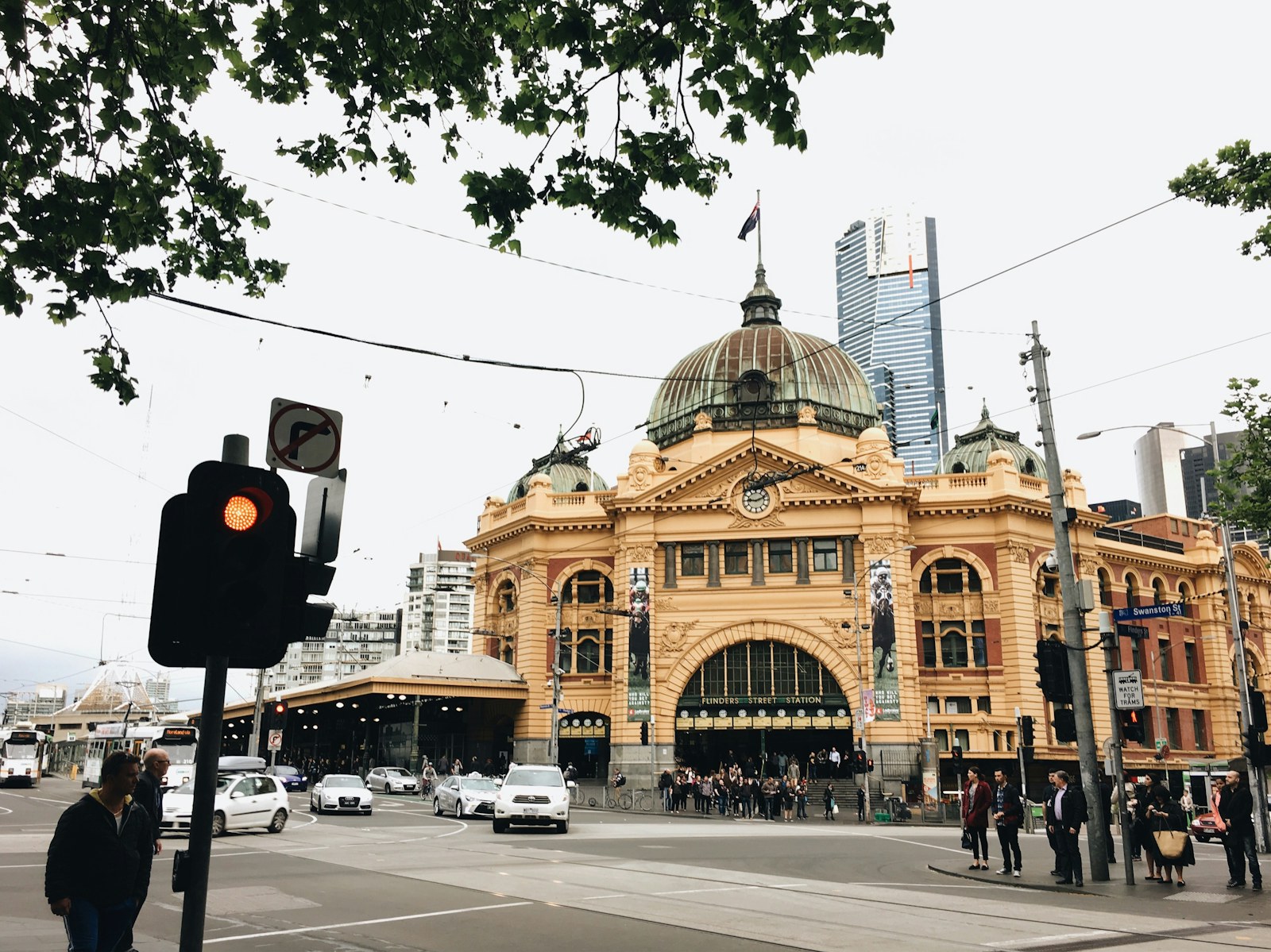
At a heritage museum in Melbourne, a buffer tank had been installed for one job: keep the chiller off through winter. It wasn't doing it. In the middle of winter, the chiller was still running 37% of the time. Trend data in PEAK showed why, and the fix turned out to be two control settings, with no capital spend.
At a glance
- 37% to 2.5% chiller runtime in mid-winter, before and after
- Around 62 to around 4 hours of chiller operation a week
- 295 to 0 simultaneous heating and cooling events a week on a single gallery unit
- Around 13,000 kWh a year in avoided chiller energy, roughly $2,300
- $0 capital spend: no new equipment and no contractor works
Challenge
In the first meeting with CIM, the site team raised a problem they had been living with for some time. They had installed a buffer tank specifically to reduce chiller runtime in winter, but it wasn't working the way it was supposed to. The chiller kept starting in weather that should never have needed it.
Museums are demanding buildings to run. Gallery conditions are tightly controlled to protect collections, so any change to temperature or humidity control has to be made carefully and backed by evidence. Nobody wanted to guess.
What PEAK found
The CIM engineer started with the chiller's run hours and worked backwards through every unit calling for cooling.
The first finding was a temperature deadband on two fan coil units set at just 0.3°C. That was far too tight, and it kept their chilled water valves cracked open with no real demand behind them. Widening the deadband brought chiller runtime down, but not all the way.
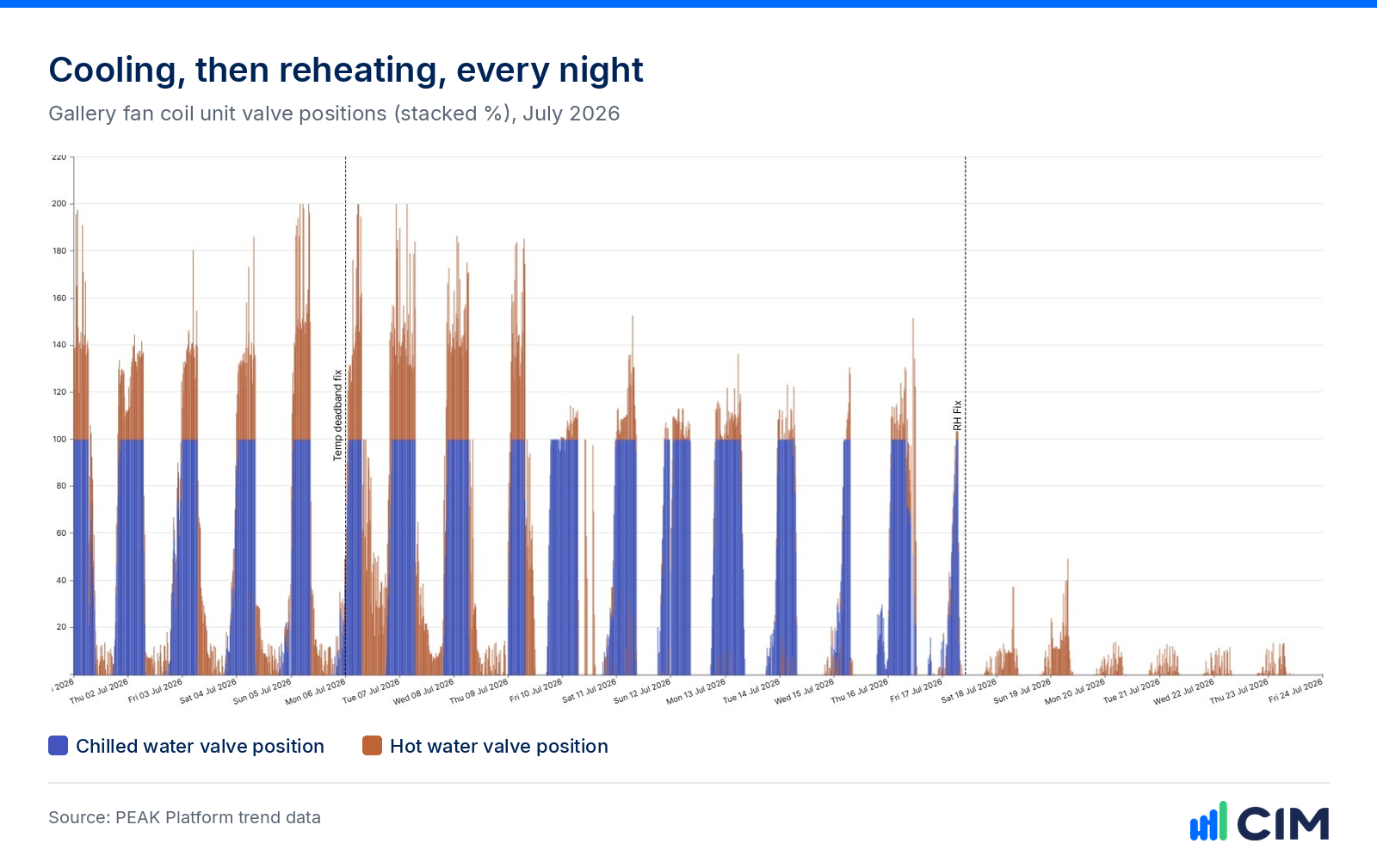
Two other units serving the same gallery kept calling for cooling every night regardless, and their trend data told a more interesting story. The zone humidity setpoint had been tightened from 55% to 50% RH, and those two zones naturally sit just above 50%. So every night, the units opened their chilled water valves to dehumidify, over-cooled the air, and then opened their hot water valves straight afterwards to reheat it. The chiller and the boiler were quietly fighting each other overnight, burning energy on both sides just to cancel each other out. On one unit alone, this happened 295 times a week.
What is simultaneous heating and cooling?
Simultaneous heating and cooling is when heating and cooling energy are delivered to the same air stream or zone at the same time, so the building pays for both and gains nothing. It rarely raises a BMS alarm, because every valve is doing exactly what it has been told to do. An over-tight humidity setpoint that forces dehumidification followed by reheat is one of the most common causes.
Across CIM's monitored portfolio it affects around a quarter of buildings, and it sits among the highest-value faults to fix. We cover how to spot it in our analysis of the most common HVAC faults in commercial buildings.
What changed
The site facilities team restored the humidity setpoint to 55% RH, and a humidity deadband was added so the valves would stop reacting to every small fluctuation in relative humidity. Together with the earlier temperature deadband fix, that was two control settings, changed about ten days apart. There was no new equipment, no contractor call-out and no change to how the galleries are conditioned.
The restored setpoint sits within recognised museum guidance. The Bizot Green Protocol recommends a stable 40 to 60% RH for most hygroscopic collection materials, and the AICCM interim guidelines for Australian collections, summarised by the IIC, set a range of 45 to 55% RH.
Impact
Once both changes were in, the chiller dropped from running 37% of the time to 2.5%, measured in PEAK across matched winter conditions. Weekly run hours fell from around 62 to around 4, and simultaneous heating and cooling on the worst unit fell from 295 events a week to zero.
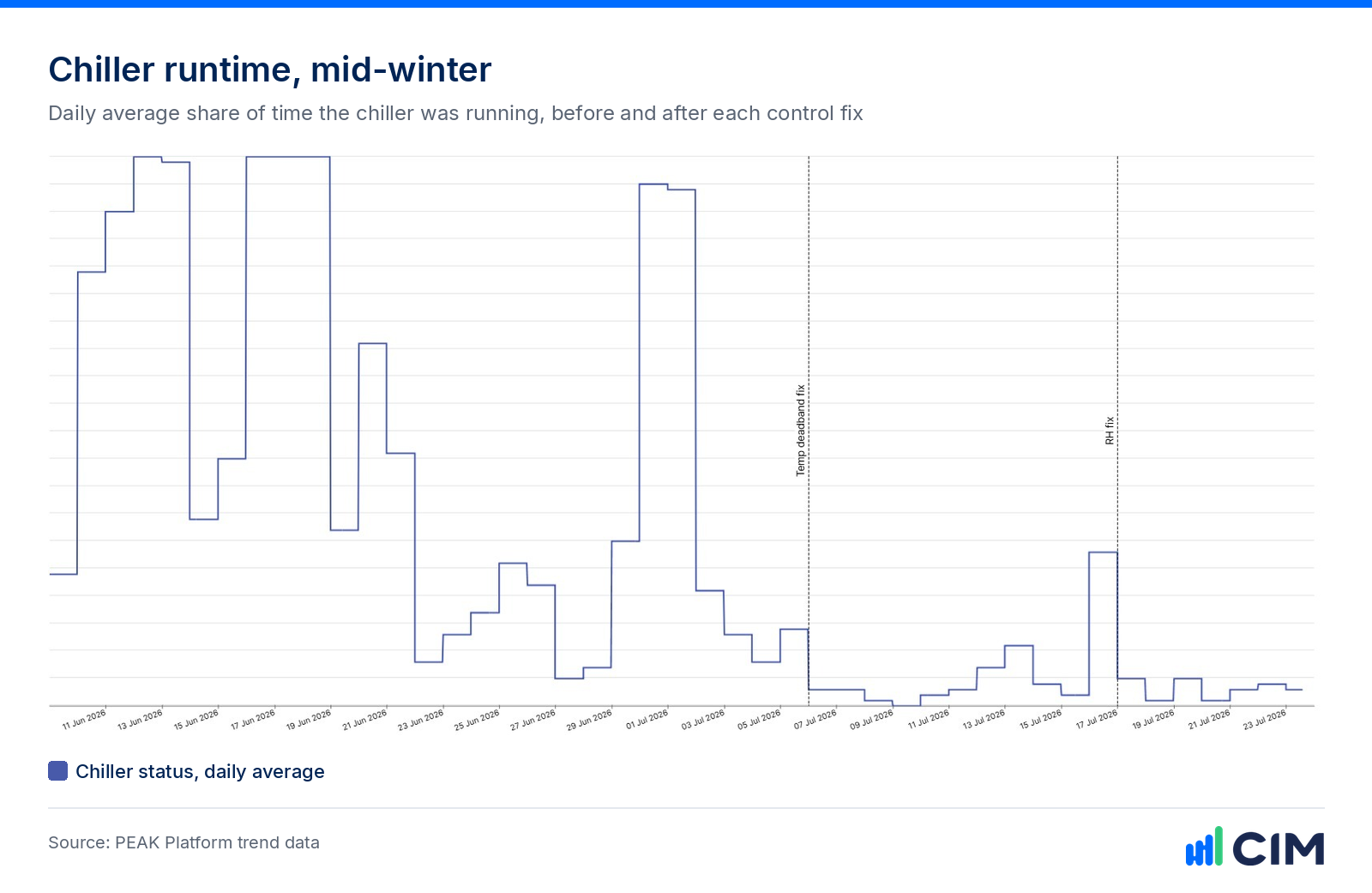
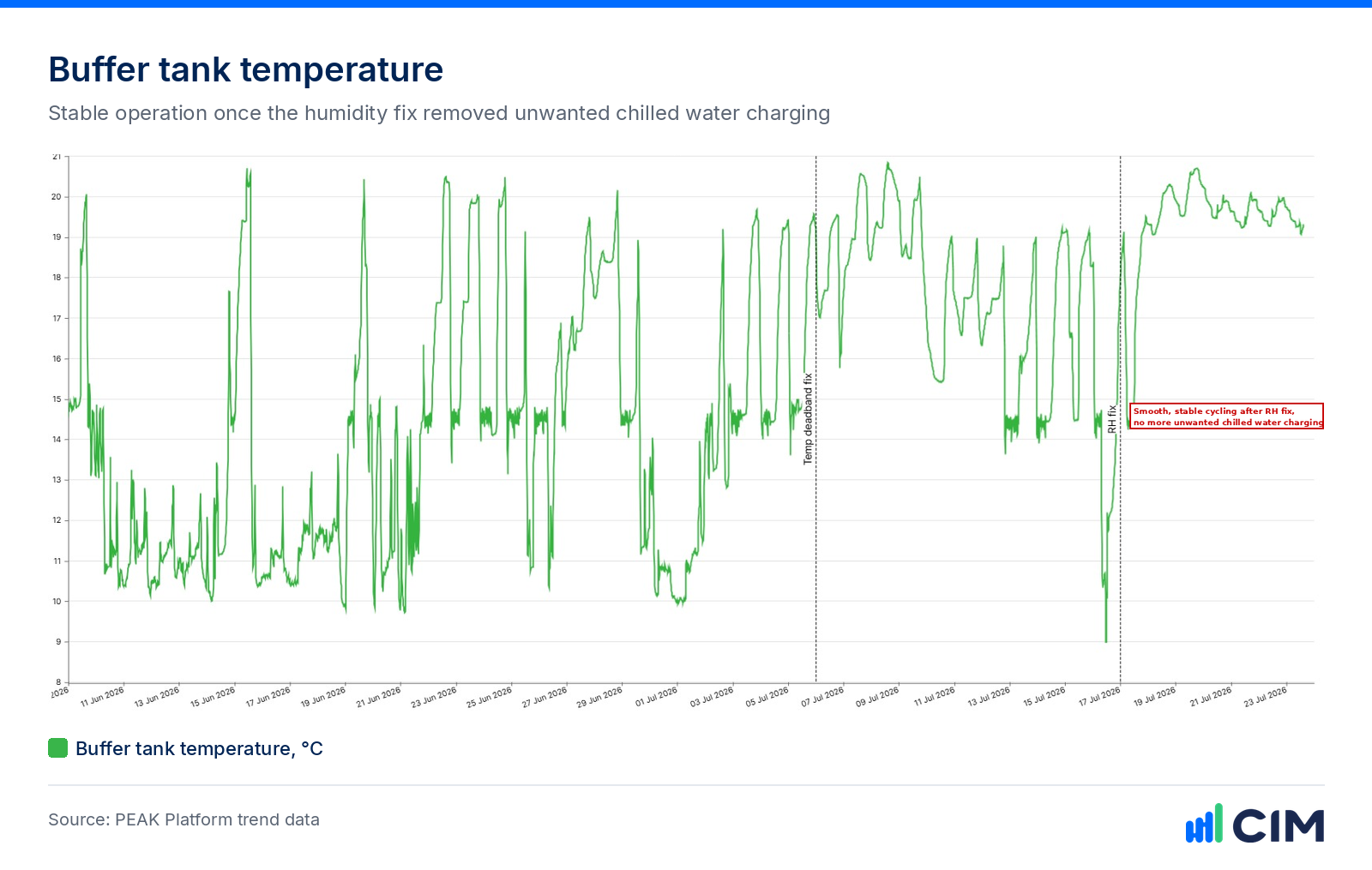
The fix was then verified in the data, not just marked complete. PEAK kept watching the same units after the change, and on a day warmer than the one when the problem was first raised, the chiller still didn't run. The buffer tank, which had been swinging through unwanted chilled water charging cycles every night, settled into smooth, stable operation. It is finally doing the job it was installed for.
Based on electrical data and the run-hour reduction against ambient temperature, CIM estimates the change avoids around 13,000 kWh of chiller energy a year, roughly $2,300, before counting the boiler energy no longer spent reheating over-cooled air. The saving is an indicative estimate rather than a metered figure.
The client's building services engineer called the result great news that showed the value of the platform, and asked straight away whether any other sites were showing unusually high plant run hours.
Why this one matters
This wasn't a plant failure. It was a control setting working against the asset, the kind of issue that doesn't trip an alarm, doesn't appear on a maintenance schedule, and can quietly run for years. It takes continuous trend analysis, the core of fault detection and diagnostics, to spot a unit cooling and then reheating the same air at 2am, and an engineer who asks why the numbers don't match what the site team expects.
The same check is now running across the client's wider portfolio. For a different route to the same kind of result, see how a misplaced outside air sensor was keeping chillers running at a Sydney office tower. For a similar humidity pattern in another building, see how PEAK helped solve excessive dehumidification, or read more about how CIM supports cultural institutions and building optimisation.
Engineers running this kind of analysis across a portfolio can find the full workflow, from detection to verified rectification, in The Building Performance Engineer's FDD Playbook.
Results
- Winter chiller runtime cut from 37% to 2.5%
- Weekly chiller run hours down from around 62 to around 4
- Simultaneous heating and cooling on the worst gallery unit eliminated, from 295 events a week to zero
- Around 13,000 kWh and $2,300 a year in estimated avoided chiller energy
- Result verified in the data on a warmer day than the original problem
- Achieved with two control setting changes and no capital spend