A landlord's managing agent does not doubt that the work was done. They doubt they can defend it. When a tenant queries the service charge, or a new agent takes over the building, the question is not whether your engineer attended. It is whether the record in front of them shows what was maintained, to what specification, what was found, what it cost, and whether the problem went away.
This guide is for UK maintenance contractors, M&E service providers and BMS contractors working on commercial buildings. It sets out what a landlord or managing agent needs to see, how SFG20 sets the baseline for planned preventive maintenance (PPM) evidence, what changed for recharged remedial works under the RICS service charge standard in December 2025, and how building data turns a closed job sheet into a verified fix.
Key takeaways
- Attendance is not evidence. A signed job sheet proves someone was there. It does not prove the task was done to specification or that the fault cleared.
- SFG20 is the baseline most tenders assume. It defines the task, frequency and skill level, and marks which tasks are statutory. Evidence should map to the schedule, not to a generic visit record.
- The service charge bar moved. The RICS professional standard effective from 31 December 2025 caps recovery at no more than 100% of proper and actual costs, and tightens the deadlines for budgets and year-end accounts.
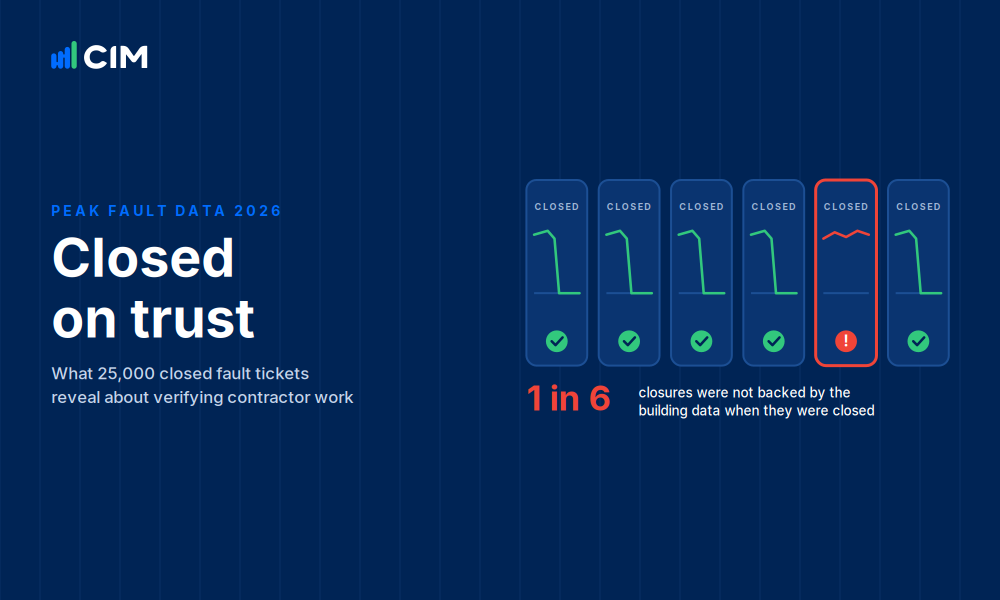
- Verification is the part almost nobody supplies. In a CIM sample of closed fault tickets, about 1 in 6 were closed before the building data confirmed the fix.
- Your evidence is your tender defence. RICS best practice is to re-tender or benchmark service contracts around every three years. The contractor with a performance record is the hardest to replace.
What evidence does a UK landlord actually need from a maintenance contractor?
Four things, and most contractors supply only the first. Proof that planned tasks were completed to the agreed specification. Proof that statutory tasks are current. A remedial register that separates chargeable work from work the contract already covers. And proof that what was fixed stayed fixed, measured in the building data rather than asserted on a job sheet.
These answer different questions for different people. The facilities manager wants to know the plant is being looked after. The managing agent wants to know the cost is recoverable and the records will survive a tenant query. The asset manager wants to know whether the building is getting better or quietly getting worse. One document that only logs attendance serves none of them well.
Scroll sideways to see the full table.
| What is asked | What most packs contain | What actually evidences it |
|---|---|---|
| Was the PPM done? | Signed job sheets and a completion percentage | Task-level completion against the SFG20 schedule, with findings recorded per asset |
| Is the building compliant? | Certificates filed separately, sometimes by another contractor | A current statutory register, with each item dated and its next due date |
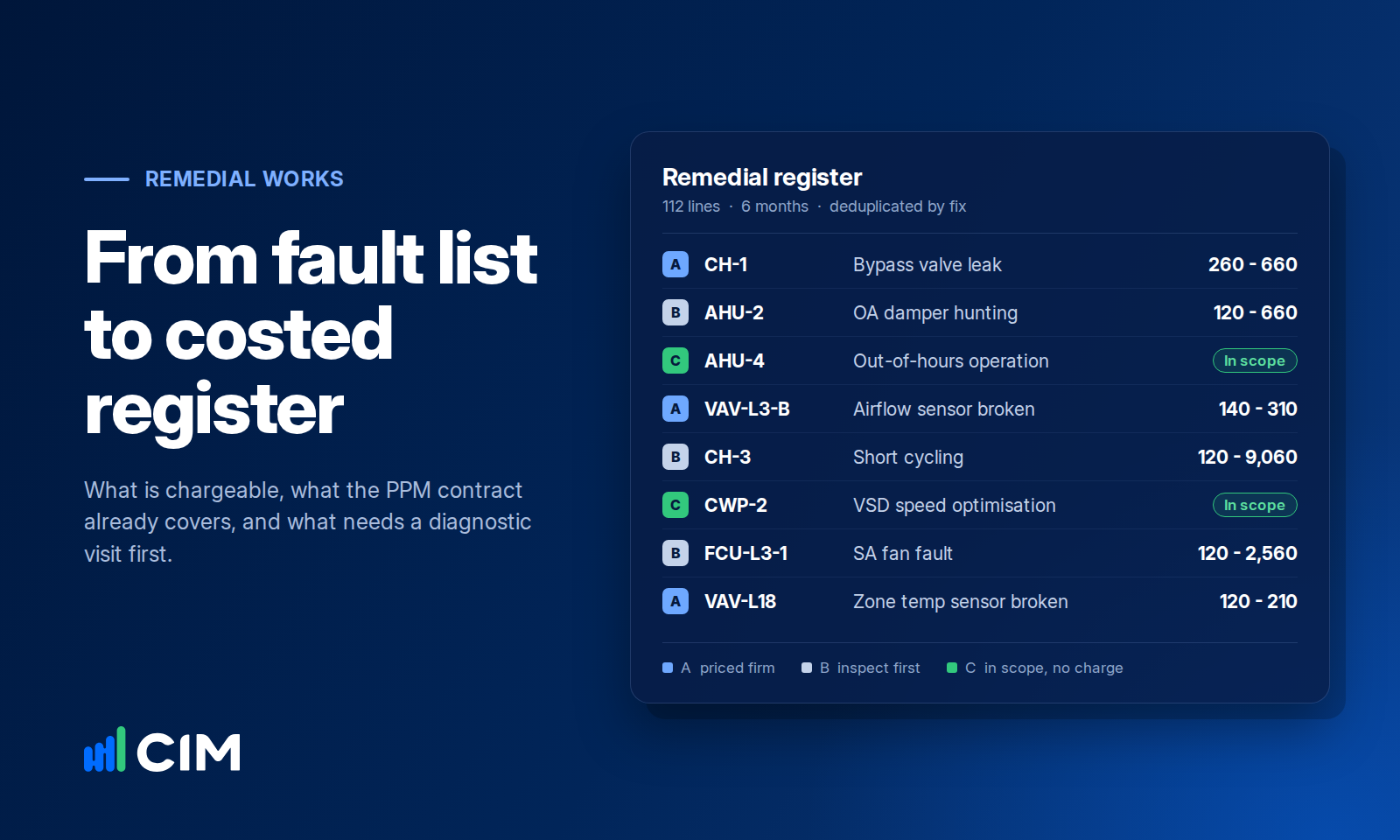
| Why is this chargeable? | A quote referencing a fault | A register line citing the contract or standard that puts it outside PPM scope |
| Did the fix work? | A closed work order | The fault condition clearing in the building data and holding across an operating cycle |
| Is the building improving? | Volume of jobs completed | Trend in repeat faults, ageing of open actions and weather-normalised energy |
The left column is what landlords and managing agents ask for. The right column is what answers it without a follow-up email.
Why doesn't a signed job sheet evidence PPM?
Because it records attendance and self-assessment at the same moment, by the same person, with nothing independent to check it against. It shows an engineer was on site and considered the task complete. It cannot show the task matched the specification, that the plant returned to normal operation, or that a setting changed during the visit was ever put back.
Two failure modes make this concrete, and both are common enough to plan for. The first is the override left behind. A point is forced to manual to test something and never released, so the plant runs outside its control strategy from that day forward. In CIM's data, about 1 in 25 action tickets concern an override left in place after a visit. The job sheet for that visit will say the task was completed.
The second is the premature close. The work order is closed when the engineer leaves, not when the condition clears. About 1 in 6 closed fault tickets in a CIM sample were closed before the data confirmed the fault had gone. Neither of these is usually bad faith. They are what happens when the only record of a visit is written at the end of it, by the person who did it.
How does SFG20 set the baseline for PPM evidence?
SFG20 defines what the evidence should be measured against. Created by the Building Engineering Services Association, it breaks each asset's maintenance into structured task lists covering what is maintained, how often, by whom and at what skill level, and it marks which tasks are statutory. Evidence that maps to those schedules is checkable. Evidence that maps to a generic visit is not.
SFG20 is written into a large share of UK maintenance tenders, which means the specification is often already agreed before anyone argues about evidence. Its task colour coding matters here: red tasks are statutory and required for compliance, while amber tasks are not required by law but reduce the risk of unexpected failure. The standard is revised continuously, with more than 700 updates a year as legislation and codes change, so a schedule frozen at mobilisation drifts out of date.
Mapping evidence to the schedule changes the conversation in a specific way. A completion percentage invites the question "which ones did you miss?". A task-level record answers it before it is asked, and it makes the findings useful: the same record that proves a filter inspection happened is the record that shows differential pressure was rising on three units. That is the difference between a compliance artefact and an operational one.
SFG20 compliance proves the schedule was followed. It does not prove the plant is working. That second question is what fault detection answers, and the two together are what a landlord is really buying. Our guide to structuring an analytics-backed maintenance contract sets out how to put both into the KPI schedule rather than leaving one informal.
What statutory compliance evidence sits alongside PPM?
Statutory records answer a different question from performance records: is the building safe and legal? Items such as water hygiene under the Legionella approved code of practice, lifting equipment under LOLER, fire damper testing, gas and electrical safety all carry their own retention and inspection regimes. They belong in a compliance register, not mixed into a maintenance performance report.
Keep the two separate deliberately. Statutory compliance is usually tracked in the client's CAFM system, often by several contractors, and the landlord's risk register depends on it being complete rather than analysed. Performance evidence is about whether the plant does its job. Mixing them produces a document that is too long for the agent and too thin for the risk team.
Where they meet is scope. A landlord asking "can you evidence PPM" sometimes means "can you evidence statutory compliance", and the two are priced and contracted differently. Settling that at mobilisation, in writing, prevents the most expensive kind of evidence dispute, which is the one about whose job it was. The HSE guidance on Legionella and on lifting equipment set out who holds the duty, which is the right starting point for that conversation.
This post is about commercial buildings. The residential and private rented sector regimes that dominate search results for landlord compliance are a different body of law and are out of scope here.
How do you evidence remedial works recharged through the service charge?
Line by line, with the reason it falls outside PPM scope cited next to it. The RICS professional standard for service charges in commercial property, effective from 31 December 2025, caps recovery at no more than 100% of the proper and actual costs of providing the services, and requires budgets at least a month before the service charge year and approved year-end accounts within four months of year end.
That matters to a contractor even though the obligations sit with the landlord and the managing agent. The agent has a fixed window to produce accounts a tenant can interrogate, and your remedial evidence is one of the inputs. Work the agent cannot substantiate is work that becomes awkward to recover, and a contractor who makes that easy is the one who keeps getting instructed.
Worth being precise about one thing: the standard does not impose a mandatory vouching requirement. Providing copy invoices on request, for example through a password-protected portal, is best practice rather than an obligation. So the bar here is not legal compliance. It is whether your documentation lets the agent meet their deadlines and answer a tenant query without coming back to you three times.
The register itself is the deliverable. Our guide to costing remedial works from FDD covers how to build and price one, including the rule that inspect, clean, calibrate or adjust generally sits inside PPM scope while replace, repair or diagnose does not. What follows is the evidence each line should carry once it is priced.
What does a verified fix look like in the evidence pack?
It looks like the fault condition that triggered the work disappearing from the building data and staying gone across a full operating cycle. Not a closed work order, not a photograph of a replaced part, but the rule that raised the alert no longer firing. That evidence is produced by the building itself, which is why it survives scrutiny that self-reported completion does not.
The mechanics are simple once monitoring is in place. A chilled water valve passing at 40% against a closed command raises a fault. The valve is replaced. If the fix worked, supply air temperature stops dropping below outside air and the alert clears without anyone returning to site. If it did not work, the alert is still there, and the register line stays open rather than being quietly marked complete.
Three things make this defensible evidence rather than a dashboard screenshot. The fault has to clear in the data, not in a status field. The evidence has to sit on the ticket, recorded in the plant room, so the completion record and the register line are the same document. And recurrence has to be tracked, so a fault that returns within weeks is flagged as a poor repair or a design issue rather than re-quoted as new work. We cover the method in detail in how to verify a contractor actually fixed an HVAC fault.

Illustrative example, based on real Compliance Agent comments. Sites and names changed.
What belongs in a monthly landlord report?
One page. Planned task completion against the schedule, statutory items due or overdue, remedial register movement separating chargeable from in-scope, verified closure rate, open actions older than 90 days with owners, and anything the landlord needs to decide. Anything longer gets filed rather than read.
The discipline is to report movement, not volume. Jobs completed is an activity number and every contractor can produce one. What the agent and the asset manager cannot get elsewhere is direction: are repeat faults falling, is the backlog ageing, did last quarter's spend change anything measurable. That is the report that gets quoted upwards rather than filed.
One page, six sections, issued with the service charge records
How do you evidence the remedial backlog without inviting a challenge?
By reporting it before you are asked, with an owner and a next step on every ageing line. A backlog that appears for the first time at a tender review looks like neglect. The same backlog reported monthly, with the lines that are waiting on landlord approval clearly marked, looks like governance.
Ageing is the number that exposes everyone. At last count, 56% of open remedial actions across the buildings CIM monitors were older than 90 days. Some of that is contractor delay. A good deal of it is work that was raised, priced and then sat waiting for a decision, which is exactly the distinction a landlord needs to see and almost never does.
Source: CIM samples from the commercial buildings monitored on the PEAK Platform. Figures are a snapshot, not a rate of new faults.
Reporting the backlog honestly has a commercial logic that is easy to miss. RICS best practice is for landlords to re-tender or benchmark service contracts roughly every three years. At that review, the incumbent either hands over a performance record that an incoming bidder cannot match, or hands over nothing and competes on price alone. The backlog report is part of building the first position.
This is also where a partner platform earns its keep. CSR Sustain, a UK partner running its own PEAK-based service, used continuous monitoring at Exchange Quay in Manchester to cut electricity consumption 10.8% year on year in the first quarter of 2026. That is a result the landlord can see in the data rather than take on trust, and it is documented in the CSR Sustain case study. Our Building Performance Engineer's FDD Playbook covers how engineers run this evidence loop day to day.
Where does CIM's PEAK Platform fit?
PEAK supplies the half of the evidence a job sheet cannot produce: whether the plant is working, and whether a fix held. It reads the existing building management system without new hardware, runs engineering rules continuously, and records the verification against the same action the engineer worked on, so the register line and the completion record are one document.
Three parts of that matter for landlord evidence specifically. Detection runs continuously rather than at visit frequency, so faults between visits are on the record. Each action carries its evidence, including trends, readings and photographs from the plant room, so the audit trail is built during the work rather than reconstructed afterwards. And the Compliance Agent chases open actions and confirms in the data that a fault has cleared and held, which is the verified closure line in the monthly report.
PEAK is independent of any equipment, controls or BMS manufacturer, which is the point when the evidence is going to a landlord. Nobody marks their own homework. The platform is used across more than 700 commercial buildings and over 100 million square feet, with buildings typically live within about 30 days. For contractors and consultancies delivering this as their own service, the CIM Partner Program provides the platform, onboarding and engineering escalation behind your team rather than in front of your client. There is more on the mechanics in data-driven maintenance.
For UK maintenance contractors
Give landlords evidence they can defend
See how contractors and M&E partners use PEAK to evidence PPM, justify remedial works and verify that fixes held.
Frequently asked questions
How can UK maintenance contractors evidence PPM and remedial works performance to landlords?
By reporting four things together: task-level completion against the agreed specification, usually SFG20; a current statutory compliance register; a remedial register that separates chargeable work from work already inside the maintenance scope, each line citing the clause that decides it; and verification from the building data that each completed fix cleared the fault and held.
What is the difference between PPM evidence and statutory compliance evidence?
They answer different questions. PPM evidence shows the planned maintenance schedule was followed and what the engineer found. Statutory compliance evidence shows the building is safe and legal, covering regimes such as water hygiene, lifting equipment, fire damper testing, gas and electrical safety. They are usually tracked separately, often by different contractors, and should be reported separately.
Does SFG20 compliance prove a building is being maintained well?
It proves the schedule was followed, which is not the same thing. SFG20 defines what is maintained, how often, by whom and at what skill level, and marks which tasks are statutory. It does not show whether the plant is actually working. Fault detection answers that second question, and landlords increasingly ask for both.
What does the RICS service charge standard require for recharged maintenance costs?
The professional standard effective from 31 December 2025 caps recovery at no more than 100% of the proper and actual costs of providing the services, requires budgets with commentary at least one month before the service charge year, and approved year-end accounts within four months of year end. Providing copy invoices on request is best practice rather than a mandatory requirement.
What counts as proof that a remedial fix worked?
The fault condition clearing in the building data and staying clear across a full operating cycle. A closed work order records that someone considered the job done. In a CIM sample of closed fault tickets, about 1 in 6 were closed before the data confirmed the fault had gone, which is why verification is measured rather than asserted.
How often should a maintenance contractor report performance to a landlord?
Monthly for the operational picture and quarterly for the review. The monthly report should fit on one page covering planned task completion, statutory position, remedial register movement, verified closure rate, ageing of open actions and decisions the landlord needs to make. The quarterly review is where trends and the forward plan are discussed.
Who is responsible for evidencing statutory compliance in a commercial building?
The duty usually sits with the landlord or the party in control of the premises, who often discharges it through contractors and a CAFM system. Which contractor holds which statutory item should be agreed in writing at mobilisation, because the most expensive evidence disputes are the ones about whose responsibility it was.

A practical playbook for the engineers who deliver building performance. Learn how to run retro-commissioning, monitoring-based commissioning and data-driven maintenance on an FDD platform: compress the RCx cycle from 12-18 months to 3-5, close the loop from alert to verified fix, and turn fixed-term projects into recurring revenue. Written for RCx and MBCx firms, engineering consultancies, and BMS and mechanical contractors.
Eleven weeks after PEAK went live, a London corporate headquarters was using 14% less electricity than a year earlier, around £27,900 saved, with the latest fortnight down 23%.
Read the story →