Condition assessments that stay true after the survey.
Read the FCA your client already has against how every HVAC asset actually runs. Rank the replacement list on evidence, find the faults no survey sees, and turn a one-off report into a service that renews.

700+
Buildings under management

100M+ ft²
Under continuous monitoring

10 yrs
Of verified outcomes
An FCA is a snapshot. The building keeps moving.
A condition assessment is a few days of engineers walking plant rooms and rating each asset. It is the right starting point for a capital plan. It just cannot see how the equipment runs, and it starts going out of date the day it is issued.

Rated by sight and age
A walk-through records install year, nameplate and what the engineer can see. It cannot tell a 30-year-old air handler that runs cleanly from one that has been failing for months.

Blind to how the plant runs
Survey reports usually exclude testing how systems actually operate. Faults, overrides and out-of-hours running never reach the rating.

Stale before the budget lands
Equipment fails, gets repaired or is replaced between surveys, while the capital plan still reads as it did on the day of the visit.
The assessor rates the asset. PEAK shows how it runs.
Keep the FCA your client already paid for. Match each line to the equipment PEAK monitors through the BMS, and every rating gets evidence from how that asset has actually behaved.
What the engineer could see on the day.
 LIVE DATA ON PEAKLast 12 months
Three answers for every line in the plan
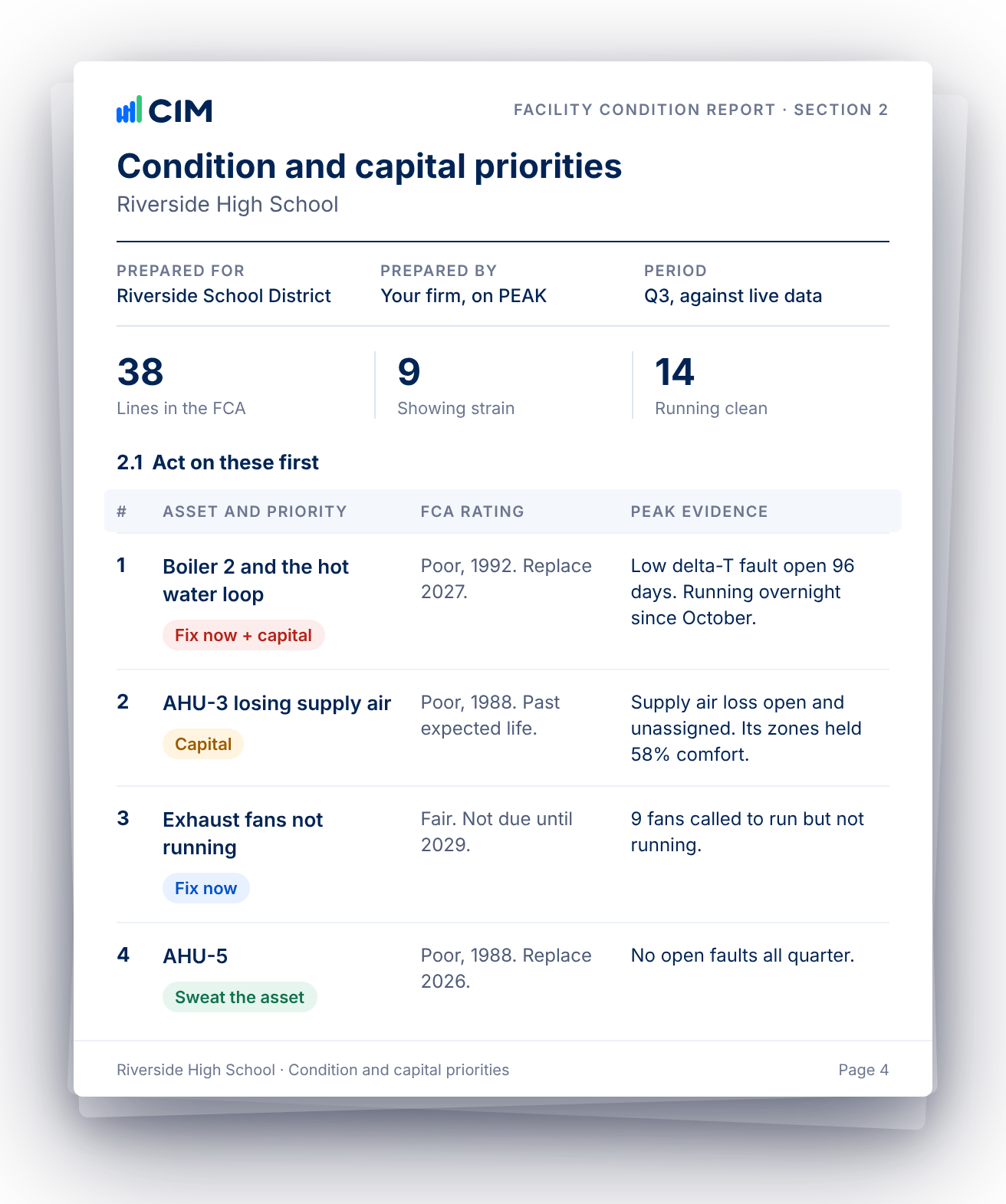
Read against live data, each FCA line lands in one of three places. The engineer still makes the call. They make it with evidence.
Past expected life and showing strain
Past expected life and showing strain in the data: an open priority fault, a unit out of service or zones it cannot hold. These go to the top of the capital request with the evidence attached.
Rated Poor on age, running cleanly
Due for replacement on paper but running without faults. The data backs a decision to defer, so the money goes where it is needed first.
Faults the survey could not see
Overrides, failed sensors and plant running overnight. Maintenance and controls work, scoped and quoted from the findings, that often fixes the problem without a replacement.
Three moments a condition assessment pays off
The same reading of survey against live data supports the work you already sell, at the points where clients decide to spend.

Contract mobilisation
Agree the asset register and the faults that already exist before you take responsibility for them, rather than inheriting them in the first 90 days.
How partners onboard clients →
Capital planning
Give the client a replacement list in an order they can defend to their board, with live evidence on every line and a reason for every deferral.
Data-driven maintenance →
Audits and retro-commissioning
Carry an audit past the site visit. Findings stay tracked as actions, and every fix is verified in the data rather than assumed.
Retro-commissioning on PEAK →
A survey you sell once. A service that renews.
The FCA stops being a report that ages on a shelf. It becomes the baseline for work you deliver every quarter, on the same client, on a contract that renews.

Any assessor, any format: a PDF report or the spreadsheet behind it.

Assets on the BMS gain live evidence. Assets without points are flagged, so you know what to bring on next.

Replace first, sweat the asset, fix now. Every line with the survey and the data side by side.

As work closes and units are replaced, the report moves with the building instead of waiting for the next survey.
What live data does not replace
A condition report built on PEAK is only as honest as the line between what was measured and what was surveyed. We keep that line visible.
The engineer's condition rating
PEAK's equipment health shows how an asset is running, which makes it evidence for a rating, not the rating itself. The assessor still grades condition and remaining life.
Systems PEAK cannot see
Roofs, envelope, fire alarm, lighting fixtures and finishes are often a large share of an FCA. Those lines rest on the survey alone, and the report says so.
Condition assessments on PEAK, explained
Something not covered here? Talk to the partner team.
What is a facility condition assessment?
A facility condition assessment (FCA) is a survey of a building's systems and assets that records their condition, age and expected remaining life, then estimates the cost and timing of repairs and replacements. Owners use it to build a capital plan. A property condition assessment (PCA) is the equivalent survey carried out for a sale or acquisition.
How is a condition assessment on PEAK different?
The survey still sets the condition ratings and costs. PEAK adds how each HVAC asset has actually been running: open faults, out-of-hours operation, comfort in the zones it serves and the work done on it. That evidence ranks the replacement list and keeps it current between surveys.
Does PEAK replace the site survey?
No. PEAK reads the building management system, so it sees the HVAC equipment and controls that report to it. Roofs, envelope, fire, lighting and finishes, and the assessor's own judgement on condition, stay with the survey.
What does a partner need to get started?
The client's existing FCA in any format, and PEAK connected to the building management system. Assets without BMS points stay on the survey alone until they are brought on, and the report flags them.
How often is the report updated?
As often as you issue it. Because the data is continuous, a quarterly report alongside monitoring or MBCx work is a natural rhythm, and the plan moves as faults close and units are replaced.
Make the survey the start of the contract, not the end
Talk to the partner team about adding live condition reporting to your FCA, capital planning and MBCx services.