Most capital plans for commercial buildings answer one question: is this equipment old enough to replace? Very few answer the question that matters more: does it still do its job?
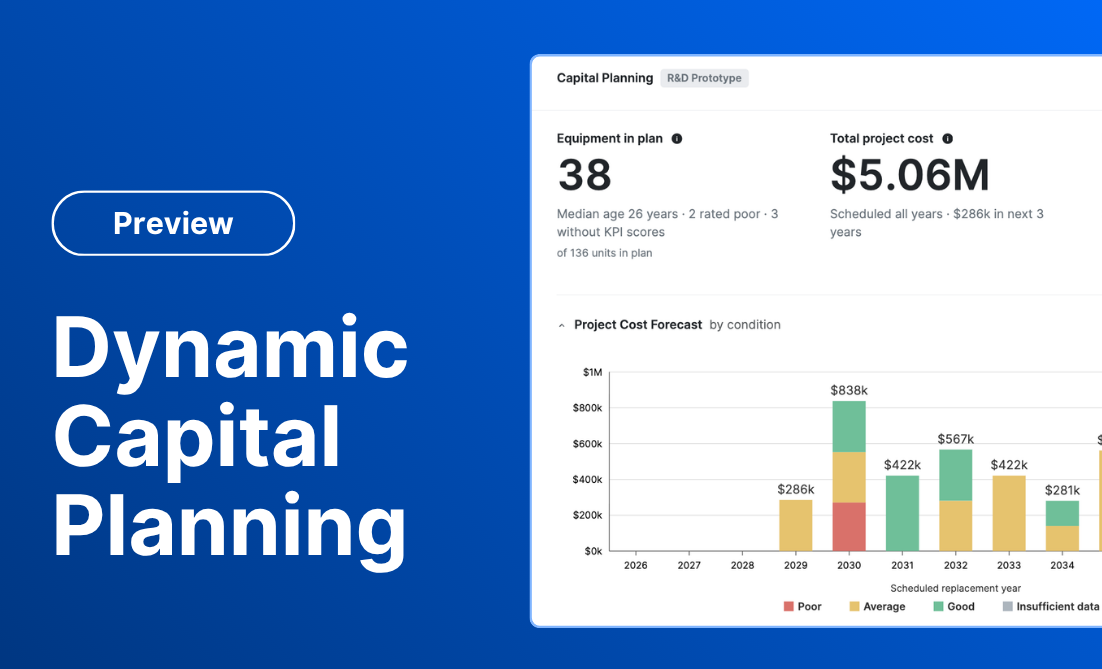
CIM's product team has recorded a 20-minute preview of Dynamic Capital Planning, the next phase of the PEAK Platform. It reorders a capital plan based on how equipment actually performs, starting with air handling units (AHUs). This post covers the thinking behind it, what we learnt benchmarking more than 6,000 AHUs, and what it means for the engineering and service partners who build capital plans for their clients.
Key takeaways
- Age-based replacement has weak foundations. The service life data most plans rely on comes from a 1978 survey of when owners replaced equipment, not whether it had failed.
- Aviation abandoned age-based replacement in 1978. The Nowlan and Heap study found most aircraft components did not become more likely to fail as they aged.
- PEAK rates every AHU on three KPIs: uptime, supply air pressure and supply air temperature, benchmarked against 6,000+ AHUs.
- Condition adjusts the replacement date. A condition factor from 0.6 to 1.2 brings poor performers forward and defers units that are still working.
- AHUs reach beta by the end of 2026, with chillers, boilers and other central plant to follow in early 2027.
Why do buildings still plan capital replacement by age?
Because the industry's default life data has always been age-based. ASHRAE's widely used service life estimates trace back to a 1978 survey asking owners when they replaced equipment, not whether it had failed. ASHRAE now describes that data as being of questionable statistical validity, yet replacement dates are still built from it.
ASHRAE's own technical FAQ on equipment service life notes that the Handbook's comparison table is based on a limited 1978 survey of 68 participants, and that service life is often confused with equipment life, causing the data to be widely misapplied. ASHRAE has since built a newer service life database, but the underlying logic of most capital plans has not changed: install year plus expected life equals replacement year.
The condition assessment that is meant to correct for this has limits of its own. Alex Shan, a former mechanical engineer and now a Product Manager at CIM, used to do this work for a living. An engineer typically gets one or two days on site to walk the plant, read nameplates, check the asset register and judge condition by eye. There is rarely time to assess each unit individually, so condition gets generalised across groups of equipment, and there is rarely budget to analyse the building management system (BMS) data that shows how the plant actually runs.
What did aviation learn when it stopped replacing parts by age?
In 1978, United Airlines engineers Stanley Nowlan and Howard Heap published a study, sponsored by the US Department of Defense, showing that most aircraft components did not become more likely to fail with age. Only around 11% of items showed age-related failure patterns, while 68% were most likely to fail soon after installation or overhaul.
Before their work, airlines overhauled components at fixed intervals on the assumption that older meant riskier. Nowlan and Heap tested that assumption against large volumes of operating data and found it held for only a small minority of parts. For most components, scheduled overhaul did not improve reliability, and the disturbance of taking a working part apart and putting it back could introduce failures rather than prevent them.
Their alternative started with a simple question: what is this item for, and how do we measure whether it is doing it? An aircraft air conditioning pack exists to supply air at a controlled temperature, so the test is whether it holds setpoint. Brakes exist to stop the aircraft on command, so the test is the condition of the wear indicators, not the number of flights since the last change. The second question was the consequence of failure, which decided how closely each item needed watching.
The results were dramatic. The initial maintenance programme for the Douglas DC-8, developed before this approach, required scheduled overhaul of 339 items. The larger, more complex DC-10, whose programme was developed with it, required scheduled overhaul of just seven. The full Nowlan and Heap report became the foundation of reliability-centred maintenance, which spread from aviation into oil and gas and heavy industry, and which today goes by names such as condition-based and predictive maintenance.
In the same year that Nowlan and Heap published, ASHRAE's survey set the age-based standard that commercial buildings still plan by. Nearly 50 years later, aviation has rewritten its rulebook and buildings largely have not.
What is PEAK Dynamic Capital Planning?
Dynamic Capital Planning is a capability in development for CIM's PEAK Platform that reorders a capital plan by how equipment actually performs. Each AHU is scored on uptime, supply air pressure and supply air temperature, benchmarked against more than 6,000 AHUs, and given a condition-adjusted replacement date to compare with the date in the existing plan.
It applies Nowlan and Heap's question to building plant. An AHU exists to run when it is called, deliver air at the right pressure and deliver it at the right temperature. PEAK already reads the BMS data that shows whether it does, so the rating comes from measured performance rather than a visual inspection.
The method has three steps:
- Measure. PEAK measures the three KPIs every 15 minutes and rolls them into a score covering the last 12 months.
- Benchmark. Each unit's score is compared with the wider AHU population and rated good, average or poor.
- Adjust. A condition factor between 0.6 and 1.2 shortens or extends the unit's expected life, so a poor performer's replacement comes forward and a good performer's is deferred by up to 20%.
Replacement due = install year + standard life × condition factor
Condition factor ranges from 0.6 for poor performers to 1.2 for good performers. For example, a unit with a 20-year standard life would fall due at 12 years with a factor of 0.6, or at 24 years with a factor of 1.2.The rating is a data point, not a verdict. Engineers can override it with their own condition assessment and a comment. A unit can perform well and still need replacing because of corrosion, refrigerant changes or a health and safety issue, and the plan should say so. In the preview, Alex overrides a well-performing AHU to poor because it does not comply with health and safety requirements, and moves its replacement from 2031 to 2028.
Watch the full 20-minute preview with Howie Mann and Alex Shan from CIM's product team.
What did benchmarking 6,000+ AHUs reveal?
Almost every AHU turns on when it is asked to, and most hold supply air pressure, with the median unit meeting its setpoint about 92% of the time. Supply air temperature is where good and poor units separate most, and the struggle is seasonal: Australian and US units fall short in winter, UK units in summer.
Source: CIM benchmarking of 6,000+ AHUs monitored on the PEAK Platform across Australia, the US and the UK.
The seasonal pattern is worth understanding. In Australia and the US, AHUs struggle most to hold supply air temperature in winter. In the UK the pattern flips: the hardest months are June to August, when many units lack the cooling capacity to meet setpoint.
The practical point is that age does not tell you which units sit in the poor-performing group. Two AHUs of the same make and age can perform very differently depending on how they were installed, controlled and maintained, and only operating data shows the difference.
What happens when performance data is overlaid on an age-based plan?
The replacement order can reverse. In one site CIM analysed with an engineering consultant partner, an age-based plan would have replaced the older, well-performing plant room first, at roughly three times the cost of the younger plant room that was actually performing poorly.
The site had two plant rooms, both overdue for replacement by age. The median AHU age was 26 years in plant room A and 31 years in plant room B, and the consultant's walkthrough rated both in poor condition. Without performance data, the natural order is oldest first: replace B, then A.
Once PEAK's performance data was overlaid, the picture changed. Plant room A was performing poorly and plant room B was performing well. Following the age-based plan would have meant spending around three times as much on plant that did not yet need replacing, while the plant that was failing waited. The condition-based plan brings A forward and defers B.
| Compared | Age-based plan | Condition-based plan |
|---|---|---|
| Replacement trigger | Install year plus expected life | Install year plus expected life, adjusted by measured performance |
| Condition evidence | Visual walkthrough, usually one or two days | 12 months of BMS data on every unit, plus engineer overrides |
| Plant room A (26 years, performing poorly) | Replaced second | Brought forward |
| Plant room B (31 years, performing well) | Replaced first, at around three times the cost | Deferred |
Example from a site analysed with a CIM engineering consultant partner, as shown in the Dynamic Capital Planning preview.
This is not a new idea for PEAK users. At QIC's Westpoint shopping centre, five of six chillers were due for replacement by age. A performance analysis on PEAK found only one needed immediate replacement, and the rest gained a five-year lifecycle extension. We covered that example in our post on smarter capital planning in commercial property. Dynamic Capital Planning turns that kind of one-off analysis into a standard, benchmarked rating across every unit.
What does condition-based capital planning mean for engineering and service partners?
It turns the capital plan from a periodic site walk into evidence partners can keep current. Partners can back replacement recommendations with performance data, prioritise plant that is failing, defer units that still work, and give clients an independent, defensible basis for capex decisions.
For the engineering consultancies, mechanical contractors and service providers who build capital plans, that changes four things.
The walkthrough stops being the only source of truth. The one- or two-day site visit still matters for things data cannot see, such as corrosion, access and compliance. But the performance rating covers every unit, not a generalised sample, and it is already calculated before the engineer arrives.
Recommendations carry evidence. A partner who recommends deferring a $1 million replacement, or bringing another forward, can show the client 12 months of measured performance and a benchmark against thousands of comparable units. That is a stronger conversation with a client's finance team than an install date and a photo.
Deferral builds trust. Telling a client that a unit does not need replacing yet is not lost work. It is what makes the next recommendation credible, and it frees budget for the plant that does need attention. As Howie puts it in the preview: if it ain't broke, don't replace it, and if it is, don't wait.
The plan becomes a living deliverable. A capital plan that updates with performance data gives partners a reason to review it with the client every quarter rather than every few years, which fits the shift from projects to platforms we described in our Partner Value Series article on retention.
Engineering judgement stays at the centre. The override function exists because partners know things about a site that no dataset captures, and the plan should reflect both.
When will Dynamic Capital Planning be available?
AHU benchmarking is scheduled for beta by the end of 2026, with chillers, boilers and other central plant following in early 2027. CIM is inviting customers with sites on PEAK for at least three to six months to share their capital plans and receive a condition-based view of their AHUs in return. Early access places are limited.
Participating customers send their existing capital plan. CIM benchmarks the AHUs already on PEAK against the 6,000+ unit dataset and returns an export with a revised condition rating and revised replacement dates, alongside the current plan for comparison. The input also shapes what the product team builds next.
To take part, or to put forward a client site, contact your CIM customer success manager or our partner team. You can watch the full preview on the Dynamic Capital Planning product update page.
Frequently asked questions
What is Dynamic Capital Planning?
Dynamic Capital Planning is a capability in development for CIM's PEAK Platform. It rates each piece of equipment on measured performance, benchmarks it against thousands of comparable units, and adjusts its expected replacement date so a capital plan prioritises plant that is failing and defers plant that is still working.
How is an AHU's condition rated in PEAK?
PEAK measures three KPIs every 15 minutes: uptime, supply air pressure against setpoint and supply air temperature against setpoint. It combines them into a 12-month score, benchmarks the score against more than 6,000 AHUs, and rates the unit good, average or poor.
How does the condition factor change a replacement date?
The replacement date is the install year plus the standard life multiplied by a condition factor between 0.6 and 1.2. Poor performers get a lower factor, bringing replacement forward. Good performers get a higher factor, extending expected life by up to 20%.
Why is age a poor guide to HVAC replacement?
Age-based service life figures largely trace back to a 1978 ASHRAE survey of when owners replaced equipment, not whether it had failed. Two units of the same age can perform very differently, and aviation research from the same year found most components did not become more likely to fail with age.
Can engineers override the performance-based rating?
Yes. The performance rating is one input to the plan. Engineers can set their own condition rating and add a comment, for example where a unit performs well but has corrosion or health and safety issues, and move its replacement date accordingly.
Which equipment will Dynamic Capital Planning cover?
It starts with air handling units, with beta availability planned for the end of 2026. Chillers, boilers and other central plant are scheduled to follow in early 2027, each with KPIs defined for that equipment type.