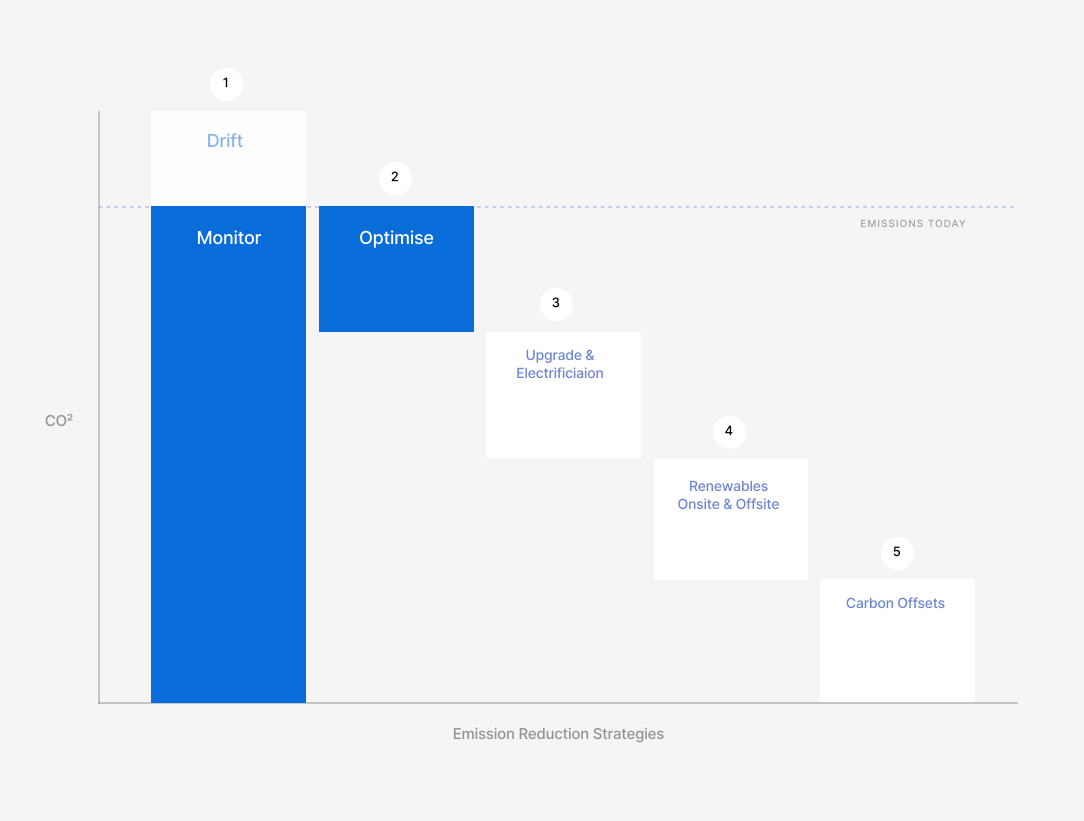
Almost every property organisation is trying to work out the fastest, most cost-effective route to net zero. In our experience, the organisations that get furthest follow the steps in order - and resist the temptation to jump straight to capital projects.
Here is the five-step sequence we see working, why the order matters, and what each step actually requires.
Step 1: Monitor and avoid energy drift
Digitising and monitoring your portfolio is the foundation of any net zero roadmap. Data gives you a benchmark to measure every future initiative against, and it identifies the largest opportunity areas before you spend anything.
Energy drift happens for all sorts of reasons: mechanical wear and tear, malfunctioning equipment, changes and overrides to Building Management System controls, changing site conditions, or design defects that were never resolved. Buildings can lose as much as 10-30% in energy efficiency, every one to two years, to drift alone.
This is the step most portfolios skip, and it is the one that makes the next four affordable.
What you need before you start
- Access to your existing BMS data - no rip-and-replace required. Most buildings already generate far more data than anyone reads.
- Utility and sub-meter data, ideally at interval level rather than monthly bills.
- A way to turn that data into ranked, diagnosed faults rather than dashboards. This is what fault detection and diagnostics does.
- A named owner for the resulting actions. Detection without accountability produces a longer list, not a lower bill.
For a breakdown of where energy actually goes in a commercial building, and the faults that most often drive it, see our guide to understanding energy use in commercial buildings.
Step 2: Building optimisation
Before committing to capital investment, it is financially prudent to make sure the systems you already own are working at their best. That means proactively fixing system issues, then monitoring closely so performance does not drift back.
HVAC systems use more than 60% of a typical building's total energy consumption, and up to a third of that energy is often wasted through malfunction, performance degradation and poorly tuned controls. Given that virtually every large building has some HVAC operational issue running right now, this is rarely wasted effort.
Two disciplines do most of the work here. Retro-commissioning systematically returns existing plant to its intended performance, and data-driven maintenance keeps it there by triggering work on condition rather than on a calendar.
Step 3: Upgrade and electrify
Monitoring and optimisation take you a long way, but some equipment will genuinely need upgrading or replacing. Done well, steps 1 and 2 generate the savings that fund this step.
Electrification is one of the most important factors in decarbonising buildings, and also one of the most expensive. Anything burning fossil fuels - furnaces, boilers, water heaters - eventually needs replacing. Many commercial properties can cut consumption and emissions substantially without a full renovation, even in older stock.
Funding step 3 from steps 1 and 2
This is the part most roadmaps leave vague. Operational savings captured in the first two steps are recurring, which means they can support a business case rather than a one-off cost avoidance claim. Three things make that case credible to a finance team:
- A verified baseline. You cannot claim a saving against a number nobody trusts. Step 1 produces it.
- Attribution. Knowing which intervention produced which saving, rather than pointing at a lower annual bill and hoping.
- Persistence. Demonstrating the saving held for twelve months, not just the month after the fix.
Step 4: Renewables
Renewables can be used onsite or offsite. Onsite generation tends to be cost-effective only where there is significant surface area, such as a shopping centre or an airport. Offsite, renewable supply can be procured through your utility provider. The destination is the same: all-electric buildings powered by zero-carbon electricity.
Worth noting: the way ratings treat renewables is changing. In Australia, NABERS retired the Energy with GreenPower result in July 2025 and replaced it with the Renewable Energy Indicator - one of several changes covered in our 2026 NABERS ratings guide.
Step 5: Carbon offsets
Offsetting is an emissions reduction strategy, but it should not form a large proportion of an overall plan. Offsetting is increasingly viewed as greenwashing when it substitutes for real reduction, and the cost of credible offsets continues to climb. Treat it as the residual, not the strategy.
Why the order matters
Each step funds and de-risks the next. Monitoring tells you where the waste is; optimisation captures the savings that pay for upgrades; upgrades and electrification reduce the load renewables need to cover; and whatever genuinely cannot be removed is what you offset.
Organisations that start at step 3 typically spend more, save less, and struggle to prove the result - because they never established the baseline that step 1 provides.
Three common mistakes
- Treating the roadmap as a capital plan. The first two steps are operational. Framing net zero purely as a capex programme delays everything behind a budget cycle that may be years away.
- Buying detection without execution. Analytics that produce a fault list nobody closes will not move an emissions number. The gap between insight and action is where most roadmaps quietly stall.
- Ignoring drift after the project ends. Savings decay. Without continuous monitoring, a successful optimisation project can be substantially undone within one to two years.
Where regulation fits
Net zero targets rarely sit alone. In practice they run alongside compliance regimes that carry their own deadlines and penalties - EPC ratings and the MEES minimum standards in the UK, building performance standards in US cities, and rating obligations across Australian government leases. Our sustainability and ratings page sets out how the major schemes compare and what each one measures.
Where to start
If you are at the beginning of this, start with step 1 and get an honest baseline. Watch a demo of the PEAK Platform to see how portfolios monitor drift, close faults and verify that savings held.

Take the first step towards achieving your sustainability goals with our Roadmap to Net Zero for Commercial Property. This comprehensive guide will show you how to reduce your carbon footprint and achieve operational efficiency in your commercial building. Start your journey towards a greener portfolio now!